
October 16, 2025
Director General, Rail Safety and Security, Transport Canada
Enterprise Building, 14th floor
427 Laurier Avenue West
Ottawa ON K1A 0N5
On 28 June 2025, Canadian National Railway Company (CN) unit grain train G89641-28 was proceeding eastward at about 41 mph on the CN Fort Frances Subdivision. At about 1340 Central Daylight Time, a train-initiated emergency brake application occurred. The train came to a stop with the lead locomotive at Mile 99.2, near Devlin, Ontario. The crew inspected the train and determined that 13 loaded hopper cars (positions 119 to 131 in the train consist) had derailed. Most of the derailed cars were extensively damaged and released their product. No one was injured.
Post-occurrence information gathered by the TSB indicates that the point of derailment (POD) was Mile 101.17, in a section of track with a 0.9° right-hand curve. The track in this area is Class 4 according to the Rules Respecting Track Safety, also known as the Track Safety Rules (TSR). The authorized speed for freight trains at the location of the derailment was 50 mph. There were no slow orders in effect at the time of the occurrence. In 2024, train traffic volume on the Fort Frances Subdivision was 78.7 million gross tons.
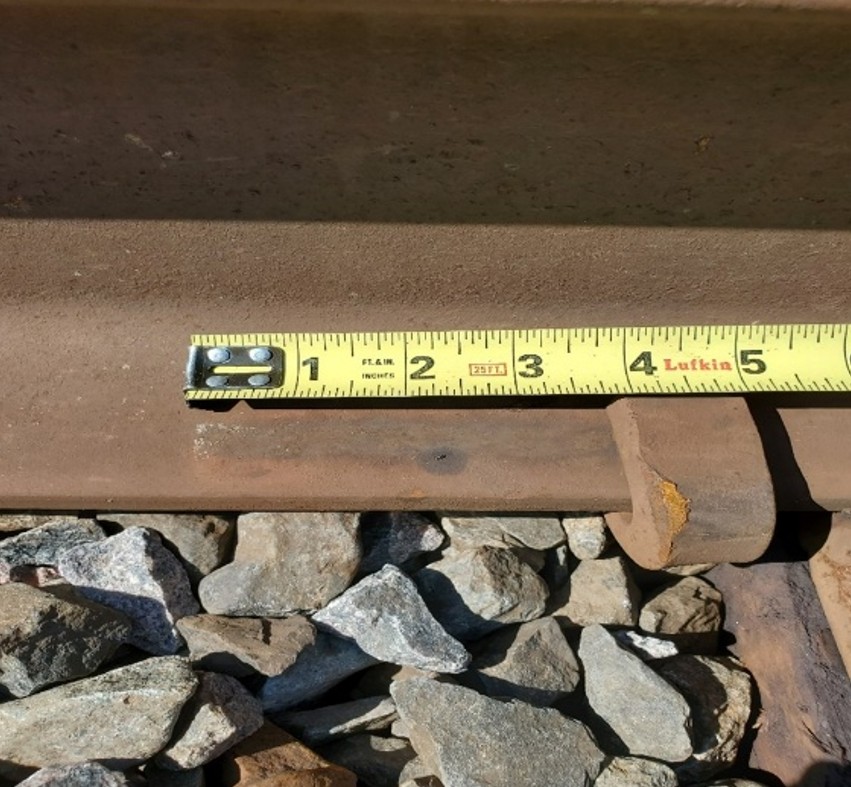
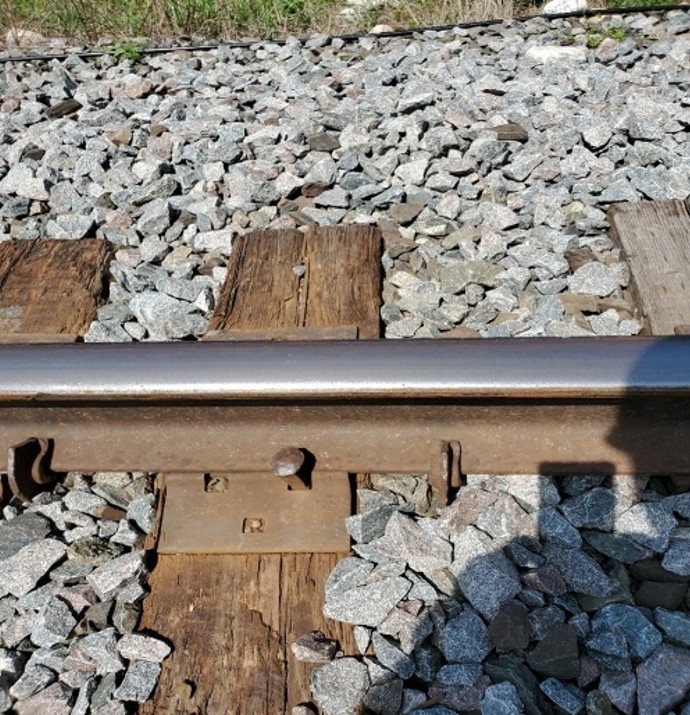
In July 2025, the TSB examined the track in the area. Signs of rail creep (longitudinal movement of the rail in relation to the position of anchors) were observed in several locations. At Mile 101.8, the anchors had been repositioned by up to 4 inches (Figure 1) during repairs conducted after the 28 June 2025 derailment. The track in the adjacent siding also showed signs of rail creep; in some cases, the anchors had moved nearly 6 inches away from the ties (Figure 2).
The Transportation Safety Board of Canada investigation into this occurrence (R25W0047) is ongoing. However, based on the observed rail creep and general condition of the track, and given the high ambient temperature on the day of the occurrence (28.6 °C), it appears a thermal misalignment (track buckle) may have occurred in the area of the POD prior to the derailment.
Recent thermal misalignment events on the Fort Frances Subdivision
CN records indicate that there were 3 other thermal misalignment events on the Fort Frances Subdivision in the month preceding the present occurrence:
- On 07 June, at Mile 73.5 (occurrence R25W0043, which resulted in the derailment of 11 covered hopper cars on CN train G89041-06)
- On 26 May, at Mile 91.5 (no train was involved)
- On 26 May, at Mile 93.4 (no train was involved)
CN identified rail creep following the 26 May events. Following the 28 June occurrence, the TSB inspected the track from Mile 73.5 to Mile 74.0 (the area where train G89041-06 derailed on 07 June) and also identified signs of rail creep on this section.
CN’s track maintenance and inspection practices on the Fort Frances Subdivision
In April 2025, CN conducted a track inspection from Mile 87.9 to Mile 143.6 as part of a 2-year plan to increase the track speed on the Fort Frances Subdivision. During that inspection, rail creep was identified in several locations, and crews were assigned to carry out destressing work in the identified areas.
Destressing work had been completed from Mile 99.1 to Mile 100 prior to the occurrence on 28 June. CN was aware of the condition of the track in the vicinity of Mile 101.17 and had planned to perform destressing work to address the issue. However, this work was postponed to prioritize repairs to track damage resulting from the 07 June derailment at Mile 73.5.
Following the 28 June occurrence, and in light of the other recent thermal misalignment events on the Fort Frances Subdivision, CN conducted an inspection of the Subdivision and identified several other locations with evidence of rail creep. Those areas were subsequently protected with slow orders and repaired.
A review of CN’s track inspection records indicates that the track in the vicinity of the 28 June derailment was inspected in accordance with the TSR prior to the occurrence. However, despite being aware that the track in this area presented risk factors, such as rail creep, that are known to increase the likelihood of thermal misalignment events, destressing work was only partially completed by CN. In addition, no slow order or other measures to protect the track were applied to the areas where rail creep was present.
Given the heavy tonnage carried on the Fort Frances Subdivision, and the associated risks that derailments pose, Transport Canada may wish to consider reviewing CN’s track inspection and maintenance practices on the Fort Frances Subdivision, particularly those related to rail destressing, securement, and movement, to ensure that destressing work is carried out in a timely fashion and that rail anchors are properly installed and maintained.
The TSB would appreciate being informed of what action, if any, will be taken in this regard.
Yours sincerely,
Original signed by:
Vincenzo De Angelis
Director, Investigations - Rail/Pipeline
cc.
Senior Director, Operations Management, Rail Safety and Security, Transport Canada
Director, Policy, Legislative and Regulatory Affairs, Rail Safety and Security, Transport Canada
Regional Director, Surface, Ontario Region, Transport Canada
Vice President, Safety-Regulatory, Canadian National Railway Company
Senior Manager, Regulatory Affairs, Safety, Canadian National Railway Company