
Main-track derailment
Quebec North Shore and Labrador Railway
Ore train PL676D
Mile 37.7, Wacouna Subdivision
Near Nicman Station, Quebec
The Transportation Safety Board of Canada (TSB) investigated this occurrence for the purpose of advancing transportation safety. It is not the function of the Board to assign fault or determine civil or criminal liability. This report is not created for use in the context of legal, disciplinary or other proceedings. See Ownership and use of content. Masculine pronouns and position titles may be used to signify all genders to comply with the Canadian Transportation Accident Investigation and Safety Board Act (S.C. 1989, c. 3).
The occurrence
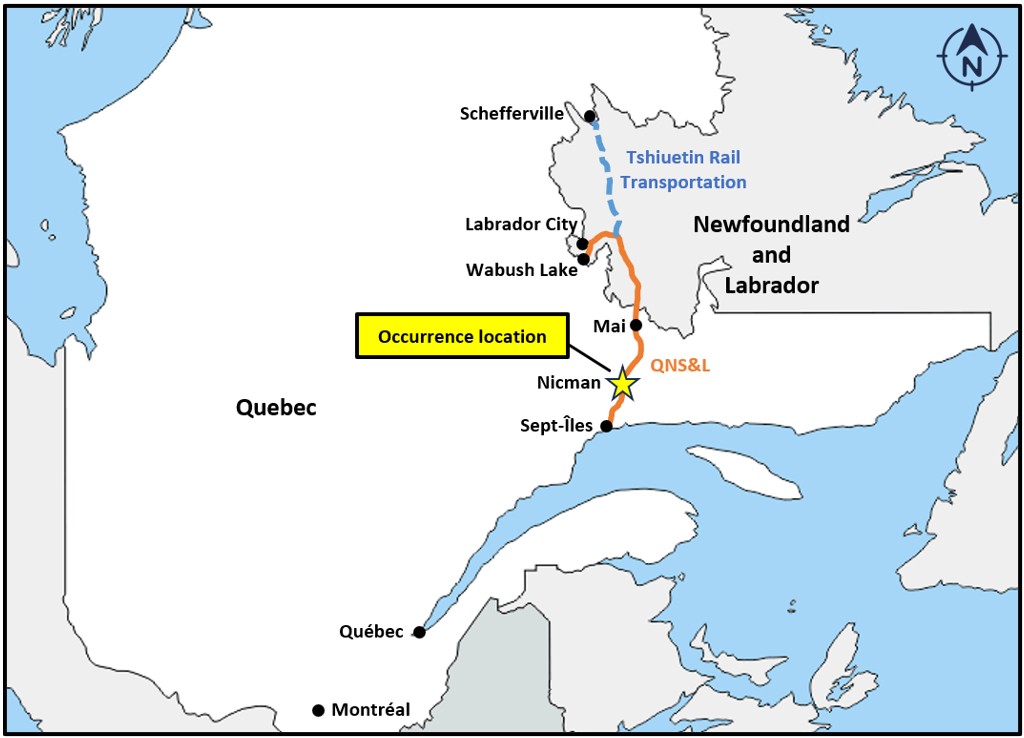
On 28 December 2025, Quebec North Shore and Labrador Railway (QNS&L) ore train PL676D was travelling southward on the QNS&L Wacouna Subdivision main track, approaching the controlled location of Nord Nicman, located north of Sept-Îles, Quebec (Figure 1).
The train consisted of 2 head-end locomotives (locomotives QNSL 525 and QNSL 419), a distributed power (DP) remote locomotive located in the 163rd position (QNSL 502), and 240 cars loaded with iron ore. It weighed 27 584 tons and was about 8600 feet long.
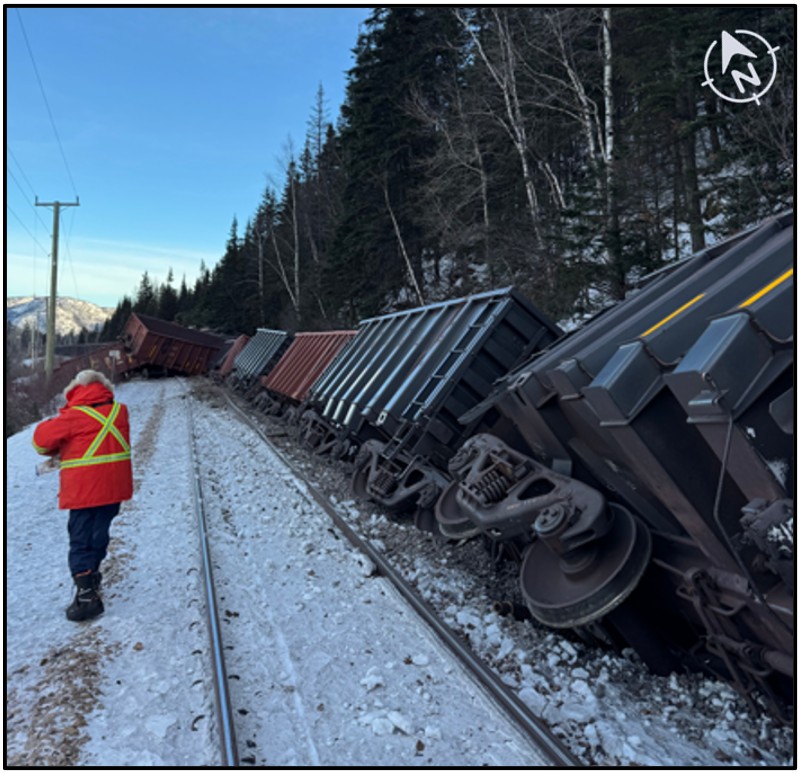
At approximately 1920,All times are Eastern Standard Time. near Mile 36.8, as the train was proceeding at about 29 mph, a train-initiated emergency brake application occurred, and the train came to a stop. After contacting the rail traffic controller (RTC) to report the situation, the locomotive engineer (LE) secured the train and proceeded to inspect it on foot. Upon reaching the 137th car, he observed that the coupler knuckle on the north end of the car was broken.The failure of the coupler knuckle on this car is not considered to be the cause of the derailment, but rather a consequence of it. It was dark, and the LE could not see the remaining cars in the train. He therefore continued walking northward alongside the train, and after a few hundred feet, upon exiting a curve, noticed that the next car (IOCC 11430) had derailed across the rails at Mile 37.7. The next 6 cars had also derailed and were leaning against the rock face on the east side (Figure 2). Twenty-two other cars and the DP locomotive had also derailed in various orientations. They all sustained extensive damage.
The train was operated by a single locomotive engineer, in accordance with QNS&L’s operating procedures for ore trains. The locomotive engineer was not injured. At the time of the occurrence, the weather was −9 °C, and the sky was mostly clear.
Site examination
All the derailed rolling stock remained within the limits of the railway right-of-way. Even though almost all the contents of the derailed cars had spilled, no significant quantity of iron ore ended up on the frozen surface of the Nipissis River, located below the west side of the railway tracks. The other cars of the consist remained on the rails and were not damaged.
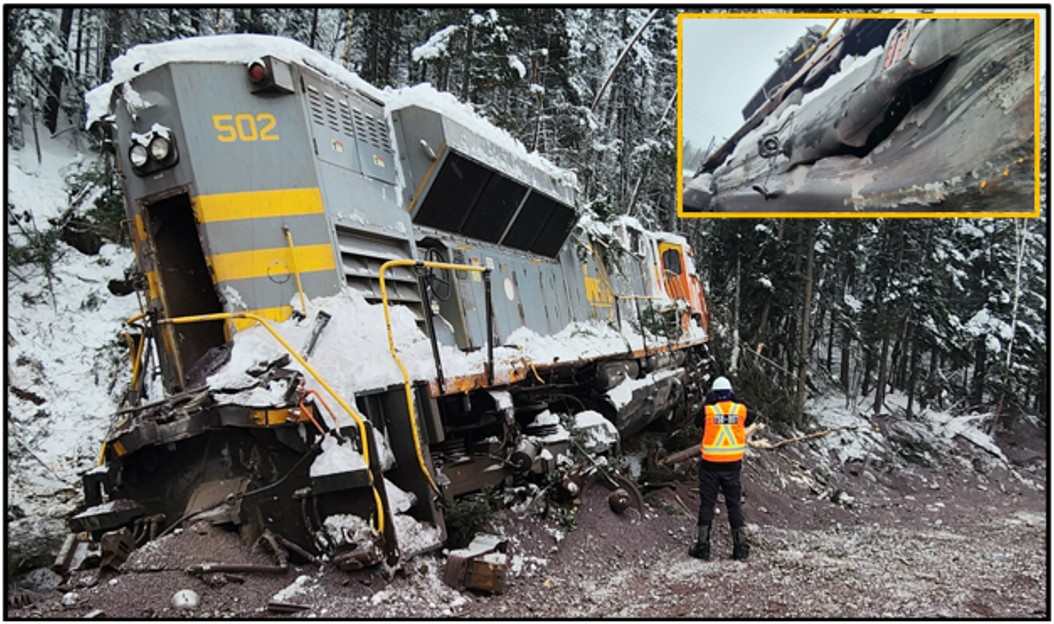
The fuel tank on locomotive QNSL 502 was punctured in the derailment (Figure 3), resulting in the release of approximately 1000 L of diesel fuel. The spill was limited to the area directly beneath the locomotive. Recovery operations for the remaining fuel in the locomotive, as well as other fluids it contained, were completed before the locomotive was moved. Most of the spilled fuel was subsequently recovered.
About 500 feet of track was destroyed. The rails were almost all torn out and broken into several pieces. They were found entangled among the damaged cars and the spilled ore.
Railway traffic was restored during the night of 04–05 January 2026, 7 days after the occurrence.
Locomotive engineer information
The LE operating the train was qualified for his position, was familiar with the territory, and met fitness and rest requirements. He had been working for QNS&L since October 2017 and became qualified as an LE the following year, in October 2018.
Recorded information
A few seconds before the emergency application of the train brakes, the LE had moved the throttle on the lead locomotive from position 5 to position 4 in order to maintain a constant train speed. A few miles earlier, the DP remote locomotive had been configured to provide neither traction nor braking. The train’s operation was not unusual for this type of train and for the terrain.
Subdivision information
The Wacouna Subdivision is a single main track that connects Sept-Îles (Mile 8.9) to Emeril Junction, Newfoundland and Labrador (Mile 225.30). The track is used by passenger trains, freight trains, and ore trains.Following the derailment, an airlift was organized to deliver food and supplies to residents of communities that had been cut off because of the shutdown of rail service. The QNS&L railway is one of the major means of transportation, other than air travel, serving several Indigenous communities in this region of northern Quebec and Labrador. Train movements are governed by the centralized traffic control system (CTC), as authorized by the Canadian Rail Operating Rules (CROR), and supervised by 2 RTCs located in Sept-Îles who share the territory.
The track is classified as Class 3 according to the Rules Respecting Track Safety, also known as the Track Safety Rules (TSR), approved by Transport Canada. The maximum allowable speed for freight trains is 40 mph.At QNS&L, maximum allowable speeds for ore trains are 40 mph for empty trains and 35 mph for loaded trains. Rail traffic on this subdivision consists of approximately 9 trains per day (ore, freight, and passenger trains), for an annual tonnage of nearly 40 million gross tons.
Track information
In the area of the occurrence, the ground is mostly level, with slight gradients ranging from +0.1% to -0.2%. The railway tracks follow the east bank of the Nipissis River. In the direction of travel, starting at Mile 37.83, there is a right-hand curve of approximately 4 degrees over 480 feet (up to Mile 37.74).The curve is followed by a short section of tangent track, then a left-hand curve of nearly 7 degrees over 493 feet (up to Mile 37.65).The track consisted of 136-pound continuous welded rail, manufactured by Nippon Steel Corporation in 2021 and installed in the summer of 2022.
For the entire year of 2025, there were 47 instances of broken rails on the main track of the Wacouna Subdivision. Of these, 25 instances, or more than half, occurred in January (13) and December (12).This value falls within the range typically observed for this type of operation.
Track inspections
Track inspections had been performed in compliance with the TSR.
The most recent track geometry inspection was conducted on 20 October 2025.No urgent or near-urgent geometry defects were identified near the occurrence site.
The most recent ultrasonic testing was performed on 04 December 2025, 24 days before the occurrence, between Mile 9.0 and Mile 57.82.Between 01 January 2025 and the day of the derailment, a total of 10 ultrasonic tests had been conducted on the Wacouna Subdivision to detect possible internal rail defects. No internal rail defects were noted for the derailment area.During the last ultrasonic test, defective rail welds were identified at Mile 29.09 and Mile 53.08 on the west-side rail.
The most recent inspection by hi-rail vehicle was done on 25 December 2025 by a qualified inspector. No defects or anomalies were noted in the area of the derailment.
Outdoor temperature fluctuations
During December 2025, significant outdoor temperature fluctuations were recorded in the Sept-Îles area (Figure 4).
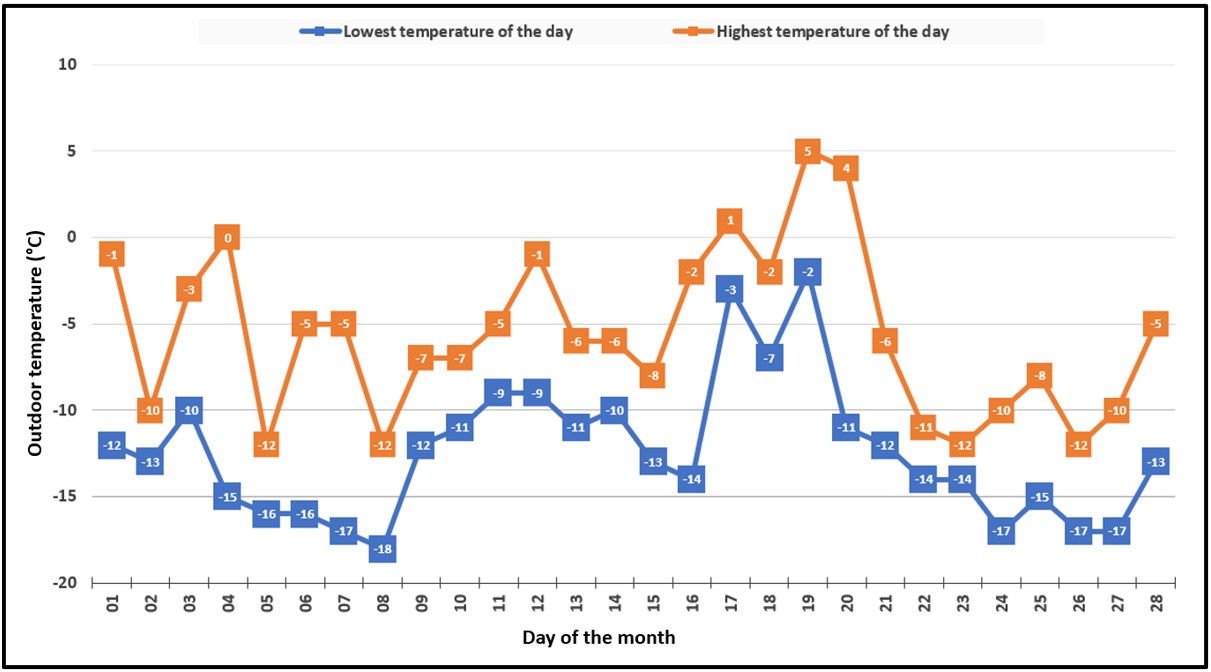
Before the occurrence, the coldest day of the month had been 08 December, with a low of −18 °C, and the warmest day had been 19 December, when the recorded temperature rose to as high as 5 °C. In the days leading up to the derailment, the outdoor temperature had dropped to near the previously recorded lows.
Stresses on continuous welded rail
Significant temperature fluctuations over a relatively short period, particularly at the start of the cold season, place heavy stresses on the rails. Cold weather causes the steel to contract, generating tensile forces in the rail. Conversely, a rise in outdoor temperature causes the material to expand, resulting in compressive forces. The forces generated in the rails by these repeated cycles can cause internal defects to form and spread. Continuous welded rail is then more susceptible to failures, such as breaks, particularly at the welds joining rail sections together.
The effects of temperature variations on continuous welded rail can also be amplified by rolling stock with wheel defects, such as flat spots. When this occurs, the rail is hammered with each wheel revolution at an intensity that varies with the severity of the defect and the speed of the train, which can cause various types of rail damage, up to and including rail failure.
Approximately 20 minutes before the occurrence train had passed, another loaded ore trainTrain QSNL A225B consisted of 164 cars and 2 locomotives and was travelling at 29 mph. It weighed 18 023 tons and was 5890 feet long. had travelled on the same track and in the same direction in the block where the derailment occurred. One of the cars on that train had a wheel on the east side with a flat spot.The wheel impact load detector located at Mile 219 had measured an impact of 78.7 kips for one of the wheels on car WAB 277, a value very close to the condemning limit of 80 kips established by QNS&L. No anomalies in the CTC track circuit had been detected after this train passed through.
The TSB was unable to determine with certainty what caused the occurrence or to confirm the track condition, given the extent of the derailment, the difficulty of access to the location, and the scattered rolling stock and contents of the cars. However, it is likely that the rail, which was then subjected to thermal stresses and impact forces, broke while train PL676D passed at Mile 37.7, causing the derailment.
Safety action taken
Since the occurrence, QNS&L has raised awareness among qualified employees about the importance of CROR Rule 110Canadian Rail Operating Rules, Rule 110: Inspecting Passing Trains and Transfers (effective 01 October 2022, approved by Transport Canada on 09 May 2022), pp. 46–47. in order to improve the quality of inspections of passing trains on the main track and to detect, among other things, potential defects such as flat spots on wheels.
Safety message
Ultrasonic testing conducted in accordance with the applicable requirements of Transport Canada’s TSR to detect potential internal rail defects is one of the most effective tools used by railway companies to verify the integrity of the rails on which trains operate. More frequent testing during the winter months—when the majority of rail breaks occur—would increase the likelihood of detecting internal defects.
This report concludes the Transportation Safety Board of Canada’s investigation into this occurrence. The Board authorized the release of this report on 08 July 2026. It was officially released on 22 July 2026.