
Collision with terrain
Privately registered
Bushmaster Super 22 (amateur-built aircraft), C-GWNQ
Lillooet Aerodrome (CYLI), British Columbia
The Transportation Safety Board of Canada (TSB) investigated this occurrence for the purpose of advancing transportation safety. It is not the function of the Board to assign fault or determine civil or criminal liability. This report is not created for use in the context of legal, disciplinary or other proceedings. See Ownership and use of content. Masculine pronouns and position titles may be used to signify all genders to comply with the Canadian Transportation Accident Investigation and Safety Board Act (S.C. 1989, c. 3).
History of the flight
At approximately 1705All times are Pacific Daylight Time (Coordinated Universal Time minus 7 hours). on 24 September 2025, the privately registered, amateur-built Bushmaster Super 22 aircraft (registration C-GWNQ, serial number B-002) took off from Runway 32 at Lillooet Aerodrome (CYLI)All locations mentioned in the report are in the province of British Columbia, unless otherwise stated. on a visual flight rules (VFR) recreational flight to Chilliwack Airport (CYCW) with only the pilot on board. The aircraft was transporting hunting equipment and venison from a hunting excursion the pilot conducted a few days earlier.
During the take-off roll, the aircraft’s fuel pressure and engine rpm decreased momentarily and then recovered just before takeoff (Figure 1, points A to C).Figure 1 reference points data extracted from the Garmin G3X flight display installed in occurrence aircraft. About 30 seconds after the aircraft lifted off, and while it was climbing through approximately 345 feet above ground level (AGL), the fuel pressure and engine rpm started to decrease again (Figure 1, points D to F). The fuel pressure and engine rpm continued to decrease. The engine lost power and, when the aircraft was at approximately 400 feet AGL, it levelled off (Figure 1, point G). At that point, the terrain directly ahead of the aircraft was flat and forested, and the pilot initiated a 180° left turnback toward CYLI. The fuel pressure and engine rpm continued to decrease, and the aircraft started to lose height. Throughout the turnback, the indicated airspeed ranged from 48 knots to 61.5 knots, the vertical speed reached a maximum of approximately 2300 fpm, and the bank angle ranged from about 29° to 37.5°. The last recorded data point (Figure 1, point I) showed that the fuel pressure had decreased to a very low value.
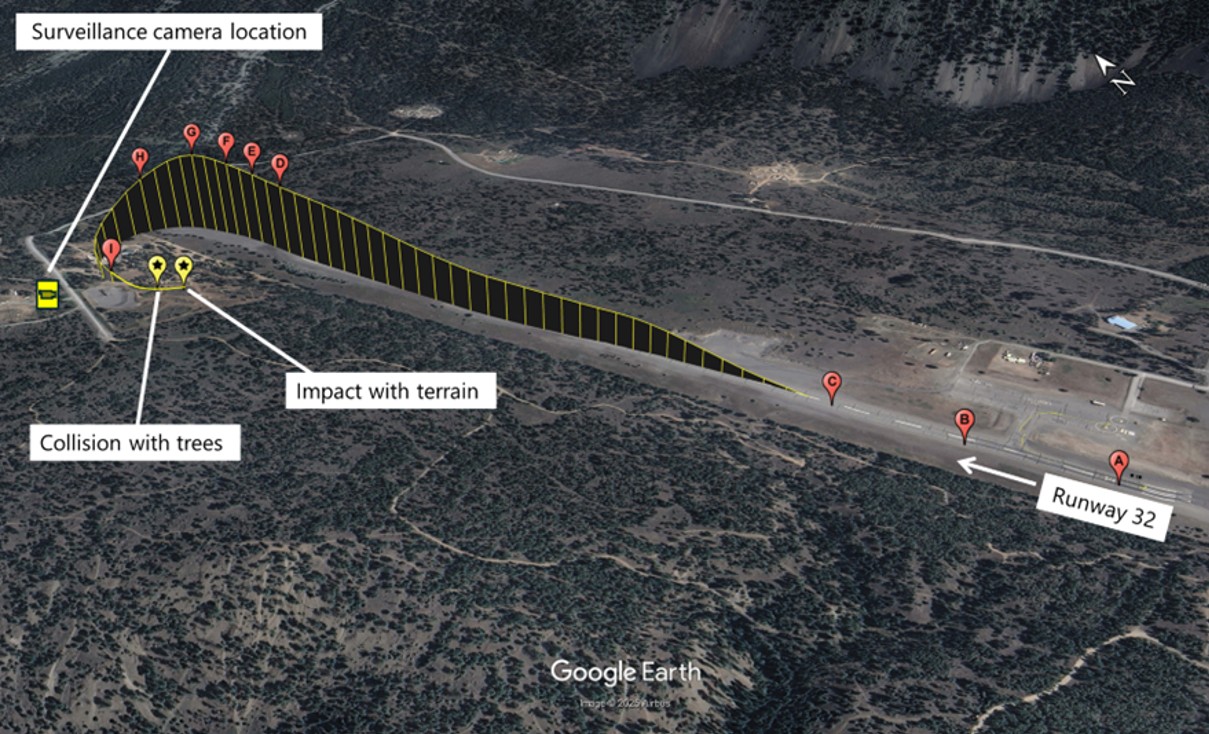
Reference point | Fuel pressure (psi) | Engine speed (rpm) |
|---|---|---|
A | 48.2 | 2530 |
B | 20.7 | 1940 |
C | 50.9 | 2750 |
D | 49.8 | 2710 |
E | 28.5 | 2640 |
F | 16 | 1360 |
G | 10.3 | 840 |
H | 6.9 | 710 |
I | 1.7 | 1070 |
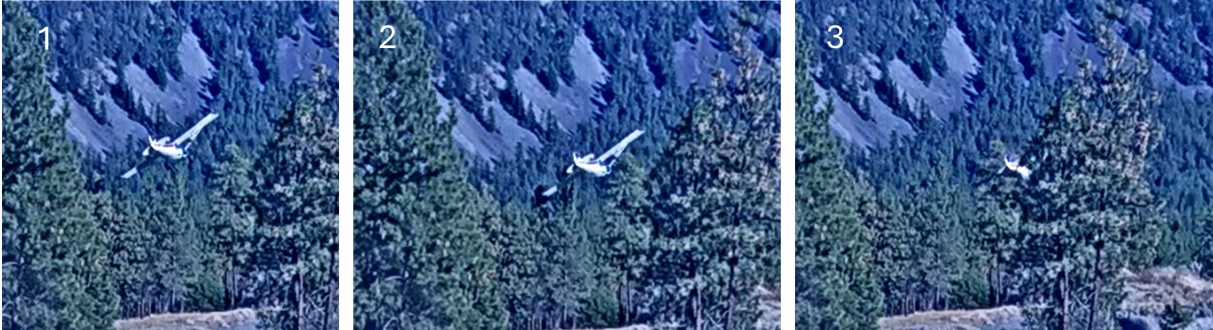
When the aircraft was at a height of approximately 35 feet AGL and banking left to turn back toward the aerodrome, it struck trees and then impacted terrain adjacent to CYLI. Surveillance cameras at a neighbouring property captured the impact (Figure 2) and indicated that the aircraft did not stall. A person at CYLI who had been accompanying the pilot on the hunting excursion and local first responders attended the scene and provided medical assistance; however, the pilot was fatally injured. There was no post-impact fire and the aircraft was destroyed.
Wreckage and impact information
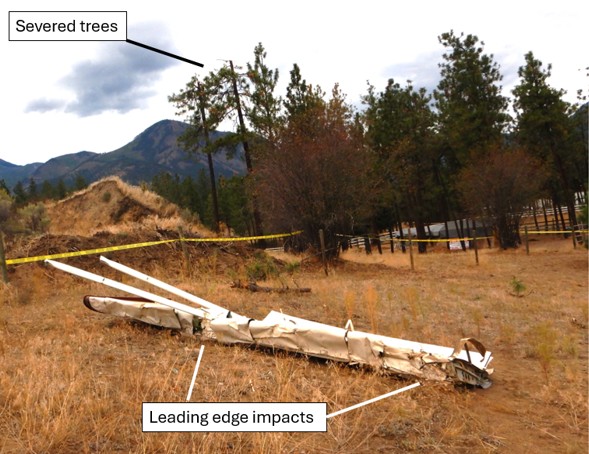
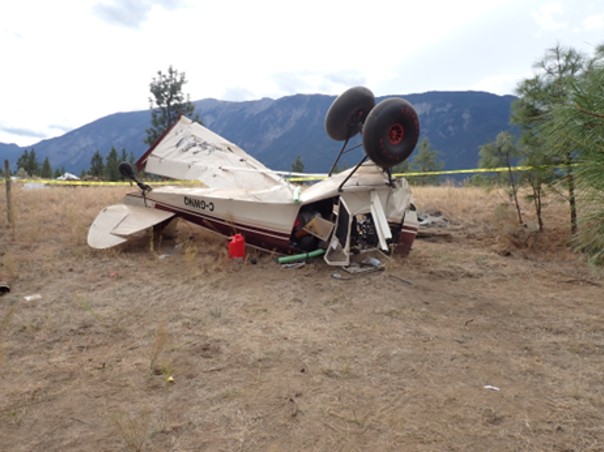
The collision with the trees tore the aircraft’s left wing from the fuselage at the wing root. The left wing exhibited signs of impact with the trees on 2 areas of the leading edge (Figure 3). The remainder of the aircraft came to rest inverted and facing predominantly south, approximately 145 feet from the trees (Figure 4) and approximately 650 feet west of the end of the runway.
Investigators confirmed that control and lifting surfaces were intact until contact with the trees and the flaps were in the up position.
The occupiable space in the cockpit of the aircraft was compromised. The accident was not survivable.
Pilot information
The pilot held a private pilot licence – aeroplane and a valid Category 3 medical certificate. At the time of the occurrence, he had approximately 565 total flight time hours, including approximately 30 hours flying the occurrence aircraft. The pilot was the registered owner of the aircraft.
There was no indication that the pilot’s performance was negatively affected by medical or pathological factors. It could not be determined if fatigue was a factor.
Aircraft information
The occurrence aircraft was an amateur-built Bushmaster Super 22 manufactured in 1988. In November 2011, it was modified to incorporate an Aerosport Power O-375-A2A reciprocating piston engine.
Given that the occurrence aircraft was amateur-built, it did not hold a type certificate.Transport Canada issues type certificates for aeronautical products as a way of certifying that a product meets the relevant airworthiness standards. Type certificates can be used as the basis for issuing some flight authorities, which are defined in subsection 101.01(1) of the Canadian Aviation Regulations (CARs) as “a certificate of airworthiness, special certificate of airworthiness, flight permit or validation of a foreign document attesting to an aircraft’s fitness for flight […]”.Conformity to a type certificate is a condition for issuing a certificate of airworthiness, but is not a condition for issuing a flight permit. The aircraft was operating under a flight permit issued by Transport Canada in 1988 as its flight authority. The flight permit was based on design data submitted by the builder and had no expiry date. It was issued under Air Navigation Order, Series II, No. 3Air Navigation Order, Series II, No. 3 was a regulation that predated the current CARs. when the aircraft was configured as a floatplane. The aircraft was never issued a special certificate of airworthiness.When the CARs were introduced in the mid-1990’s, special certificates of airworthiness began being issued for amateur-built aircraft instead of flight permits. Subsection 507.03(1) of the current Airworthiness Manual explains that “a special certificate of airworthiness (Special C of A) is issued for an aircraft that does not meet all the requirements for a certificate of airworthiness […].”
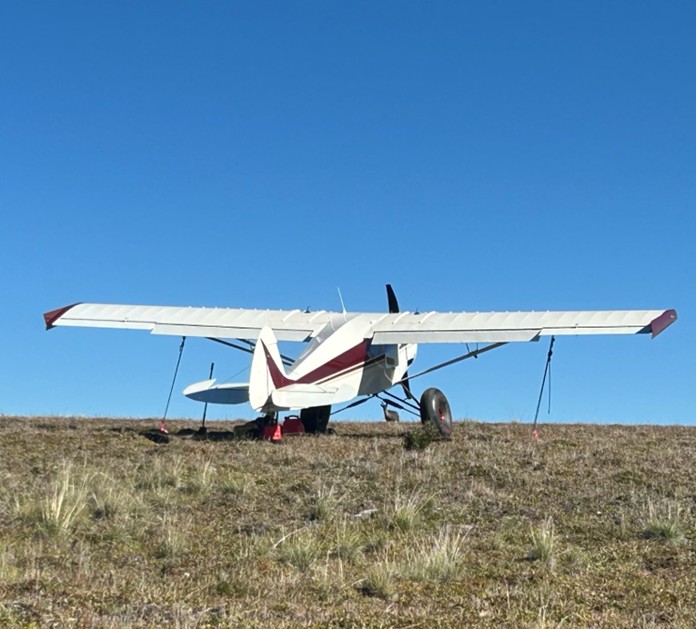
The pilot purchased the occurrence aircraft in July 2024, and approximately 2 months later it was reconfigured to a land plane with fixed landing gear (Figure 5).
The pilot maintained and modified the aircraft himself.Transport Canada, SOR/96-433, Canadian Aviation Regulations, paragraph 571.11(2)(b) permits owners of amateur-built aircraft to sign a maintenance release for their aircraft. During the first 6 months of 2025, the aircraft underwent extensive modifications, including being fitted with the following: a 2-bladed, carbon fibre, constant-speed propeller; electronic fuel injection and ignition systems; a water/methanol injection system; a custom turbocharging system; an autopilot system; and a Garmin G3X flight display, which provided flight and engine data. The investigation could not determine whether the water/methanol injection system was in use during the occurrence flight.
Aircraft modifications and regulatory requirements
Major modificationsSubsection 101.01(1) of the CARs defines major modification as “an alteration to the type design of an aeronautical product in respect of which a type certificate has been issued that has other than a negligible effect on the weight and centre-of-gravity limits, structural strength, performance, power plant operation, flight characteristics or other qualities affecting its airworthiness or environmental characteristics.” performed on type-certificated aircraft must be reported to Transport CanadaTransport Canada, SOR/96-433, Canadian Aviation Regulations, section 571.12. and be performed in accordance with either approved data or specified data.Ibid., subsection 571.06(1).,The terms approved data and specified data are defined in subsection 571.06(1) of the Airworthiness Manual. Given that amateur-built aircraft do not have type certificates, these requirements do not apply to aircraft classified as amateur-built. Modifications made to an amateur‑built aircraft must be performed in accordance with acceptable data.Transport Canada, SOR/96-433, Canadian Aviation Regulations, subsection 571.06(1).,The term acceptable data is defined in subsection 571.06(1) of the Airworthiness Manual. In contrast to the requirements for type-certificated aircraft, the Canadian Aviation Regulations (CARs) do not contain a defined procedure for reporting modifications made to amateur‑built aircraft.
Section 549.23 of the Airworthiness Manual stipulates the regulatory requirements for design changes and repairs carried out on amateur-built aircraft. Specifically, it states that an inspection by a Transport Canada representative is required following any design changes and repairs that affect the “structural integrity, geometry, performance […] and maximum permissible take-off mass.”Transport Canada, SOR/96-433, Canadian Aviation Regulations, Airworthiness Manual, Chapter 549: Amateur-Built Aircraft, Subchapter A: General, section 549.23. It also states that these kinds of design changes and repairs “may invalidate the Special Certificate of Airworthiness for amateur-built aircraft.”Ibid.
A Transport Canada exemptionTransport Canada, Exemption from section 549.01 of the Canadian Aviation Regulations and Chapter 549 of the Airworthiness Manual – Airworthiness Standards – Amateur-Built Aircraft (02 April 2009). for amateur‑built aircraft contains related information and summarizes some of the applicable regulations. It states that “repairs and modifications […] must conform to technical data acceptable to the Minister”,Ibid., Appendix A: Standards and Design and Construction for Amateur-Built Aircraft, Part VII: Continuing Airworthiness, Information notes (ix). which owners may develop themselves provided it is appropriately reviewed, analyzed, or aligned with recognized standards or practices. Any change affecting “structural strength, performance, power plant operation, or flight characteristics […] must be reported to the Minister before further flight […]”Ibid., Information notes (xi). and the Minister retains final authority over data acceptability.
Some of the modifications made to the occurrence aircraft after the flight permit was issued likely affected the aircraft’s performance, power plant operation, and flight characteristics. There was no record of these modifications being inspected by a Transport Canada representative or reported to the Minister before flight.
Previous fuel pressure issues
The investigation determined that in June 2025, after the aircraft modifications were completed, the aircraft began experiencing significant momentary drops in fuel pressure during operation.In some instances, the fuel pressure dropped to about 18 psi before recovering to the operating pressure setting. The manufacturer recommends that the fuel system operating pressure be set to 35 psi. These issues continued through early September 2025. Specifically, the primary electric fuel pump repeatedly lost pressure, requiring the backup pump to activate. No defects related to these issues were recorded in the journey log.The last entry in the journey log was for a flight conducted on 01 August 2025.
In the days leading up to the hunting excursion, the fuel pressure was repeatedly adjusted and ground runs were performed.The Garmin G3X data showed that throughout several days preceding the hunting excursion, multiple ground runs were conducted on the aircraft, and the fuel pressure was adjusted to about 40 psi. From 17 to 23 September 2025, the aircraft experienced 5 major fuel‑pressure drops at the start of take‑off rolls, some accompanied by notable reductions in engine rpm, yet the pilot continued the takeoffs and flights. During this time, the fuel pressure was adjusted again in an attempt to resolve the issue. On 23 September 2025, the fuel pressure was adjusted to about 60 psi.
On the day of the occurrence, the pilot was conducting a series of flights to return to CYCW. During the 1st flight, the aircraft’s alternator stopped producing power. Consequently, the pilot diverted from an intended fuel stopover at CYLI and flew for approximately 45 minutes to Vanderhoof Aerodrome (CAU4), where the electrical issue was repaired. Shortly afterward, the pilot initiated the take-off roll from CAU4 during which the aircraft again experienced significant momentary fuel pressure and rpm reductions.The Garmin G3X data showed that the fuel pressure momentarily decreased from approximately 60 psi to 20 psi and the engine rpm decreased from about 2600 rpm to 1000 rpm before recovering. The fuel pressure recovered, and the pilot continued the flight to CYLI for fuelling.
After the aircraft landed at CYLI, the backup electric fuel pump’s 10 A circuit breaker tripped while the aircraft was taxiing to the fuelling area, and the fuel pressure dropped to a very low value before the engine was shut down. During the stopover, the pilot adjusted the aircraft’s fuel pressure to about 52 psi. After refuelling at CYLI, a gurgling sound was heard coming from the aircraft.
Fuel system description and examination
In June 2025, the aircraft began operating with a Fly EFII System32 electronic fuel injection and ignition system kit designed for non-type certified aircraft. It included dual electronic control units (ECUs), a cockpit controller, various sensors, dual electric fuel pumps, and a regulator. The kit also allows for a customer-designed and -provided fuel header tank. The dual ECUs and fuel pumps provide redundancy in case of a failure during operation.The No. 1 fuel pump is considered the primary pump whereas the No. 2 fuel pump acts as a backup pump if the No. 1 pump fails. The Fly EFII System32 was integrated with the occurrence aircraft’s Garmin G3X flight display and provided the display with various engine parameters. The system does not have a mechanical fuel pump.
The fuel pressure is to be set to a static pressure of 35 psi with the engine off and 1 pump running. If the primary fuel pump pressure drops below a preset value, the automatic backup fuel pump circuit senses the drop and activates the backup fuel pump.The manufacturer recommends that the trigger point at which the backup fuel pump engages be set to 10 psi below the system static pressure. For example, if the static pressure is set to 35 psi, the trigger point should be set to 25 psi because that is a reasonable point to indicate that the No. 1 fuel pump is experiencing a pressure problem. A cockpit controller provides system information and indicates when the backup fuel pump activates.
The EFII System32 fuel system returns unused fuel from the engine to the fuel tanks or an optional header tank through a pressure regulator. The fuel tanks and header tank must be vented.Transport Canada, Advisory Circular (AC) No. 549-001: Amateur-built Aircraft Fuel Systems, Issue 01 (10 October 2023), section 4.1: Fuel tanks. According to the manufacturer, if the aircraft is equipped with a header tank, the tank must have a minimum capacity of 5 U.S. gallons so that the heat the fuel absorbs while circulating through the engine compartment can disperse into the cooler fuel in the header tank. Smaller tanks increase the risk of fuel overheating, which can lead to vapour lock. The manufacturer notes that because of the pressure drop that occurs in the fuel pressure regulator, vapour bubbles form in the return line connected to the header tank. Consequently, insufficient venting of the header tank can trap air in the tank and prevent it from filling completely with fuel.Fly EFII , EFII System32 Installation Instructions For Lycoming 4 and 6 cylinder engines, Revision 6/19, Fuel System, p. 5.
The occurrence aircraft was configured with a custom header tank that had a capacity of about 3 U.S. gallons. The aircraft also had a shutoff valve installed in the header tank vent line. This valve was not included in the manufacturer’s design and was not visible to the pilot. It was found in the closed position after the accident.
The on-site examination of the wreckage revealed that the backup fuel pump circuit breaker had been tripped and the primary fuel pump circuit breaker was closed. The fuel pump mode selector switch was found in the 1 / Auto position. The investigation collected a spare fuel pump assembly and multiple hand tools from the aircraft.
It was determined that the primary fuel pump lost pressure, triggering the backup pump during many of the takeoffs before the occurrence flight. The aircraft completed the planned flights after each of those takeoffs using only the backup fuel pump. It was apparent that the backup pump was also triggered during the occurrence flight. Insufficient venting and the incorrect size of the header tank likely resulted in the fuel pumps ingesting air and possibly becoming vapour locked, with resulting pressure losses. This was supported by the gurgling sound heard after refuelling, which indicated that air trapped in the header tank was likely venting through the wing tank fuel lines since the header tank vent was closed by a valve.
The fuel pumps were sent to the TSB Engineering Laboratory in Ottawa, Ontario, for examination. Testing revealed that the backup pump was drawing nearly 10 A while the system pressure was set to 50 psi, which is significantly higher than the current draw of a properly functioning pump. It is likely that the continued operation of the backup pump while ingesting a combination of air and heated fuel caused internal damage, which created the excessive current draw. It is probable that this condition caused the backup pump circuit breaker to trip during the occurrence flight, leading to fuel starvation and the subsequent engine power loss.
Engine power loss after takeoff
The occurrence aircraft did not have a flight manual nor was it required to by regulation. Consequently, no emergency procedures were available for the pilot to follow during an engine power loss.
Transport Canada’s Flight Training Manual cautions that numerous fatal accidents have resulted from attempting to turn back to the aerodrome following an engine failure after takeoff. The manual states:
Experience and careful consideration of the following factors are essential to making a safe decision to execute a return to the aerodrome:
- Altitude.
- The glide ratio of the aircraft.
- The length of the runway.
- Wind strength/ground speed.
- Experience of the pilot.
- Pilot currency on type.Transport Canada, TP 1102E, Flight Training Manual, 4th Edition (revised August 2004), Exercise 22: Forced Landing, p. 128.
International agencies, including the U.S. Federal Aviation Administration (FAA)Federal Aviation Administration, FAAS Team (FAA Safety Team), FAA-P-8740-44, Impossible Turn (2017). and the Australian Transport Safety Bureau (ATSB),Australian Transport Safety Bureau, ATSB Transport Safety Report AR-2010-055: Avoidable Accidents No. 3: Managing partial power loss after takeoff in single-engine aircraft (2013). also provide similar guidance on procedures to follow if an engine fails after takeoff.
TSB records show that since 2012 there have been 34 accidents in Canada involving a power loss on takeoff where a turn back towards the runway was attempted. As a result of those accidents, 13 aircraft were destroyed and 12 people received fatal or serious injuries.
Weather information
Weather was not considered to be a factor in this occurrence.
TSB laboratory reports
The TSB completed the following laboratory reports in support of this investigation:
- LP085/2025 – NVM Data Recovery – Display and Fuel System
- LP014/2026 – Fuel System Review
Safety messages
Owners of amateur-built aircraft are reminded that certain design changes may require an inspection by a Transport Canada representative and may invalidate an aircraft’s flight authority. Moreover, modifying aircraft without following acceptable data may jeopardize the safety of the aircraft.
Pilots are reminded that knowingly operating an aircraft with defects affecting airworthiness is hazardous and can result in serious injury, fatalities, and damage to aircraft and property.
Additionally, pilots are cautioned about the risks associated with performing a turnback to an aerodrome following an engine failure at takeoff. When the aircraft is at a low height, landing in a field or other area directly ahead is usually safer than attempting to force a return to the runway.
This report concludes the Transportation Safety Board of Canada’s investigation into this occurrence. The Board authorized the release of this report on 27 May 2026. It was officially released on 07 July 2026.