
Collision with terrain
Hanley Heli Service Inc.
Bell Helicopter Textron 206L (helicopter), C-GCHM
Fort Chipewyan Airport (CYPY), Alberta, 4 NM ESE
The Transportation Safety Board of Canada (TSB) investigated this occurrence for the purpose of advancing transportation safety. It is not the function of the Board to assign fault or determine civil or criminal liability. This report is not created for use in the context of legal, disciplinary or other proceedings. See Ownership and use of content. Masculine pronouns and position titles may be used to signify all genders to comply with the Canadian Transportation Accident Investigation and Safety Board Act (S.C. 1989, c. 3).
Summary
On 12 February 2024, the Hanley Heli Service Inc. Bell Helicopter Textron 206L helicopter (registration C-GCHM, serial number 45083) was conducting aerial geo-survey operations, with a sensor attached to a 300-foot longline, in the western area of Lake Athabasca near the Fort Chipewyan Airport (CYPY), Alberta. While returning to CYPY due to deteriorating weather and at approximately 0.4 nautical miles from the threshold of Runway 22, the pilot encountered reduced visibility, reversed course, and then turned toward Lake Athabasca. A few minutes later, at approximately 1518 Mountain Standard Time, the helicopter collided with the ice-covered surface of Lake Athabasca. The pilot, who was the sole occupant on board, was fatally injured. The helicopter was destroyed by the impact forces. There was no post-impact fire.
1.0 Factual information
1.1 History of the flight
At 0838All times are Mountain Standard Time (Coordinated Universal time minus 7 hours). on 12 February 2024, the Hanley Heli Service Inc. (Hanley) Bell Helicopter Textron (Bell) 206L helicopter departed Fort Chipewyan Airport (CYPY), Alberta, on a day visual flight rules (VFR) flight with the pilot and 1 technician on board to conduct a maintenance operation on a geo-survey base station, located approximately 25 nautical miles (NM) east of CYPY. At 0938, the helicopter landed back at CYPY. It was then refuelled, in preparation for a 2nd flight that day.
At 0958, the occurrence helicopter was started up and lifted off. Ground support personnel attached a geo-survey sensor (referred to as a “bird”) to the occurrence helicopter using a 300-foot longline (Figure 1). Shortly thereafter, the helicopter departed CYPY and transited to the planned survey area, located over the western section of Lake Athabasca, Alberta. The pilot was the sole occupant.
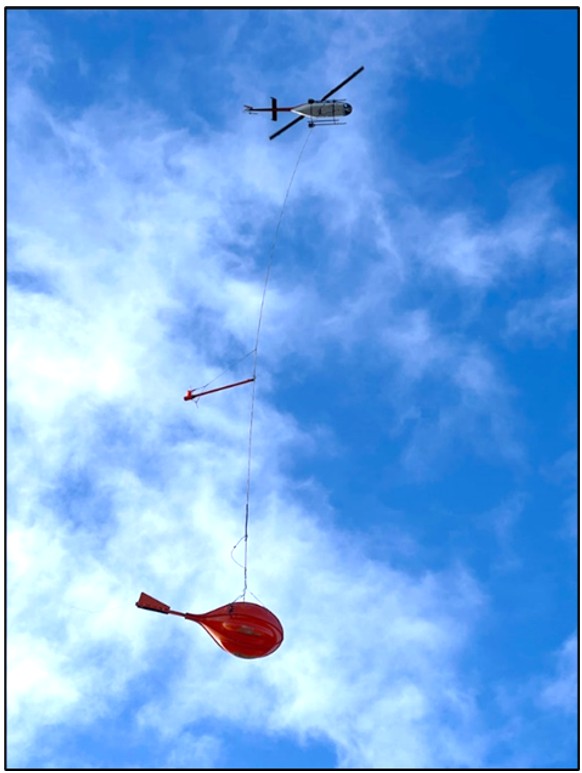
Hanley was operating 2 Bell 206L helicopters from CYPY and had been conducting geo-survey operations from that airport since 28 January 2024. At approximately 1000, the other helicopter (registration C-GLSH) departed CYPY to conduct geo-survey operations to the northeast of the airport. The pilot of that helicopter (hereafter referred to as the 2nd pilot) was the sole occupant.
At approximately 1130, the 2nd pilot observed a global positioning system (GPS) warning on the geo-survey equipment and returned to CYPY, landing at 1220. Upon landing, the geo-survey console on the helicopter was removed by ground support personnel for repairs.
At 1257, the occurrence pilot called the 2nd pilot via cellphone, using a Bluetooth connection in his headset, to say that he was returning to CYPY to refuel. The helicopter landed at 1259, was refuelled, and departed again at 1317 to continue geo-survey operations.
Approximately 30 minutes later, the geo-survey equipment on the 2nd helicopter was repaired. While preparing to depart, the 2nd pilot observed what appeared to be heavy snowfall approaching from the northwest of CYPY. At 1429, the 2nd pilot called the occurrence pilot for a position report. The occurrence pilot reported that he was flying a survey line and had approximately 10 km (5.4 NM) remaining on that line.
The 2nd pilot suggested that the occurrence pilot finish that line and return to CYPY because the weather was deteriorating. The occurrence pilot acknowledged and, at approximately 1438, he completed the survey line and then turned toward CYPY.
At that point, the helicopter was 21 NM east-southeast of CYPY. Shortly thereafter, at 1441, the occurrence pilot called the 2nd pilot to inform him that he would be back at CYPY in 10 to 15 minutes. The occurrence pilot would remain on the phone with the 2nd pilot for the remainder of the flight.
The 2nd pilot told the occurrence pilot that the approach would be conducted in low visibility conditions. The 2nd pilot then mentioned to the occurrence pilot that he could leave the bird on the ground somewhere en route if required. This would allow the occurrence pilot to fly lower and make it easier to see references on the ground during an approach in reduced visibility.
The occurrence pilot informed the 2nd pilot that the visibility en route appeared to be acceptable and that he would attempt to return to CYPY from the northeast and align with Runway 22, with the bird still attached to the 300-foot longline.
Shortly after, the occurrence helicopter’s track began deviating right (i.e., to the north) of the direct track to CYPY (Figure 2). When the helicopter was approximately 5 NM east of CYPY, it turned right 90° toward the east and proceeded eastward for approximately 1.5 NM before commencing a gradual left turn that eventually brought the helicopter back toward CYPY. During that gradual turn, at approximately 1501, the occurrence pilot called the 2nd pilot and indicated that visibility was poor but that he was trying to arrive from the north.
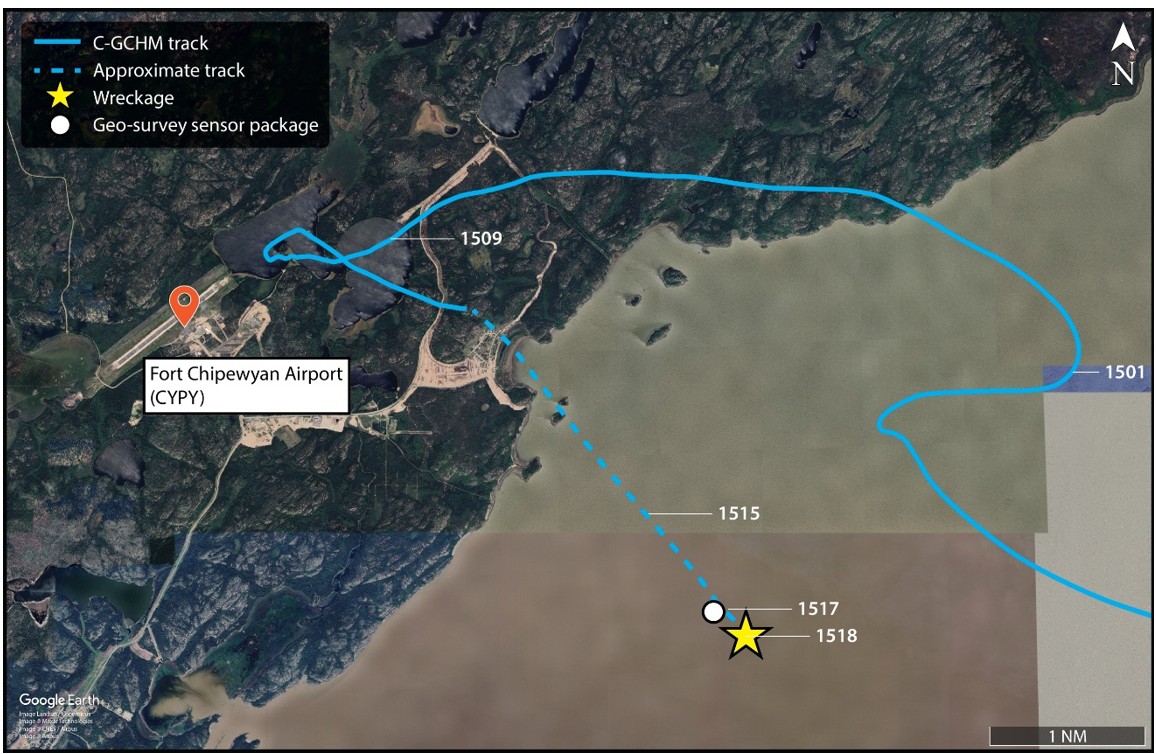
As the occurrence helicopter got closer to CYPY (within 2 NM), the occurrence pilot activated the aircraft radio control of aerodrome lighting (ARCAL) type K systemAn aircraft radio control of aerodrome lighting (ARCAL) type K system allows the pilot to operate all aerodrome lighting for a duration of approximately 15 minutes by keying the microphone 7 times initially. This will ensure all lights are on maximum intensity. The intensity may be adjusted up or down to any one of 3 settings by keying the microphone 7, 5, or 3 times within 5 seconds for high-, medium-, or low-intensity settings, respectively. and subsequently told the 2nd pilot that he was unable to see Runway 22 or runway lights. At that time, personnel on the ground estimated the visibility to be ¼ statute mile (SM) in blowing snow.
The final approach path for Runway 22 crosses over a small unnamed lake that begins approximately 1.3 NM from the threshold and ends approximately 0.1 NM from the threshold. The lake’s width varies from approximately 0.5 to 0.6 NM. At 1509, the occurrence helicopter was approximately 1.3 NM east-northeast of the threshold of Runway 22, crossing the shore of the frozen lake, and at a height of 600 feet above ground level (AGL). The helicopter’s track inbound took it over the lake (Figure 3), approximately 0.2 NM from the closest shore on the right side. The 2nd pilot, who was situated approximately 0.4 NM south-southwest of the threshold of Runway 22 could hear the occurrence helicopter, but he was unable to see it.
After overflying a small spit of land, approximately 0.5 NM northeast of the threshold of Runway 22, the occurrence pilot reported that the helicopter was accumulating ice. He then reported losing all visual references, and that he was unsure of the helicopter’s position. At that point, the shore was approximately 0.33 NM horizontally to the right and 0.25 NM in front of the helicopter’s ground track. The occurrence pilot made a 180° turn to the right over the frozen lake and continued in that direction for approximately 0.25 NM. After the turn, the shore was less than 100 m horizontally to the right. While the helicopter was reversing course, the 2nd pilot suggested that the occurrence pilot fly toward Lake Athabasca, approximately 2 NM east of CYPY, in the hopes of re-acquiring visual references, and to possibly land along the shore.
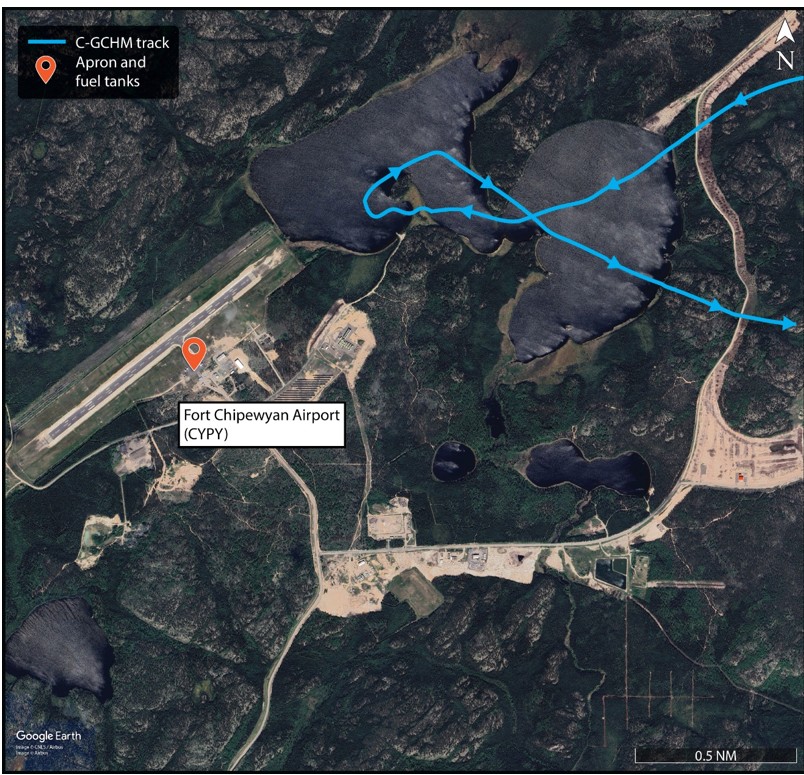
When the helicopter was approximately 0.7 NM northeast of the threshold of Runway 22, and on the reciprocal track for Runway 22, the occurrence pilot reported that he was turning the helicopter toward Lake Athabasca. Over the next several minutes, the helicopter flew easterly toward Lake Athabasca, crossing perpendicular to the shoreline as it continued to fly over the ice-covered lake.
At 1515, the helicopter was approximately 3.3 NM east-southeast of CYPY at 839 feet AGL with a ground speed of approximately 27 knots. About 2 minutes later, when the helicopter was over Lake Athabasca, the occurrence pilot informed the 2nd pilot that he had released the external load, he had lost control of the helicopter, and the helicopter was spinning.
Moments later, at 1518, the helicopter impacted the frozen surface of Lake Athabasca, 0.2 NM from where the bird came to rest, and slightly more than 4 NM east of CYPY, in a nose-down, right-banked attitude. The helicopter’s 406 MHz emergency locator transmitter (ELT) activated, and a distress signal was detected by the search and rescue satellite system.
At approximately 1540, a search party was assembled at Allison Bay, Alberta, with the 2nd pilot and local first responders. The search party departed by snowmobile out onto Lake Athabasca; however, they were unable to find the helicopter due to low visibility in blowing snow. At approximately 1730 the search party returned to Allison Bay. At that point, the 2nd pilot contacted the company owner, who is also the operations manager and chief pilot, to notify him of the accident and then contacted the local Royal Canadian Mounted Police (RCMP) and the Joint Rescue Coordination Centre (JRCC) in Trenton, Ontario, to report the accident.
At approximately 1737 the RCMP arrived at Allison Bay. Ten minutes later, an Indigenous Elder led a 2nd search effort, consisting of the RCMP and local first responders, onto the frozen lake.
Shortly after commencing the 2nd search, the bird and longline were found. Approximately 10 minutes later (at 1810), the helicopter was found. The pilot had been fatally injured.
1.2 Injuries to persons
The pilot was alone on board. Table 1 outlines the degree of injuries received.
Degree of injury | Crew | Passengers | Persons not on board the aircraft | Total by injury |
|---|---|---|---|---|
Fatal | 1 | 0 | – | 1 |
Serious | 0 | 0 | – | 0 |
Minor | 0 | 0 | – | 0 |
Total injured | 1 | 0 | – | 1 |
1.3 Damage to aircraft
The helicopter was destroyed as a result of impact forces.
1.4 Other damage
The bird was destroyed.
1.5 Personnel information
1.5.1 General
Pilot licence | Commercial pilot licence – helicopter (CPL-H) Private pilot licence – aeroplane (single-engine land) |
|---|---|
Medical expiry date | 01 February 2025 |
Total flying hours | Approximately 2500 (including 350 hours on airplanes) |
Flight hours on type | 77.5 |
Flight hours in the 24 hours before the occurrence | 6.5 |
Flight hours in the 7 days before the occurrence | 34.9 |
Flight hours in the 30 days before the occurrence | 67.5 |
Flight hours in the 90 days before the occurrence | 67.5 |
Flight hours on type in the 90 days before the occurrence | 67.5 |
Hours on duty before the occurrence | 7.3 |
Hours off duty before the work period | 15.5 |
The occurrence pilot held a valid Canadian commercial pilot licence – helicopter, restricted to daylight VFR flying. The pilot had type ratings on the Bell 206, and the Robinson Helicopter Company RH22 and RH44. The pilot completed his commercial helicopter training in January 2016, with a total of 103 flight hours.
The occurrence pilot had met the owner of Hanley a few years before the accident, while working on the same aerial spray contract, and they remained in contact. In the fall of 2023, the pilot contacted the owner of Hanley and expressed a desire to do some other types of helicopter flying besides aerial spray operations.
In December 2023, the occurrence pilot was hired by Hanley on a contract starting in January 2024. The occurrence pilot was hired so that Hanley could operate 2 Bell 206L helicopters in support of the aerial geo-survey contract based at CYPY.
The investigation determined that the vast majority of the occurrence pilot’s flight experience was acquired conducting aerial spray operations for another Canadian helicopter operator during spring and summer months.
1.5.2 Training file
The company’s ground training is done via self-study. After completing company exams, the occurrence pilot was provided with the answer keys and instructed to self-correct his exams. This was followed by a verbal discussion with the owner.
The company uses a Flight Training / PCC Form to track initial and recurrent training, as well as pilot competency checks (PCCs). The training form states that exercises will be assessed using a numerical 1–4 grading number system,1 means requires retraining; 2 means improving but needs more training; 3 means satisfactory; 4 means excellent. or a “B” for briefed. Despite this, Hanley developed the practice of using checkmarks instead of the 1–4 grading system. According to the form, “upon completion of a training session,[A training session is a flight, or portion of a flight, dedicated to training.] the Training Pilot shall complete the form for the particular session.”Hanley Heli Service Inc., Rotary-Wing Company Operations Manual – Aerial Work, Amendment 5 (01 April 2022), Section 11.2: Flight Training / PCC Form. The form also states that exercises conducted during the PCC will be assessed as satisfactory (S) or unsatisfactory (U). The assessment column on the occurrence pilot’s Flight Training / PCC Form was empty. According to the company, this was an oversight.
According to company records, the occurrence pilot’s initial Bell 206L training was completed by the owner while ferrying the newly leased occurrence helicopter from Terrace Airport (CYXT), British Columbia, to CYPY.
A summary of the reported training sessions appears in Table 3.
Training session | Date | Hours | Observation |
|---|---|---|---|
1 | 24 January 2024 | 0.4 | The first 18 exercises on the form are checked. |
2 | 26 January 2024 | 0.9 | The next 20 exercises on the form are checked. |
3 | 27 January 2024 | 0.7 | The remaining 23 exercises on the form, including external load, aerial spraying, confined area, and some general exercises, are checked. |
Per the regulations, pilots of Canadian Aviation Regulations (CARs) Subpart 702 operators, such as Hanley, can complete a PCC instead of a pilot proficiency check (PPC). However, when a PCC is conducted, the chief pilot, or a pilot delegated by the chief pilot, is required to ensure that pilots be certified as competent in the performance of the check items in Schedule II - Pilot Proficiency Check - Helicopters.Transport Canada, Commercial Air Service Standards, Standard 722: Aerial Work, Division VII: Personnel Requirements, subsection 722.65(2). The owner certified that the occurrence pilot successfully completed the PCC on 27 January 2024. There were no comments listed on the form for any of the exercises. To further understand the initial training received during the ferry flight, the investigation obtained and examined satellite tracker information for the flight, captured at 2-minute intervals. In addition, the flight times were analyzed using forecast upper-level winds during those flights. With the exception of a portion of a flight on 26 January 2024 (see Section 1.5.5 External load experience at Hanley Heli Service,Inc.), the investigation could not identify satellite track information consistent with the exercises reported to have been completed during each training session. For instance, there are no clear examples of the flight profiles typical of confined area operations, autorotations, or emergency procedures that are, by nature of the landing portion of the exercise, normally conducted over a hard surface (e.g., a runway at an airport).
Table 4 shows an analysis of the ferry flights, using forecast winds to determine estimated transit times.
Ferry flight date | Corresponding training session | Flight hours recorded in journey log | Estimated transit time (hours) | Estimated additional time available for training (hours) |
|---|---|---|---|---|
24 January 2024 | 1 | 2.9 | 2.9 | 0.0 |
26 January 2024 | 2 | 2.4 | 0.8 | 1.6** |
27 January 2024 | 3 | 3.6 | 3.5 | 0.1 |
* These calculations were predicated on upper-level winds along the route and based on a 100-knot true airspeed for flights that did not involve external load operations and a 75-knot true airspeed for the external load transit flight on 27 January 2024.
** See Section 1.5.5 External load experience at Hanley Heli Service, Inc.
Hanley does not conduct reduced visibility or inadvertent flight into instrument meteorological conditions (IIMC) training, nor is it required to by regulation.
The occurrence pilot had the appropriate licence and ratings for the flight; however, the investigation was unable to confirm that the pilot had met the PCC requirements to act as the pilot-in-command (PIC) of a commercial flight at the time of the accident.
1.5.3 Instrument flight experience
In 2015, while undergoing helicopter pilot training, the occurrence pilot completed 5 hours of in-aircraft instrument flight training and 5 hours of instrument flight training in a simulator. The pilot had no other instrument flight experience recorded in his personal log.
1.5.4 Winter-flying experience
To further understand the occurrence pilot’s experience operating during the winter months, the investigation reviewed his personal logs. A breakdown of his helicopter winter-flying experience is summarized in Table 5.
Year | Winter helicopter flying experience |
|---|---|
2015 | November and December - Initial helicopter training (multiple flights) |
2016 | January - Initial helicopter training (multiple flights) |
2017 | December – 1 flight (0.9 flight hours) |
2018 | January – 2 flights (1.1 flight hours, 0.6 flight hours) November – 1 flight (0.4 flight hours) December – 1 flight (0.7 flight hours) |
2019 | January – 2 flights (1.1 flight hours, 1.0 flight hours) February – 3 flights (1.0 flight hours, 1.7 flight hours, 2.0 flight hours) December – 1 flight (0.6 flight hours) |
2020 | February – 2 flights (0.7 flight hours, 0.7 flight hours) December – 2 flights (0.4 flight hours, 2.5 flight hours) |
2021 | February – 1 flight (0.5 flight hours) |
2022 | Nil |
2023 | Nil |
Since completing his flight training in January 2016, the pilot accumulated approximately 16 hours flying helicopters during the winter months. The investigation determined that the occurrence pilot’s winter helicopter flying experience after his flight training and before joining Hanley was gained during maintenance test flights for his previous employer. These flights were conducted in good weather conditions.
There is no indication that the occurrence pilot had operational experience conducting flights “in the white” (i.e., winter operations in snow-covered areas with limited external references) as a commercial helicopter pilot. When the occurrence pilot began flying with Hanley, it had been approximately 35 months since he had last flown a helicopter during the winter.
The occurrence pilot had approximately 25 hours of fixed-wing winter flight experience, primarily acquired in December 2020 and January 2021 during training, and he had a few solo flights in December 2022 and January 2023.
1.5.5 External load experience at Hanley Heli Service, Inc.
The occurrence pilot had no prior external load experience before joining Hanley. His external load training was conducted by the company chief pilot (i.e., owner), as permitted by regulation.
There is no record of the occurrence pilot’s external load training outlining the number of flights conducted, hours flown, or sequences (e.g., flight manoeuvre, type of longline, type of load, etc.) carried out, nor was one required by the regulation.
The pilot’s training forms indicate that external load training was conducted on 27 January 2024. It was later determined that the pilot completed external load training, consisting of circuits using a practice 100-foot longline and small weight, on 26 January 2024 before an en route stop at the Peace River Aerodrome (CYPE), Alberta. Satellite tracker data suggests that this portion of the flight consisted of 5 circuits and some hover work, for a total of approximately 1.5 hours.
On 27 January 2024, the bird was transported from Fort McMurray Airport (CYMM), Alberta, to CYPY using a shorter longline (approximately 75 feet). When leaving CYMM, the owner piloted the helicopter during the initial takeoff and departure with the bird because light aircraft were parked in the vicinity of the bird pick-up location. After takeoff, control was transferred to the occurrence pilot who then flew the helicopter to CYPY. Once at CYPY, the occurrence pilot conducted some production flights with the owner on 28 and 29 January.
On 30 January 2024, the occurrence pilot conducted external load training (i.e., load pick up, circuit, set down) with the owner using the 300-foot longline and the bird. Satellite tracker data shows a ground track consistent with a circuit and some practise survey line flying for a total of 1.5 hours.
To understand the occurrence pilot’s external load experience at the time of the accident, the investigation reviewed the helicopter’s journey log, which has a dedicated column for recording hook events. A hook event is recorded in the journey log for every external load that is lifted off the ground. Based on existing records, the occurrence pilot completed a total of 13 hook events on external load flights before 11 February 2024 (the day before the accident). According to Hanley, the hook events noted in the journey log were underreported. The investigation was unable to determine the exact number of hook events completed by the occurrence pilot.
The investigation determined that the occurrence pilot completed 2 dedicated external load training flights (involving multiple load pickups, circuits, and drop-offs) under the supervision of the owner. Those flights occurred on 26 and 30 January 2024. The rest of the occurrence pilot’s external load flights, before commencing solo operations, were to transport the bird from CYMM to CYPY, a test flight, and some production flights with the owner.
1.6 Aircraft information
1.6.1 General
The Bell 206L is a light, utility helicopter with a single turboshaft engine and a single main rotor. It can carry 1 pilot and up to 6 passengers. The occurrence helicopter was configured to be flown by 1 pilot from the right front seat. The helicopter was equipped with both an electric and a mechanical load release system for external load operations.
On 22 January 2024, Hanley commenced a 12-month lease for the occurrence helicopter from another Canadian air operator. Before commencing the lease, the helicopter underwent a progressive inspection (800-hour). On 05 February 2024, a 50-hour service check was performed.
At the time of the accident, the helicopter had flown approximately 18.7 hours since the last 50-hour service check.
Manufacturer | Bell Helicopter Textron |
|---|---|
Type, model, and registration | 206L, C-GCHM |
Year of manufacture | 1977 |
Serial number | 45083 |
Certificate of airworthiness | 31 March 1977 |
Total airframe time (approximate) | 18 359 hours |
Engine type (number of engines) | Rolls-Royce 250-C20R/2 (1) |
Rotor type (number of rotor blades) | Semi-rigid (2) |
Maximum allowable take-off weight | 3999 lb (1814 kg) |
Recommended fuel types | Jet A, Jet A-1, Jet B |
Fuel type used | Jet A |
A review of the available data indicates that the weight and centre of gravity were within the prescribed limits.
There was no indication that an aircraft system or component malfunction contributed to this occurrence.
1.6.2 Flight instruments
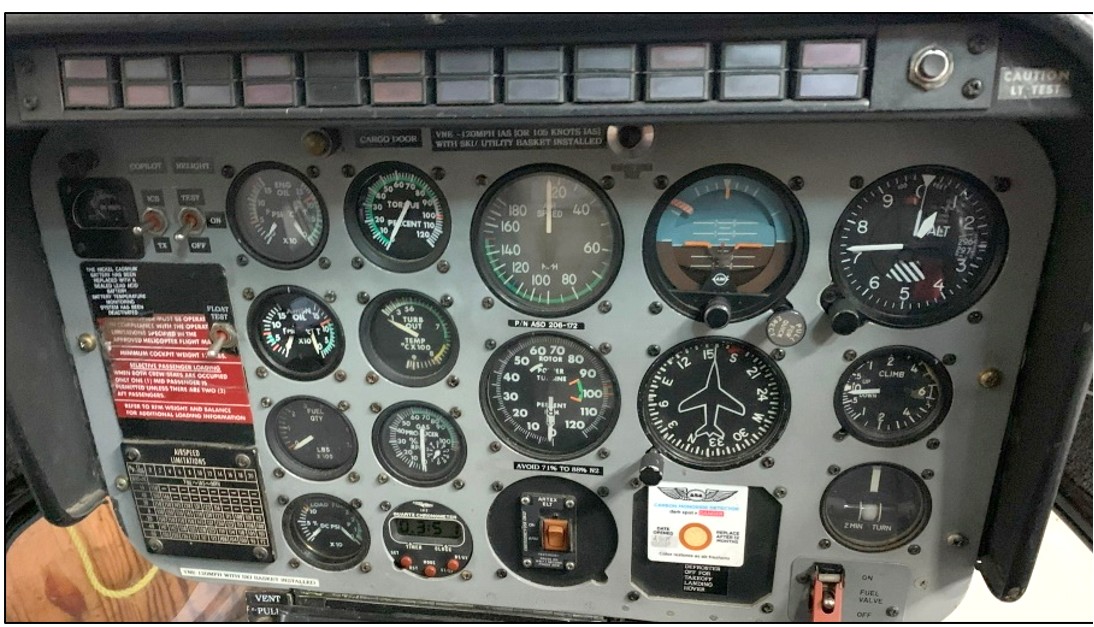
The helicopter was certified and equipped for daytime VFR flight in accordance with section 605.14 of the CARs.Transport Canada, SOR/96-433, Canadian Aviation Regulations, section 605.14: Power-driven Aircraft — Day VFR. Basic flight instrumentation included an airspeed indicator, an artificial horizon, a barometric altimeter, a gyroscopic direction indicator, a vertical speed indicator, and a ball-in-tube slip and skid indicator.
The flight instruments were configured in the standard “T” format, intended to facilitate a pilot’s ability to maintain an effective instrument scan (Figure 4).
The helicopter was also equipped with a tablet for using the ForeFlight application and a radar altimeter display, both mounted on the top of the instrument panel (Figure 5). ForeFlight provides a moving map feature, providing real-time position information. It also includes a synthetic vision capability; however, the helicopter did not have the required equipment for attitude information to be shown on the display. The radar altimeter display in the cockpit provides the pilot with constant information about the helicopter’s actual height, in metres, above the surface and provides directional guidance to ensure the pilot remains on the survey line, at the predetermined survey height. The radar altimeter does not include a low-height setting selector that the pilot can use. The target height for the radar altimeter is set by geo-survey technicians while the aircraft is on the ground.
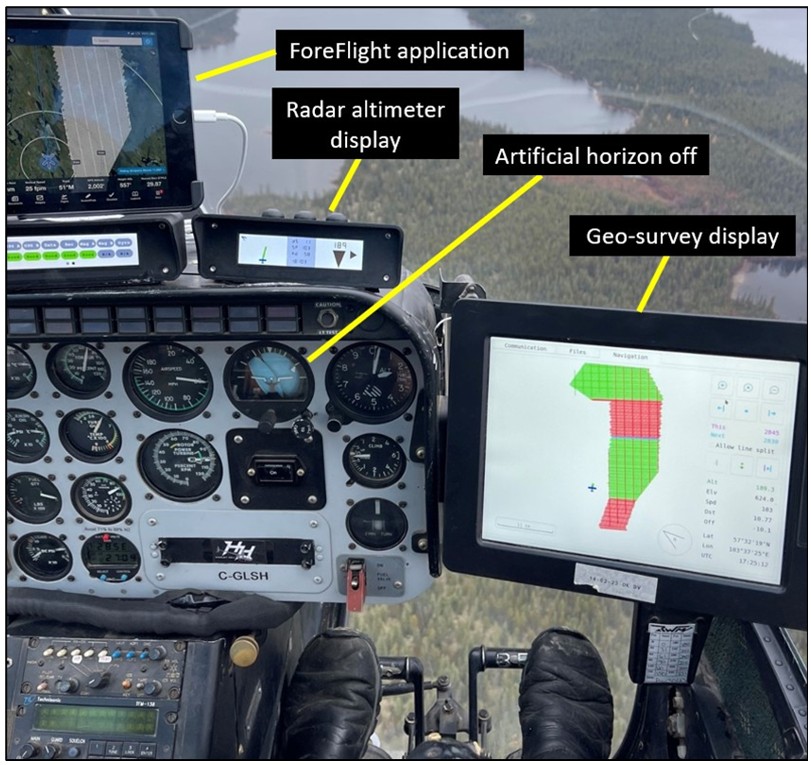
To the right of the instrument panel was a geo-survey display showing the planned and actual track lines. As seen in Figure 5, the combination of the geo-survey equipment, along with the tablet, restricts the pilot’s vertical field-of-view, looking forward. This makes it hard for a pilot to see references that fall beneath the pilot’s sightline and the top of the equipment on or near the instrument panel. (The geo-survey sensor package installation will be discussed further in Section 1.6.3 Geo-survey sensor package installation.)
At the time of the accident, Hanley had 3 active pilots: the occurrence pilot, the 2nd pilot, and the owner. During the course of the investigation, it was noted that the owner and the 2nd pilot routinely flew with the DIR GYRO switch, which controls the directional gyro (heading) and artificial horizon (attitude) indicators, in the OFF position because it was not required for VFR operations (Figure 5).
It was reported that on-site geo-survey personnel had instructed pilots to leave the artificial horizon off because it interfered with the GPS data.
The investigation was unable to determine the source of this verbal guidance; the guidance was subsequently confirmed to be inaccurate. According to management at the geo-survey company, there were no issues operating the artificial horizon during geo-survey operations.
The helicopter was not equipped with any type of autopilot or stability augmentation system, nor was it required to be by regulation for VFR helicopter flight operations.
1.6.3 Geo-survey sensor package installation
The geo-survey sensor package installation consisted of the bird (i.e., the external load), an external radar altimeter antenna mounted to the skid tube, a GPS antenna and radar altimeter display mounted on top of the instrument panel, a geo-survey display mounted to the right side of the instrument panel, and a console unit in the cabin of the helicopter.
A Transport Canada (TC)-approved Supplemental Type Certificate (STC) for the geo-survey sensor package is held by Expert Geophysics Ltd. for use in the Airbus Helicopters AS350 series of helicopters. There is no STC for the Bell 206 helicopter; however, the geo-survey sensor operations manual includes installation procedures for the Bell 206.
According to the installation procedure, installing the radar altimeter bracket “requires an EO [engineering order] or Maintenance release done by the operators AME [aircraft maintenance engineer].”Expert Geophysics Ltd., Operations Manual for MobileMT, Version 2.0 (May 2024), p. 37. According to TC, an appropriately rated AME licence holder must sign the maintenance release certifying that the modification was properly completed.
The investigation determined that the geo-survey sensor package was installed in the occurrence helicopter by Expert Geophysics Ltd. ground personnel and Hanley personnel during an en route stop at CYMM.
There was no maintenance release or engineering order associated with this installation. Hanley personnel were unaware that an AME’s authorization was required.
According to the geo-survey company, the bird has a value of approximately $150,000 (USD).
1.7 Meteorological information
1.7.1 Weather analysis
To assist the investigation, the TSB obtained a meteorological assessment from Environment and Climate Change Canada.
According to that assessment, at around 0500 on 12 February 2024, a low-pressure system (low) had developed in the vicinity of Great Slave Lake, Northwest Territories, and moved east-southeast passing to the east of Lake Athabasca by 1700 on 12 February 2024 (Figure 6). This low resulted in widespread cloud over northern Alberta as well as developing and intensifying snow and flurries as the low travelled into northern Saskatchewan.
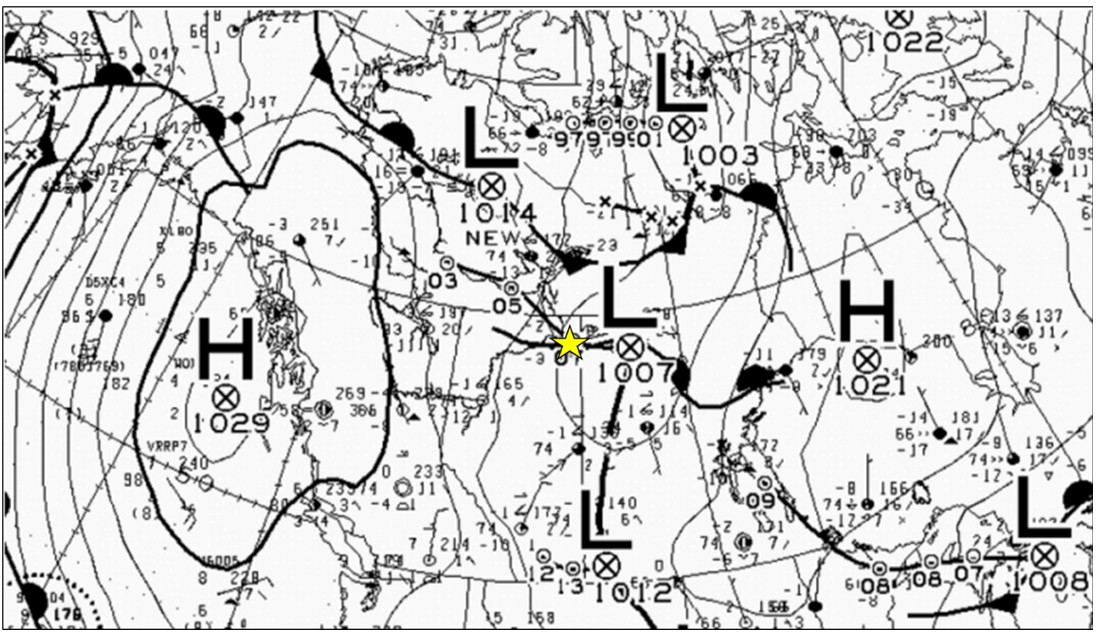
CYPY is rather isolated in terms of upstream weather stations that would report prevailing weather, particularly to the northwest, where the low had approached from. To the northwest of CYPY is Fort Smith Airport (CYSM), Hay River/Merlyn Carter Airport (CYHY), both in the Northwest Territories, and High Level Airport (CYOJ), Alberta. These airports are 80, 188, and 18 NM from CYPY, respectively. These 3 stations provide surface observations.
CYOJ and CYSM were not affected by the approaching low. The low passed through CYHY; however, it was in its earliest stages before the low had time to develop. CYHY reported snow beginning to fall at 0836 and the visibility reduced to ¾ SM by 0900. Conditions rapidly improved afterward.
Satellite imagery shows cloud cover indicative of embedded convective clouds, which could explain why the visibility in snow varied just before and just after the accident. According to the analysis, conditions would have been favourable for moderate icing in cloud below 10 000 feet ASL.
The winds were generally northwesterly or northerly during the afternoon and evening, usually about 10 knots with gusts up to the low 20-knot range. These winds, in a conditionally unstable lower level, would have limited ability to generate turbulence and as a result were not likely to have been a factor in this occurrence.
1.7.2 Reported weather at Fort Chipewyan Airport
Table 7 shows the aerodrome routine meteorological reports (METARs) at CYPY leading up to, and shortly after, the accident:
Time | Wind direction (°T) / speed (kt) | Visibility (SM) | Precipitation | Sky condition | Temp (°C) | Dew point (°C) | Altimeter (inHg) |
|---|---|---|---|---|---|---|---|
1400 | 320/6 | 9 | Nil | Broken ceiling at 6000 feet AGL; overcast layer at 7600 feet AGL | −2 | −8 | 29.71 |
1432 | 300/7 | 9 | Light snow | Broken ceiling at 4400 feet AGL; broken and overcast layers at 5500 feet AGL and 6700 feet AGL, respectively | −2 | −8 | 29.72 |
1438 | 320/8 | 5 | Light snow | Broken ceiling at 3800 feet AGL; overcast layer at 5500 feet AGL | −3 | −7 | 29.72 |
1446 | 320/8 | 2 ¼ | Light snow | Overcast ceiling at 3200 feet AGL | −3 | −6 | 29.72 |
1448 | 320/8 | 2 | Light snow | Overcast ceiling at 3000 feet AGL | −3 | −6 | 29.72 |
1457 | 330/6 | 1 ¾ | Light snow | Overcast ceiling at 2400 feet AGL | −3 | −5 | 29.73 |
1500 | 330/6 | 1 ½ | Light snow | Overcast ceiling at 2200 feet AGL | −3 | −5 | 29.72 |
1548 | 290/7 | 1 ¼ | Light snow | Few clouds at 800 feet AGL; overcast ceiling at 1400 feet AGL | −3 | −4 | 29.75 |
1556 | 290/8 | ¾ | Light snow | Few clouds at 800 feet AGL; overcast ceiling at 1200 feet AGL | −3 | −4 | 29.75 |
1600 | 300/8 | ¾ | Light snow | Few clouds at 600 feet AGL; overcast ceiling at 1200 feet AGL | −3 | −4 | 29.75 |
1700 | 310/8 | ½ | Snow | Vertical visibility 800 feet AGL | −4 | −5 | 29.77 |
1.7.3 Aerodrome forecasts for Fort Chipewyan Airport
The aerodrome forecast (TAF) issued at 1041 forecast the weather to be as follows: winds from the west at 8 knots, visibility greater than 6 SM, a broken ceiling at 3000 feet AGL, and temporarily from 1300 to 1700 visibility of 5 SM in light snow, with a broken ceiling at 2000 feet AGL. The forecast also mentioned that temporarily from 1700 to 2300, the visibility would decrease to 2 SM in light snow showers along with an overcast ceiling at 1200 feet AGL. An amended TAF issued at 1505 forecast the lower visibilities and ceiling starting 2 hours earlier at 1500 rather than 1700.
The investigation was unable to determine what weather information the pilot obtained or reviewed before the occurrence; however, before commencing flying for the day, the pilots discussed the approaching frontal system and that the weather was forecast to deteriorate later that day.
1.8 Aids to navigation
Not applicable.
1.9 Communications
While at CYPY, the occurrence pilot and the 2nd pilot often communicated with each other by cellphone, which was connected to the helicopter intercom system. This was because they had been instructed by geo-survey personnel to limit use of the helicopter radios while conducting geo-survey operations, due to interference with the geo-survey sensor package.
The helicopter radios were used for en route position reports and when communicating on the mandatory frequency established for CYPY.
The occurrence pilot used a Garmin inReach satellite communication messaging/tracking device during survey operations. No messages were sent on the day of the occurrence; however, the unit provided flight track information that assisted the investigation.
1.10 Aerodrome information
1.10.1 General
CYPY has 1 runway: Runway 22/04, which is asphalt and measures 5000 feet long by 150 feet wide. There is an apron and fuel tanks located to the southeast of Runway 22/04. The elevation of CYPY is 761 feet ASL. CYPY is located in, and surrounded by, uncontrolled airspace below 700 feet AGL. The surrounding terrain in the vicinity of CYPY is relatively flat, within approximately 50 feet of station elevation.
1.10.2 Airport lighting
CYPY is equipped with ARCAL type K lighting. The lighting for Runway 22 consists of unidirectional flashing strobe lights at each corner of the threshold, threshold and runway end lights, and medium intensity runway edge lights. The runway is also served by a precision approach path indicator (PAPI) lighting system designed to provide visual glide slope indications to pilots.
1.11 Flight recorders
1.11.1 General
The helicopter was not equipped with a flight data recorder (FDR) or a cockpit voice recorder (CVR), nor was either required by regulation.
1.11.2 Satellite tracking system
The helicopter was equipped with a Skytrac DSAT-200 P satellite flight-tracking system, which is not required by regulation. The DSAT-200 P transmits data to Skytrac servers while in operation, but no additional data is saved to the unit. The occurrence flight’s Skytrac data consisted of 360 data points covering flights from the previous day up to 1518 on the day of the occurrence. Positional, attitude, speed and track data were recorded at 2-minute intervals.
1.12 Wreckage and impact information
The helicopter impacted the frozen surface of Lake Athabasca in a nose-down, right-banked attitude (Figure 7). The helicopter was oriented approximately 100° right of its track from where the bird came to rest on the ice. With the exception of a few pieces of the main-rotor blades, most of the wreckage was located within approximately 50 feet of the fuselage. Other than at the location of the fuselage, there were no other indications of impact scars in the snow.
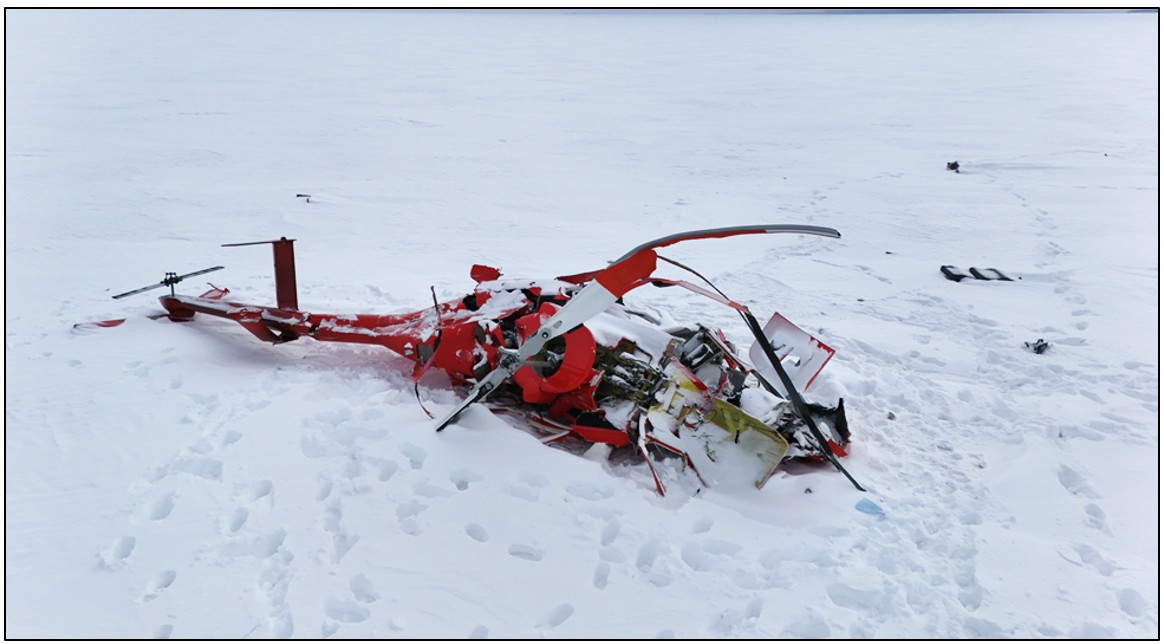
The extent of the damage, combined with the relatively contained accident site, suggests that the helicopter impacted the ice with high vertical g-forces and with little-to-no forward ground speed. Damage to the main-rotor blades was consistent with a significant amount of power being applied at the point of impact.
When search personnel first arrived on site, some snow was present on the wreckage; however, there was no indication of icing observed on the helicopter’s rotor blades or other leading edge surfaces. Icing was not considered a factor in this occurrence.
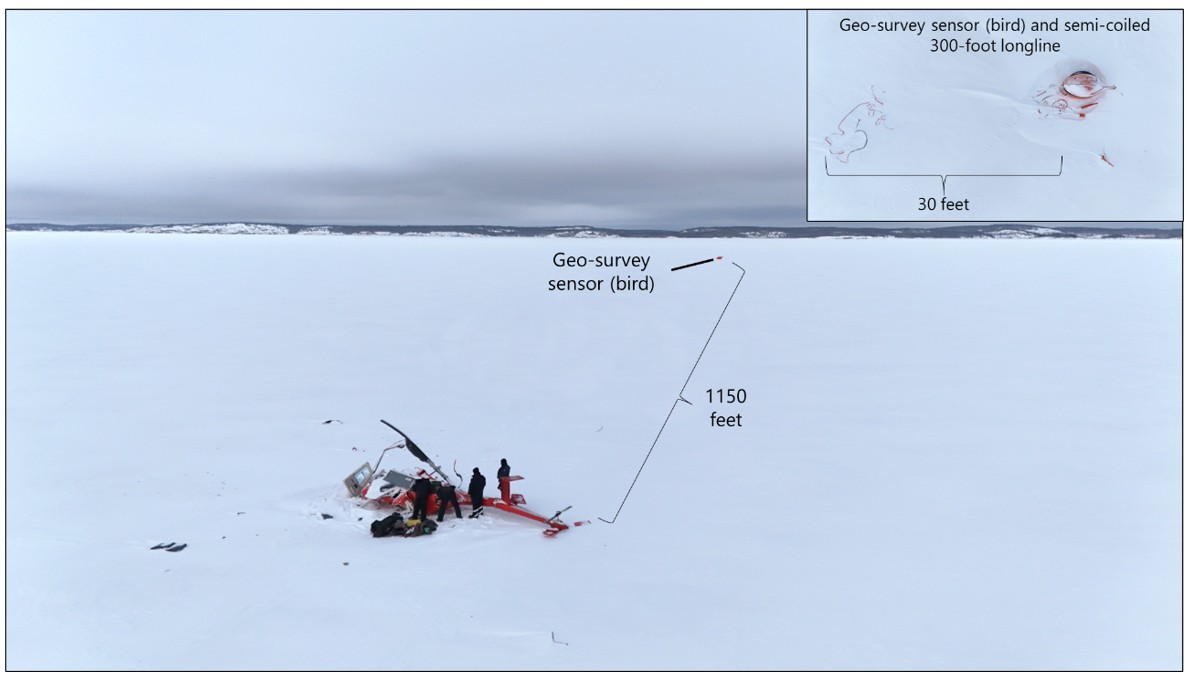
The bird was approximately 1150 feet to the northwest of the main wreckage. The 300-foot longline was found, in a semi-coiled fashion, within approximately 30 feet of the bird, and oriented 90° to the right of the track between the bird and the main wreckage (Figure 8). This suggests that the external load was released at a low ground speed while the helicopter was moving/drifting right of the track between the external load and the main wreckage.
The overhead panel was examined during the on-site portion of the investigation. The directional gyro switch, which also powers the artificial horizon, was found in the ON position. All of the other switches on the overhead panel were found in the OFF position. This suggests that switches moved during the impact sequence. Therefore, the switch position cannot be considered a reliable indication that the artificial horizon was on at the time of impact. The artificial horizon was destroyed by impact forces and was not examined further.
1.13 Medical and pathological information
There was no indication that the pilot’s performance was negatively affected by medical or pathological factors, or by fatigue.
1.14 Fire
Not applicable.
1.15 Survival aspects
The accident was not survivable. The pilot was not wearing a helmet, nor was he required to be by regulation. Due to the severity of the injuries, a helmet would not have changed the outcome of this accident.
The helicopter was equipped with a safety belt consisting of a lap strap and shoulder harness. The pilot’s lap strap was fastened; however, the inboard (left side) mounting bracket failed during impact. The bracket fractured in overload and pulled away from the fuselage. The shoulder harness was not fastened.
1.16 Tests and research
1.16.1 TSB laboratory reports
The TSB completed the following laboratory reports in support of this investigation:
- LP035/2024 – NVM Data Recovery – Flight Tracker
- LP040/2024 – Indicator Light Bulb Analysis
1.17 Organizational and management information
1.17.1 General
Hanley Heli Service Inc. is a TC-approved commercial air operator authorized to operate under CARs Subpart 702 (Aerial Work) in day-VFR conditions. The company is authorized to conduct the following types of aerial work: application (spraying), surveying, external loads, inspection and surveillance, wildlife management, photography, forest fire management, and advertising (banner towing).
According to the company website, Hanley was founded in 2016 and its main base of operation is located in Hanley, Saskatchewan. The company was initially created to provide a local helicopter aerial application service to the Saskatchewan farming community.
At the time of the accident, the company’s fleet consisted of 2 Bell 206L (including the occurrence helicopter, which was on lease) and 1 Robinson R44 helicopter. Maintenance of Hanley’s helicopters was contracted to TC-approved maintenance organizations. The owner is the sole full-time helicopter pilot at Hanley.
Since its inception, Hanley has operated primarily during the summer months, conducting aerial application work. In 2018, the company began a small amount of external load work, including bird towing and vertical reference operations. In 2022, 2023, and 2024, Hanley engaged in some short-duration winter-flying contracts.
Normally, Hanley employs seasonal pilots from May until September and then lays off those pilots during the winter months.
According to Hanley’s company operations manual (COM), the owner occupies the positions of accountable executive, operations manager, chief pilot, person responsible for maintenance control (PRM), and electronic flight bag (EFB) administrator. The COM also references a health and safety representative; however, there is no name identified for that position. According to Hanley, that information is posted on a company safety message board.
1.17.2 Owner/chief pilot
The owner held a CPL-H. As permitted by regulation, he acted as chief pilot and trained both of Hanley’s contract pilots who were operating at CYPY at the time of the occurrence.See section 1.18.6.1 Qualifications and responsibilities of operations personnel for a discussion of the requirements for a CARs Subpart 702 chief pilot.
At the time of the occurrence, the owner had approximately 3400 hours total flight time, including the following:
- 160 hours of operational winter-flying experience (roughly 4 months total) acquired during the winters of 2022 and 2023;
- 250 hours of external load operation experience, primarily acquired doing geo-survey “bird towing”Bird towing is used to describe external load operations where sensors are carried in an aerodynamically-shaped vessel, or bird, that is towed on the external cable. operations and some vertical referenceVertical reference operation refers to a flying technique where the pilot primarily looks down to maintain a position over the ground rather than relying on the horizon for aircraft control. longline work; and
- some winter-flying exposure, which was obtained during his initial flight training.
According to the company, the owner had provided 134 hours of training to 7 pilots since assuming the chief pilot role in 2020. The training ranged from conducting PCCs for a returning pilot to training newly licensed helicopter pilots. The majority of the training hours was provided to new pilots.
During the initial certification process, the owner completed an operations manager/chief pilot exam prepared by a consultant. The exam focused on regulatory requirements and responsibilities for both positions.
1.17.3 Operational control
Hanley operates all flights under a Type D operational control system,Transport Canada, Commercial Air Service Standards, Standard 722: Aerial Work, Division III: Flight Operations, section 722.12: Operational Control System. which is commonly referred to as a “pilot self-dispatch” system. Under this type of control system, “the pilot is responsible for a flight from preflight to postflight including all decisions regarding the flight.”Hanley Heli Service Inc., Rotary-Wing Company Operations Manual – Aerial Work, Amendment 5 (01 April 2022), Section 5.3, Description of the Operational Control System.
1.17.4 Company operations manual
1.17.4.1 General
Hanley’s company operations manual (COM) dictates how the flight operations are conducted.
1.17.4.2 Weather minima
Section 7.11.2 of Hanley’s COM states that the helicopter is to be operated with visual reference to the surface and that the minimum visual meteorological conditions (VMC) for VFR flight shown in Table 8 must be adhered to.Ibid., Section 7.11.2: Day VFR Weather.
Airspace | Flight Visibility | Distance From Cloud | Distance AGL | |
|---|---|---|---|---|
Control Zones | Not less than 3 miles** | Horizontally: 1 mile Vertically: 500 feet | Vertically: 500 feet | |
Other Controlled Airspace | Not less than 3 miles | Horizontally: 1 mile Vertically: 500 feet | – | |
Uncontrolled Airspace | 1000 feet AGL or above | Not less than 1 mile during day | Horizontally: 2000 feet Vertically: 500 feet | – |
Below 1000 feet AGL – helicopter | Not less than 1 mile during day | Clear of cloud. | – | |
Section 7.12 of Hanley’s COM states that the company is not authorized for night VFR, VFR over-the-top,A VFR over-the-top flight is one that is conducted above a cloud or fog layer. The pilot has no reference to the ground and instead flies with reference to the top of the cloud layer. or instrument flight rules (IFR) flights.
1.17.4.3 Flight in hazardous conditions
Section 7.15 of Hanley’s COM lists several hazardous flight conditions that a pilot may encounter, including whiteout. The COM states that flight in whiteout conditions is prohibited. According to the COM, a whiteout is associated with the following conditions:
- overcast (flat light);
- poor depth definition; and,
- no perception of aircraft movement.Hanley Heli Service Inc., Rotary-Wing Company Operations Manual – Aerial Work, Amendment 5 (01 April 2022), Section 7.15: Flight in Hazardous Conditions, p. 51.
The COM states that if a pilot inadvertently encounters whiteout conditions, the pilot must “use available references, reverse course if possible, look for a feature that stands out from the surrounding terrain (tree, rocks, etc.), land as soon as possible.”Ibid., Section 7.15.1: General, p. 51. The COM makes no reference to strategies that can be used to help a pilot avoid, or recover from, a complete loss of visual references due to flat light and/or whiteout conditions, nor is such a reference required.
1.17.5 Standard operating procedures
Standard operating procedures (SOPs) assist with pilot decision making by providing pilots with predetermined successful solutions, based on corporate knowledge and industry best practices, for specific situations that may be encountered. SOPs are beneficial when a pilot lacks the knowledge or experience to effectively deal with a situation, particularly when the wrong course of action could reduce safety margins.
Hanley does not have SOPs, nor are they required for single-pilot operations.
1.17.6 Safety management at Hanley Heli Service Inc.
According to Hanley’s air operator certificate, one of the conditions of approval is that “the air operator shall conduct a safe operation.” One of the tools intended to help organizations manage safety is a safety management system (SMS). SMS is an internationally recognized safety management process that allows companies to identify hazards, manage risks, and make operations safer—ideally before an accident occurs. When implemented properly, an SMS allows companies to proactively manage safety through the timely identification of hazards that can reduce safety margins, and the implementation of defences to reduce the risk posed by those hazards.
TSB Safety Issue Investigation (SII) Report A15H0001 found that the factors contributing to air-taxi accidents from 2000 to 2014 fell into 2 broad areas, one of which was inadequate management of operational hazards.
Hanley has not implemented an SMS into its operation, nor is it currently required for CARs Subpart 702 operators. At Hanley, the owner handled all safety-related issues. If there was a problem, contract pilots were expected to inform the owner, who would then manage the issue. The company did not conduct formal risk assessments before commencing a contract, nor was it required by regulation.
1.17.7 Training at Hanley Heli Service Inc.
1.17.7.1 General
Training is intended to support pilot decision making by establishing if/then performance expectations, providing pilots with a frame of reference for operational decision making. When a situation is encountered, pilots will typically revert to basics and do what they have been taught to do during training. For this reason, it is important that training be realistic and address situations that may be encountered during actual operations.
As part of this investigation, the TSB examined Hanley’s training program. Hanley does not conduct any instrument flight or simulator training, nor is it required to by regulation. The rest of this section will expand on some of the training and the general approaches to operations that existed at Hanley.
1.17.7.2 External load operations
Hanley’s external load ground training syllabus consisted of information specific to the R44 and R44 II helicopters. It did not address considerations specific to the Bell 206L. According to company documentation, 90 minutesHanley Heli Service Inc., Lesson: External Load Training – Class B and C: Ground Training: Student is allocated during external load ground training for the following topics, which are required by regulation:Transport Canada, Commercial Air Service Standards, Standard 722: Aerial Work, Division VIII: Training, paragraph 722.76(6)(b).
- Restrictions related to external load operations over built-up areas
- Preparation of loads and load rigging procedures
- Steps to be taken before starting operations (e.g., briefings, inspections, pre-flight checks, etc.)
- Precautions related to aerodynamics of external loads (e.g., oscillations, unweighted cables, etc.)
- Instruction on the applicable external load flight manual supplementHanley Heli Service Inc., Lesson: External Load Training – Class B and C: Ground Training: Student
During the course of the investigation, it was determined that Hanley’s external load ground training typically consisted of a 1-hour instructor-led discussion followed by approximately 2.5 hours of self-study. The instructor-led portion of the training is done in a conversational manner, rather than a formal training plan/presentation.
Although not identified as a learning objective in company documentation, according to the company pilots ground training discussions addressed situations such as releasing a load when an aircraft system failure occurs or if the load gets caught on something.Email from Hanley Heli Service Inc. to the TSB, Re: A24W0016 – Longline experience/training (28 October 2024).
Per the Commercial Air Service Standards (CASS),Transport Canada, Commercial Air Service Standards, Standard 722: Aerial Work, Division VIII: Training, paragraph 722.76(6)(b). Hanley’s external load flight training syllabus includes:
- Pick-up, departure, approach, and delivery of representative Class B external loads,A helicopter Class B external load is “an external load that can be jettisoned and that is not in contact with land, water or any other surface.” (Source: Transport Canada, Canadian Aviation Regulations, SOR/96-433, subsection 101.01[1].) as applicable; and
- Manoeuvring with Class C external loads,A helicopter Class C external load is “an external load that can be jettisoned and that remains in contact with land, water or any other surface.” (Source: Transport Canada, Canadian Aviation Regulations, SOR/96-433, subsection 101.01[1].),Transport Canada, Commercial Air Service Standards, Standard 722: Aerial Work, Division VIII: Training, paragraph 722.76(25)(b). as applicable.Hanley Heli Service Inc., Rotary-Wing Company Operations Manual – Aerial Work, Amendment 5 (01 April 2022), Section 10.3.13: External Load Training – Class B and C.
According to the CASS, there is no minimum number of hours of ground instruction or flight training, or minimum number of sequences that must be completed before being considered “trained” to conduct external load operations.Transport Canada, Commercial Air Service Standards, Standard 722: Aerial Work, Division VIII: Training, paragraph 722.76(6)(b). As a result, the amount of ground and flight instruction a pilot receives before being permitted to conduct external load operations is left to the discretion of the air operator. In the United States, the requirements are similar to those in Canada when the training is conducted internally by a helicopter operator’s chief pilot. However, in the United States, if external load training is done at an approved Part 141 pilot school,Federal Aviation Administration (FAA)-certificated pilot schools, regulated in accordance with Title 14 of the Code of Federal Regulations (14 CFR) Part 141, are required to use a structured training program and syllabus that is approved by the FAA. (Source: Federal Aviation Administration, Advisory Circular (AC) 141-1B: Part 141 Pilot Schools, Application, Certification, and Compliance. 2017). the training must meet the requirements of Federal Aviation Regulations (FARs) section 141.11 and include at least the following:
(a) 10 hours of training on:
- Rotorcraft external-load operations;
- Safe piloting and operating practices and procedures for external-load operations, including operating in and around congested areas; and
- Applicable provisions of part 133 of this chapter.
(b) 15 hours of flight training on external-load operations.Federal Aviation Administration, Code of Federal Regulations (CFR), Title 14, Chapter I, Subchapter H, Part 141, Appendix K to Part 141—Special Preparation Courses at https://www.ecfr.gov/current/title-14/chapter-I/subchapter-H/part-141 (last accessed on 17 April 2025).
There is no similar requirement for CAR Subpart 406 flight training units (FTU)In Canada, the equivalent to the FAA’s Part 141 is TC’s CARs Part 406 (Flight Training Units). in Canada; however, 1 FTU offering external load training allocates 8 hours for in-flight instruction and 1 hour for ground instruction for an initial external load course. For recurrent courses, that same provider allocates 1.5 hours for in-flight instruction and 0.5 hours for ground instruction.
During the investigation, it was noted that neither the ground training nor flight training syllabus at Hanley made mention of in-flight encounters with reduced visibility, or in-flight situations where it may be necessary to release the external load off-site due to an unexpected and/or emergency situation.
Subparagraph 722.76(25)(a)(iii) of the CASS states, as a general requirement, that aerial work training must include “procedures for handling malfunctions and emergencies related to the aerial work equipment.”Transport Canada, Commercial Air Service Standards, Standard 722: Aerial Work, Division VIII: Training, subparagraph 722.76(6)(a)(iii). Paragraph 722.76(25)(c) of the CASS, which outlines training specific to Class D external loads,According to Transport Canada, SOR/96-433, Canadian Aviation Regulations, SOR/96-433, subsection 101.01(1), a helicopter Class D external load is “an external load with a person carried externally or any external load, other than a Class A, B or C external load.”. requires that the training include “simulated emergencies and malfunction procedures with representative Class D loads.”Transport Canada, Commercial Air Service Standards, Standard 722: Aerial Work, Division VIII: Training, clause 722.76(25)(c)(iv)(C). In contrast, paragraph 722.76(25)(b) of the CASS, which outlines training specific to Class B and Class C external loads does not require that the training include simulated emergencies and malfunction procedures with representative Class B or Class C loads. Although not practised verbally“Verbally” means that a pilot is presented with an in-flight scenario and instructed to verbally explain how they would respond to the situation. When conducting “verbal-only” scenarios, the pilot will not initiate actions in response to the verbal scenario. or simulated“Simulated” means that the pilot is presented with a simulated in-flight scenario (e.g., instructed that there is a warning light illuminated) and the pilot is expected to carry out the response to a logical conclusion or until the training pilot advises that the simulated scenario is complete. during in-flight training, Hanley pilots are briefed that they can release the external loadOn the Bell 206 L, this can be accomplished by using an electrical release button on the cyclic or a manual release handle located between pilot seats. in an emergency situation if flight safety is jeopardized.
One pilot indicated that, in an emergency, the decision to jettison an expensive external load, such as a bird, would not be easy given that the load would likely be destroyed.
1.17.7.3 Winter operations
According to Hanley, the company’s ground training includes some basic winter operations considerations. For example, before working at CYPY, pilots were cautioned to be careful because of limited weather reporting, and that it could be difficult to maintain visual references because of ice and/or snow.
The rest of Hanley’s winter training focused primarily on servicing-related challenges when operating in cold temperatures. Hanley’s training did not specifically identify the risks associated with, and strategies for dealing with, flat light and/or whiteout conditions, nor was it required to by regulations.
1.17.7.4 Reduced-visibility operations
Hanley does not conduct reduced-visibility training, nor is it required to by regulation since the company is not approved by TC to conduct reduced-visibility operations (down to ½ SM) in uncontrolled airspace. As a result, when conducting a day-VFR flight operating below 1000 feet AGL in uncontrolled airspace, flight visibility of at least 1 SM was required.Transport Canada, SOR/96-433, Canadian Aviation Regulations, section 602.115.
At Hanley, pilots are instructed to avoid losing visual references. According to the company, if a pilot begins to lose visual reference while conducting external load operations with a geo-survey sensor package, the pilot would ideally set the external load down in a controlled manner and then land somewhere safe.
During the investigation, Hanley pilots were asked how they would react to a loss of visual references. Hanley’s general approach to operations is that the pilots should complete a 180° turn to escape the region of reduced visibility. The investigation noted significant differences in how Hanley pilots reported that they would conduct the 180° turn to recover from a loss of visual references. One pilot’s approach was to maintain airspeed above translational lift and then carry out a 180° turn. The other pilot’s approach was to rapidly decelerate by lowering the collective, a manoeuvre often referred to as a “quick stop,” and then conduct a rapid pedal turn and accelerate forward on the reciprocal track.
1.18 Additional information
1.18.1 TSB Watchlist
The TSB Watchlist identifies the key safety issues that need to be addressed to make Canada’s transportation system even safer.
Safety management is a Watchlist issue. Under the current regulations, CARs Subpart 705 operators are the only commercial air operators required to implement an SMS. There is no similar requirement for CARs subparts 702, 703, or 704 operators.
As a result, more than 90% of the commercial aviation industry is not required to have a TC-approved SMS. To address this underlying safety deficiency, the TSB issued recommendations A16-12 and A16-13, calling for, respectively, an SMS to be mandatory for all commercial air operators, and for TC to regularly evaluate the capability of operators to effectively manage safety.
Transportation companies have a responsibility to manage safety in their operations, and TC has a responsibility to ensure that companies possess that ability. Compliance with regulations is intended to ensure a minimum level of safety. Since regulatory requirements cannot address every possible scenario, companies need to be able to identify hazards in their operations and implement mitigation strategies.
One of the strategies that companies with a positive safety culture use to proactively manage safety is to systematically review accident investigation reports that may be relevant to a company’s operations. For example, commercial VFR helicopter operators might find value in reviewing accident investigation reports involving other commercial VFR helicopter operations.
Learning from the experience of others can assist air operators to more clearly understand the hazards that may exist, as well as potential defences that can be used to mitigate the risk associated with those hazards.
ACTION REQUIRED The issue of safety management in air transportation will remain on the Watchlist until
|
1.18.2 Inadvertent flight into instrument meteorological conditions
1.18.2.1 General
The primary requirement for VFR operations is that the aircraft be “operated with visual reference to the surface.”Ibid., sections 602.114 and 602.115. When a pilot operates in reduced visibility, often referred to as a degraded visual environment (DVE), their situational awareness and ability to control their aircraft can be seriously impacted, particularly when visibility decreases below 1 SM.R. Jones and R. Bratt, “NATO Degraded Visual Environment Research” (North Atlantic Treaty Organization [NATO]), Defence Investment Division, 30 September 2019).,M. A. Crognale and W. K. Krebs, “Performance of Helicopter Pilots During Inadvertent Flight Into Instrument Meteorological Conditions,” in The International Journal of Aviation Psychology (05 July 2011).
As external visual cues diminish, it can draw a pilot’s attention outside of the aircraft.Ibid. If the pilot is far (horizontally or vertically) from the available cues, workload will increase as the pilot struggles to maintain spatial orientation. If there are other issues competing for the pilot’s limited attentional resources (e.g., trying to monitor an external load), it can exacerbate an already stressful situation. When sufficient visible cues are not present, pilots may experience difficulty assessing height, speed, and distance, increasing the risk of spatial disorientation.North Atlantic Treaty Organization (NATO), RTO Technical Report TR-HFM-162, Rotary-Wing Brownout Mitigation: Technologies and Training (January 2012), at www.sto.nato.int/publications/STO%20Technical%20Reports/RTO-TR-HFM-162/$$TR-HFM-162-ALL.pdf (last accessed on 24 April 2025).,Ibid. Spatial disorientation is defined as the “inability of a pilot to correctly interpret aircraft attitude, altitude or airspeed in relation to the Earth or other points of reference.”Australian Transport Safety Bureau (ATBS), ATSB Transport Safety Report – Aviation Research and Analysis Report – B2007/0063, An overview of spatial disorientation as a factor in aviation accidents and incidents (2007), p. vii, at atsb.gov.au/publications/2007/b20070063 (last accessed on 15 July 2026). When external cues are poor or non-existent, spatial disorientation can be overcome by referring to flight instruments to control the aircraft’s position.Ibid., p 25. However, if a pilot operating visually does not recognize impending spatial disorientation, and therefore does not transition to flight instruments before all references are lost, they may experience a rapid loss of aircraft control. In practical terms, instrument meteorological conditions (IMC) may exist any time a pilot is required to fly by reference to the flight instruments when there are insufficient external visual cues to maintain aircraft control by reference to the surface.
There are 2 prominent schools of thought, or philosophies, with regards to inadvertent flight into instrument meteorological conditions (IIMC) when operating in areas at risk of flat light and whiteout conditions (e.g., remote, snow-covered regions). One school of thought is to ensure that pilots have the skills, equipment (i.e., technologyTSB Safety Issue Investigation (SII) Report A15H0001 highlights how improved on-board technology, if incorporated into an operation, has significant potential to enhance safety.,See Section 1.18.3.10 of TSB Air Transportation Safety Investigation Report A21C0038 for an explanation of how technology can be used as a defence against IIMC accidents.), and procedures needed to recover from an inadvertent loss of visual references. The TSB has previously identified that this approach was more common among Canadian commercial helicopter operators with pilots who possess IFR flight experience.TSB Air Transportation Safety Investigation Report A21C0038.
The other school of thought is commonly referred to as the avoid-at-all-costs approach to IIMC. This approach, which is more prevalent among VFR-only helicopter operators, relies exclusively on a VFR pilot’s ability to recognize when meteorological conditions are approaching IMC and to initiate action before visual references are lost.
Some operators are of the opinion that VFR helicopter pilots do not have the proficiency to carry out an IIMC recovery procedure solely with reference to their flight instruments. As a result, those helicopter operators see no value in providing IIMC recovery training to pilots.
1.18.2.2 Previous studies and industry efforts aimed at reducing inadvertent flight into instrument meteorological conditions accidents
The United States Helicopter Safety Team (USHST) conducted a study of 31 fatal IIMC helicopter accidents in the United States from 2008 to 2020. The study noted that the pilots in those accidents lost control and crashed within a median time of only 56 seconds after inadvertently entering IMC.United States Helicopter Safety Team, “56 Seconds to Live: Unintended Flight into Instrument Meteorological Conditions (UIMC) Awareness and Prevention Course”, at ushst.org/56secs/56training/(last accessed on 15 July 2026). To address growing concerns about the rate of IIMC accidents, the USHST created an online course titled “56 Seconds to Live”.Ibid.,The USHST uses the term “unintended flight into IMC,” or UIMC, synonymously with IIMC. For consistency, the report uses IIMC. The online course highlights the importance of pilot decision making and avoiding IIMC; however, the course acknowledges that not every IIMC incident can be prevented. For that reason, the USHST advocates that consideration be given to IIMC recovery techniques and frequent IIMC flight training with a qualified instructor. Likewise, the USHST also promotes the use of en route decision triggers, which consist of establishing specific (minimum) altitude and (minimum) airspeed triggers where a decision must be made. The belief is that by establishing clear triggers, a decision to take alternative action will be made early enough to maintain control of the aircraft.
In March 2021, Helicopter Association International (HAI)The Helicopter Association International has since changed its name to Vertical Aviation International. published an article in its Rotor magazine, titled “A 360-Degree Approach To IIMC.” The article highlights the importance of practising the “skills to avoid IIMC if possible, to recover when needed”S. Boughton, “A 360-Degree Approach To IIMC,” in Rotor, The Magazine of Helicopter Association International (March 2021), pp. 68-73. because simply warning pilots of the dangers is not preventing IIMC from happening.
1.18.2.3 Instrument training requirements in Canada
To obtain a commercial helicopter pilot licence in Canada, a pilot requires 10 hours of instrument flight time.Transport Canada, Commercial Air Service Standards, Standard 421: Flight Crew Permits, Licences and Ratings, section 421.31. During the flight test to obtain the private and commercial helicopter licence, a pilot must demonstrate the ability to maintain control by reference to flight instruments during simulated IIMC.Transport Canada, TP 3077, Flight Test Guide – Private and Commercial Pilot Licence (Helicopter), 3rd Edition (February 2013), Item Ex. 30 – Instrument Flying. Once a private or commercial helicopter pilot licence is obtained, there is no requirement for the pilot to undergo recurrent instrument flight training, and there is no requirement for Canadian helicopter operators to provide pilots with IIMC training. Since there is no recurrent requirement for IIMC training, erosion of instrument flight skills will occur. The more time that has elapsed from when a pilot last practised recovering from IIMC, the less likely the pilot will have both the skill and confidence to carry out such a manoeuvre under real-life conditions.TSB Safety issue investigation (SII) 90-SP002: VFR flight into adverse weather (13 November 1990).,Australian Transport Safety Bureau (ATSB), AR-2012-122, Avoidable Accidents No. 7: Visual flight at night accidents: What you can’t see can still hurt you (17 December 2013).
1.18.3 TSB Air Transportation Safety Investigation Report A21C0038
1.18.3.1 General
The TSB’s investigation into a commercial VFR helicopter accident on Griffith Island, Nunavut,TSB Air Transportation Safety Investigation Report A21C0038. involving a non-instrument rated pilot with limited experience “in the white” operating in an area at an increased risk of flat light and/or whiteout conditions explored these conditions in detail.
Flat light occurs when an overcast sky diffuses available light, making it difficult to distinguish the sky from the ground and causing a loss of depth perception.Australian Transport Safety Bureau (ATSB), ATSB Transport Safety Report AO-2013-216, Controlled flight into terrain involving Aérospatiale AS350B2 VH-HRQ (25 May 2015), p. 9. Whiteout occurs when a person becomes engulfed in a uniformly white glow, causing everything around them to look white, and making it difficult to see references or the horizon, which are critical for spatial orientation.Ibid., p. 10. The combination of flat light and whiteout conditions can create a potentially life-threatening situation.Federal Aviation Administration (FAA) Back to Basics – Flying in Flat Light and White Out Conditions video, at youtube.com/watch?v=dptvV9u8nNQ (last accessed on 17 July 2026).
The investigation into the accident on Griffith Island identified a number of safety deficiencies relevant to this occurrence. For a detailed understanding of those issues, refer to TSB Air Transportation Safety Investigation Report A21C0038.TSB Air Transportation Safety Investigation Report A21C0038, at https://www.tsb.gc.ca/eng/rapports-reports/aviation/2021/a21c0038/a21c0038.html (last accessed on 17 July 2026).
1.18.3.2 Outcome of the investigation
The TSB investigation determined that as the helicopter crossed Griffith Island, the uniformly snow-covered and featureless terrain, an overcast sky, and snow squalls likely created flat light and whiteout conditions that resulted in IMC. Then, while the pilot was likely attempting to visually manoeuvre the helicopter in response to IIMC, an unintentional descent resulted in the helicopter impacting the terrain on a near-reciprocal track to the intended route. The helicopter was destroyed and there were no survivors. TSB research found that from 2000 to 2021, helicopter accidents in Canada were more than twice as likely to involve loss of visual reference as compared to airplane accidents.From 2000 to 2021, there were a total of 5177 accidents in Canada that involved airplanes or helicopters. Of 4378 airplane accidents, 68 (1.55%) involved loss of visual reference. For helicopters, the proportion was 27 (3.38%) of 799 accidents (excluding from rotor-induced whiteout conditions). In the 4-year period from 2021 to 2024, the proportion of loss of visual reference accidents involving helicopters is 4 times that of the same ratio for airplanes. Since 2000, loss of visual reference accidents in Canada involving airplanes and helicopters have resulted in 144 people being killed or seriously injured.From 2021 to 2024, there were a total of 623 accidents in Canada that involved airplanes or helicopters. Of those accidents, 21 (3.4%) involved a loss of visual reference. The investigation discovered that 2.16% of airplane accidents involved a loss of visual reference, compared to 8.85% for helicopters (excluding those from rotor-induced whiteout conditions).
To address the risk of loss of visual reference accidents in helicopters, the TSB issued 4 safety recommendations following the investigation. Three of those recommendations are related to topics that are directly relevant to this occurrence: training, technology, and procedures. Implemented together, these 3 recommendations will create a defence-in-depth approach to IIMC-related accidents. To be effective, pilots must be trained in how to effectively use the technology available to them and they should have formally established procedures, based on industry best practices, as a means of supporting pilot decision-making.
Table 9 outlines the key safety issues, the recommendations, and their current status.
Safety issue | Recommendation | Current assessment / file status |
|---|---|---|
Training | The Department of Transport require commercial helicopter operators to ensure pilots possess the skills necessary to recover from inadvertent flight into instrument meteorological conditions. TSB Recommendation A24-01 | Satisfactory in Part / Active |
Technology | The Department of Transport require commercial helicopter operators to implement technology that will assist pilots with the avoidance of, and recovery from, inadvertent flight into instrument meteorological conditions. TSB Recommendation A24-02 | Satisfactory in Part / Active |
Standard operating procedures | The Department of Transport require operators conducting single-pilot operations under Subpart 604 and Part VII of the Canadian Aviation Regulations to develop standard operating procedures based on corporate knowledge and industry best practices to support pilot decision making. TSB Recommendation A24-03 | Satisfactory Intent/ Active |
Helicopter requirements for reduced-visibility operations in uncontrolled airspace | The Department of Transport enhance the requirements for helicopter operators that conduct reduced-visibility operations in uncontrolled airspace to ensure that pilots have an acceptable level of protection against inadvertent flight into instrument meteorological conditions accidents. TSB Recommendation A24-04 | Satisfactory Intent / Active |
The TSB has previously identified safety issues related to helicopter collision with terrain accidents. In 1990, the TSB issued recommendations calling for verification of proficiency in basic instrument flying skills,TSB Recommendation A90-81. increased requirements for flight instrumentation,TSB Recommendation A90-84. and other systems such as radar altimeters.TSB Recommendation A90-83. To date, TC has not taken the measures needed to address these recommendations, which were issued more than 30 years ago. Over the years, the TSB has issued a number of other recommendations for measures that would assist a pilot to avoid, or recover from, IIMC.TSB recommendations A90-81, A90-82, A90-83, A90-84, A94-18, A94-19, A94-20, A96-12, A16-08, and A16-10. At the time of report writing, none of TC’s responses to TSB recommendations focused on recovering from IIMC were assessed as “Fully satisfactory.”An explanation of the TSB’s assessment rating can be found at www.tsb.gc.ca/eng/recommandations-recommendations/rg.html (last accessed on 17 July 2026).
TSB Air Transportation Safety Investigation Report A21C0038 was released 3 days after the A24W0016 occurrence. During discussions with Hanley pilots conducted several months after this occurrence, it was identified that company personnel were unfamiliar with the outcome of TSB investigation A21C0038. Specifically, they were unaware that the report highlighted the risk of relying on the avoid-at-all-costs approach to IIMC and the inherent dangers present when VFR-only pilots operate in areas conducive to flat light and whiteout conditions without instrument flight training. Additionally, Hanley pilots were unaware that the investigation resulted in 4 safety recommendations aimed at addressing the safety deficiencies related to IIMC accidents.
1.18.4 Additional occurrences involving a loss of visual reference and other investigations
The TSB has investigated a number of loss-of-spatial-awareness accidents during commercial helicopter flightsTSB air transportation safety investigations reports A18O0134, A15C0130, A14C0109, A13H0001, A13H0002, A13C0073, A12C0084, A12P0079, A12W0031, A11C0038, A11W0152, A11W0070, A10Q0148, A10Q0132, A10Q0133, and A94C0015. as well as loss of spatial awareness during privateTSB air transportation safety investigation reports A19O0026, A18Q0016, and A11Q0168. and training flightsTSB Air Transportation Safety Investigation Report A18Q0186. in helicopters. In addition, in 1990, the TSB published Aviation Safety Study 90-SP002: VFR Flight into Adverse Weather.TSB Safety issue investigation (SII) 90-SP002: VFR flight into adverse weather (13 November 1990).
1.18.5 Human performance factors
1.18.5.1 Situational awareness and mental models
Situational awareness is an important component of human performance, and a prerequisite to effective decision making. The most widely used model of situational awareness has 3 distinct levels, and it states that effective performance requires flight crews to:
- perceive information in the operating environment (Level 1 - Perception);
- comprehend the significance of this information (Level 2 - Comprehension); and
- use this information to anticipate future states (Level 3 - Projection).M. R. Endsley, “Situation Awareness in Aviation Systems,” in: J. A. Wise, V. D. Hopkin, and D. J. Garland, Handbook of Aviation Human Factors (Taylor and Francis, 2010), p. 12-3.
Mental models play an important role in situational awareness and, consequently, in the decision-making process.N. Li, J. Huang, Y. Feng, et al., “A Review of Naturalistic Decision-Making and Its Applications to the Future Military,” in IEEE Access, Vol. 8 (2020), pp. 38276–38284.,T. L. Seamster, R. E. Redding, Applied Cognitive Task Analysis in Aviation, 1st Edition (Routledge, 1997), Glossary of selected terms, p. 309. A mental model is an internal structure that makes it possible for people to describe, explain, and predict events and situations in their environment.E. Salas, F. Jentsch, and D. Maurino, Human Factors in Aviation, 2nd edition (Academic Press, 2010), p. 66.
Mental models are largely dependent on a person’s understanding of their circumstances, past experience, and expectations about the future. People typically use their operational experience and training to rapidly assess a situation they are experiencing and make judgments, based on their goals, when selecting a course of action.G. Klein, “Naturalistic decision making,” in Human Factors, the Journal of the Human Factors and Ergonomics Society, Vol. 50, No. 3 (June 2008), pp. 456-460.
Breakdowns can occur at any of the 3 levels of situational awareness for a number of reasons. For example, without the proper experience and training, cues may go unperceived, the severity of the current situation may be misunderstood, and alternative action may not be anticipated.
Generally speaking, mental models are resistant to change unless a person perceives compelling cues to suggest that alternative action is required.J. Reason, Human Error (Cambridge University Press, 1990). Since an inaccurate mental model will interfere with the perception of critical elements and/or comprehension of their importance, a person must actively challenge their own understanding of the current situation and consider cues that may suggest a different course of action is more appropriate.
1.18.5.2 Pilot decision making
Pilot decision making is a dynamic process consisting of gathering and evaluating information (situational awareness) and then selecting a course of action. Once a course of action is selected, the pilot must reinitiate the process by assessing whether the selected course of action is achieving the desired results and modifying the course of action if necessary. The information-gathering and processing required for situational awareness can be significantly affected by a number of cognitive biases and heuristics, leading to non-optimal decisions.J. A. Wise, V. D. Hopkin, and D. J. Garland, Handbook of Aviation Human Factors, 2nd Edition (CRC Press: 2016), Chapter 12.
As highlighted in a TC educational package, pilot decision making occurs within a function of time. Before the flight, a pilot engages in “ample-time decision making.” During flight, which is a highly dynamic environment, a pilot engages in “time-critical decision making.”Transport Canada, TP 13897E, Pilot Decision Making, at tc.gc.ca/eng/civilaviation/publications/tp13897-menu-1889.htm (last accessed on 20 July 2026). Typically, time spent during ample-time decision making (e.g., flight planning) reduces a pilot’s in-flight workload and helps reduce the need and time required for time-critical decision making. This will help a pilot anticipate the challenges (e.g., reduced visibility) that may be encountered during the flight and identify contingency plans, without the additional workload associated with controlling the aircraft. On the other hand, an unexpected encounter with a hazard (e.g., low clouds and/or reduced visibility) for which contingencies have not been considered is a time-critical decision-making situation that increases a pilot’s workload. In these situations, a number of factors influence the decision-making process. Self-perception is one of the factors that can influence a pilot’s decision to continue flight in adverse weather conditions. Research has shown that self-perception may not always be accurate,J. Kruger and D. Dunning, “Unskilled and Unaware of It: How Difficulties in Recognizing One’s Own Incompetence Lead to Inflated Self-Assessments,” in Journal of Personality and Social Psychology, Vol. 77, Issue 6 (December 1999). and “that people in general tend to be overly optimistic about their skills and abilities.”S. Pavel, M. Robertson, and B. Harrison, “The Dunning-Kruger Effect and SIUC University’s Aviation Students,” Journal of Aviation Technology and Engineering (2012). For example, studies suggest that pilots often underestimate the risk of a loss of control due to a lack of visual references, and that they have a high level of self-confidence in their ability to maintain aircraft control in adverse weather conditions.Federal Aviation Administration (FAA), DOT/FAA/AM-02/17, Office of Aerospace Medicine Technical Reports, Risk Perception and Risk Tolerance in Aircraft Pilots (September 2002).,M. W. Wiggins, et al. “Characteristics of Pilots Who Report Deliberate versus Inadvertent Visual Flight into Instrument Meteorological Conditions,” in Safety Science, Vol. 50, Issue 3 (2012), pp. 472–477.,J. Goh and D. Wiegmann, “Visual Flight Rules Flight Into Instrument Meteorological Conditions: An Empirical Investigation of the Possible Causes,” in the International Journal of Aviation Psychology, Vol. 11, Issue 4 (2001), pp. 359-379. As skill is developed, there is a resulting increase in metacognitive competence that makes it easier for a person to recognize the limitations of their abilities.J. Kruger and D. Dunning, “Unskilled and Unaware of It: How Difficulties in Recognizing One’s Own Incompetence Lead to Inflated Self-Assessments,” in Journal of Personality and Social Psychology, 77. 1121-34. 10.1037//0022-3514.77.6.1121 (January 2000). Proximity to destination is another factor that can influence the decision to continue flight in adverse weather conditions. As goal achievement gets closer (e.g., getting closer to the destination), there may be a natural tendency to downplay potential risk in favour of goal completion (i.e., reaching the destination).J. M. Orasanu, et al. “Errors in Aviation Decision Making: Bad Decisions or Bad Luck?”, paper presented at the Fourth Conference on Naturalistic Decision Making (May 1998), p. 8.,J. Goh and D. Wiegmann, “Visual Flight Rules Flight Into Instrument Meteorological Conditions: An Empirical Investigation of the Possible Causes,” in the International Journal of Aviation Psychology (2001) Issue 11, pp. 359-379.,D. O’Hare and T. Smitheram, “’Pressing On’ Into Deteriorating Weather Conditions: An Application of Behavioral Decision Theory to Pilot Decision Making,” in International Journal of Aviation Psychology, Vol. 5, Issue 4 (1995), pp. 351–370. This is often referred to as plan continuation bias, which is a form of confirmation bias, and has been described as a “deep-rooted tendency of individuals to continue their original plan of action even when changing circumstances require a new plan.”B. A. Berman and R. K. Dismukes, “Pressing the Approach,” Aviation Safety World (December 2006), p. 28. Plan continuation bias may be the result of an incorrect assessment of the situation,S. Shappell, C. Detwiler, K. Holcomb, et al., “Human error and commercial aviation accidents: an analysis using the human factors analysis and classification system,” Human Factors, Volume 49, Issue 2 (2007), p. 239.,E. K. Muthard and C. D. Wickens, “Change detection after preliminary flight decisions: Linking planning errors to biases in plan monitoring,” Proceedings of the Human Factors and Ergonomics Society Annual Meeting (September 2002), p. 1. an incorrect anticipation of the risks,L. Bourgeon, C. Valot, S. Fauconnet, et al., “The Effects of Success Related Pressure on Information Processing Strategies and Plan Continuation Error,” Proceedings of the International Symposium on Aviation Psychology (2009), p. 6. or an overestimation of one’s ability to deal with the situation.L. Bourgeon, C. Valot, A. Vacher, et al., “Study of perseveration behaviors in military aeronautical accidents and incidents: Analysis of Plan Continuation Errors,” Proceedings of the Human Factors and Ergonomics Society Annual Meeting (September 2011), p. 4. In many cases, plan continuation bias arises from:
- early and sustained cues that suggest the plan is safe and that are compelling and unambiguous; and
- later cues that suggest the situation is changing but that are much weaker, difficult to process, ambiguous, or contradictory.S. Dekker, The Field Guide to Understanding Human Error (Ashgate, 2006), p. 94.
Once a plan is made and committed to, it becomes more difficult to recognize stimuli or conditions in the environment that would suggest a new plan is warranted. For the new stimulus to be recognized and acted on, it needs to be significantly compelling, because it strongly conflicts with the person’s mental model or situational awareness. Often, the stimuli or conditions will appear obvious to people external to the situation; however, as workload increases, it can be very difficult for a person caught up in the situation to recognize the saliency of the cues and the need to alter the plan.E. Muthard and C. Wickens, “Factors that mediate flight plan monitoring and errors in plan revision: Planning under automated and high workload conditions,” presented at the 12th International Symposium on Aviation Psychology (Dayton, Ohio, United States, 14–17 April 2003).
Therefore, pilots are more likely to experience plan continuation bias during periods of high workload while flying, especially if they lack experience in similar situations.Ibid. Since inexperienced pilots “are less able to recognize and accurately interpret a situation, they are more often forced into knowledge-based behaviour”Transport Canada, TP 13897E, Pilot Decision Making (February 2002), Module 2: The Decision-making Process, p. 5. rather than experience-based behaviour. In addition, since their knowledge is generally more limited, “they are more likely to make knowledge-based mistakes.”Ibid. As a result, there may be an initial tendency for a pilot to continue flight in deteriorating weather conditions, especially if the pilot believes it is only temporary or that it will not get much worse.
If flight is continued to the point where visual references are unexpectedly lost, it can produce a startle effect,According to Flight Safety Australia, “Without warning: the startle factor” (10 August 2015), at flightsafetyaustralia.com/2015/08/without-warning-the-startle-factor/ (last accessed on 10 July 2025), “The startle response (also known as limbic hijack) is the physical and mental response to a sudden unexpected stimulus.”. which is an involuntary set of reactions to acute stress that temporarily affects a person’s mental and physical capabilities. Startle impacts a pilot’s ability to operate an aircraft by negatively affecting fine motor skills, hearing, and vision.
Because the response also impacts cognitive functions, the combination of effects on a person can interfere with their ability to see, think, and act during time-critical decision-making situations. This can lead to delayed reaction times and possibly task saturation. In those situations, important cues can go undetected due to attentional narrowing,J. Prinet N. and N. Sarter, “Attentional Narrowing: A First Step Towards Controlled Studies of a Threat to Aviation Safety,” paper presented at the 18th International Symposium on Aviation Psychology (2015), pp. 189-194. decisions may be based on an inaccurate understanding of the risk, and, in extreme cases, aircraft control can be compromised.
In many instances, a pilot will attempt to respond using knowledge acquired through training and operational experience. If a pilot has been taught to rely on external cues, that is what they will most likely do. If they have been taught to transition to flight instruments before all references have been lost, that is also what they are likely to do.
1.18.6 Transport Canada
1.18.6.1 Qualifications and responsibilities of operations personnel
To act as a chief pilot in commercial aviation, certain regulatory requirements must be met. According to the CASS, the check pilot of a CARs Subpart 702 day-VFR-only operation must have the following qualifications:
(A) If the Air Operator Certificate authorizes:
(I) VFR day only - hold a valid Airline Transport Pilot Licence or Commercial Pilot Licence for the category of aircraft operated; […]
(B) if applicable, hold a type rating for one of the aircraft operated;
(C) have at least 500 hours of flight time, of which 250 hours were acquired within the preceding three years on the category of aircraft operated by the air operator;
(D) be qualified in accordance with the air operators training program to act as pilot-in-command on one of the types operated by the air operator;
(E) have demonstrated knowledge to the air operator with respect to the content of the operations manual, provisions of the regulations and standards, and if applicable, the approved check pilot manual and standard operating procedures.Transport Canada, Commercial Air Service Standards, Standard 722: Aerial Work, Division II: Certification, subparagraph 722.07(2)(b)(i).
Since the knowledge requirement outlined in clause 722.07(2)(b)(i)(E) of the CASS states that the candidate must “have demonstrated knowledge to the air operator”, it means that the owner of a CARs Subpart 702 operation who decides to act as the chief pilot can make that decision in isolation, without any form of approval by TC. On the other hand, chief pilots for CARs subparts 703, 704, and 705 operations must be approved by TC, and the CASS requires them to “demonstrate knowledge to the Minister”.Ibid., Standard 723: Air Taxi: Helicopters, Division II: Certification, subclause 723.07(2)(b)(i)(B)(IV).,Ibid., Standard 724: Commuter Operations: Helicopters, Division II: Certification, clause 724.07(2)(b)(i)(G).,Ibid., Standard 725: Airline Operations - Aeroplanes, Division II: Certification, clause 725.07(2)(b)(i)(D).
Although TC does not approve chief pilots for CARs Subpart 702 operators, TC determined that the owner met the requirements outlined above to act as chief pilot. As a result, the owner was permitted by regulation to conduct the training provided to the occurrence pilot.
2.0 Analysis
There was no indication that an aircraft system malfunction contributed to this occurrence. As a result, the analysis will focus on the circumstances of the occurrence flight and the pre-conditions that existed leading up to the accident.
In particular, the analysis will describe the most likely occurrence scenario, which was a collision with terrain resulting from a loss of visual references in flat light and whiteout conditions during a day-VFR (visual flight rules) geo-survey operation. The analysis will then look at the factors that likely influenced the pilot’s decision-making process, the organizational defences in place at Hanley Heli Service Inc. (Hanley), and the regulatory environment.
2.1 Inadvertent flight into instrument meteorological conditions
Inadvertent flight into instrument meteorological conditions (IIMC) continues to present a significant risk to aviation safety, and to be responsible for numerous fatal accidents. This is particularly true for commercial helicopter operations. As preceding TSB research has identified, loss of visual reference accidents are more than twice as likely to involve helicopters than airplanes.
Looking beyond just the helicopter sector, according to the TSB’s Safety Issue Investigation (SII) Report A15H0001, most fatalities resulting from aircraft accidents involve flights that had begun in visual meteorological conditions (VMC), continued in conditions leading to the loss of visual references, and ended in either controlled flight into terrain or a loss of control.
It is important to highlight that IMC exists whenever there are inadequate visual cues to control the aircraft. Therefore, if a pilot is unable to see references on the ground or discern a visible horizon, the pilot is in IMC and must rely on their flight instruments if they hope to maintain control and regain VMC.
This occurrence involved a helicopter pilot with only the minimum required amount of instrument flight experience needed for a commercial helicopter licence, which he acquired in 2015. In addition, there is no indication that the occurrence pilot had previously been exposed to visibilities as low as those encountered during the occurrence flight.
This would have presented a number of challenges for the pilot, who, in the absence of any recent instrument flight experience, would have had no choice but to rely on what he knew, which was to search for outside visual cues.
After an unsuccessful attempt to return, under day-VFR, to the airport due to the reduced visibility, the occurrence pilot reversed course and then turned toward Lake Athabasca. The somewhat straight line after the turn and subsequent 90° right turn directly toward the lake suggests that the pilot had regained visual references and was following the instructions received by the 2nd pilot who was on the ground at Fort Chipewyan Airport (CYPY).
However, instead of turning to follow the shoreline, the helicopter crossed perpendicular to the shoreline and continued out over the snow-covered ice under an overcast sky and in falling snow. It is possible that the occurrence pilot intended to follow the shoreline but was unable to make it out or, because of his lack of experience operating “in the white”, he believed it was best to continue out over the ice due to the lack of obstacles. Regardless of the reason, this resulted in the helicopter flying into an area that was highly conducive to flat light and whiteout, devoid of ground references, which are critical for spatial orientation.
The overcast cloud layer likely resulted in diffused light that reflected off the snow-covered featureless surface producing flat light conditions, which would have significantly reduced or eliminated contrast and shadows and degraded the pilot’s ability to assess height above ground, distance, and rate of closure.
Additionally, the presence of snow squalls, in conjunction with the flat light and snow-covered surface, likely produced whiteout conditions that engulfed the helicopter in a uniformly white glow. This would have made it very difficult for the occurrence pilot to discern a visible horizon, to see references in the distance, or to see references beneath the helicopter, which was more than 300 feet above the ice because the external load remained attached to the helicopter.
Due to the insidious nature of flat light and whiteout conditions, it would have been extremely difficult for a pilot who was inexperienced in those conditions to recognize them and take appropriate and timely action to maintain spatial orientation as the helicopter transitioned from VMC into IMC.
Finding as to causes and contributing factors
When the helicopter flew out over Lake Athabasca under day-VFR, the overcast sky and uniformly snow-covered and featureless surface resulted in flat light conditions that coupled with snow squalls to create whiteout in IMC.
In this occurrence, a number of factors played a role in the outcome of this IIMC accident. The helicopter was equipped with the basic flight instruments necessary to conduct an IIMC recovery procedure, as well as a radar altimeter. However, records indicate that the pilot last flew by reference to the flight instruments, and practised an IIMC procedure, in 2015 while completing his commercial helicopter pilot licence. As a result, it is unlikely that the pilot would have possessed the confidence and proficiency needed to transition from visual references to flying solely by reference to the flight instruments.
Further complicating matters is the fact that once the airspeed dropped below 60 knots, the helicopter would have become less stable, making it harder to control, either visually or by reference to flight instruments. If the artificial horizon had been off, as was common for Hanley pilots, an IIMC recovery would have been virtually impossible because there would have been no way to know the helicopter’s attitude.
Communications between the occurrence pilot and the 2nd pilot during the final moments of the flight demonstrate how stressful and mentally demanding it can be for a helicopter pilot who suddenly loses visual references critical for spatial orientation. This is particularly true for VFR pilots, such as the occurrence pilot, who do not possess the skill and confidence to transition to flight instruments before all outside references are lost.
Instead of transitioning to flight instruments, the occurrence pilot would have deferred to his training, and what he was comfortable doing, which would have been to fly solely by reference to external cues. When the occurrence pilot reported that the helicopter was spinning and that he was jettisoning the external load, it was too late. At that point, the pilot was already experiencing spatial disorientation.
This resulted in a loss of control and subsequent high-energy impact, at low forward speed and a nose-down, right-banked attitude, approximately 60 seconds after the pilot reported that he had lost all visual references. This is consistent with the study completed by the United States Helicopter Safety Team (USHST) that noted that helicopter pilots who inadvertently fly into IMC have a median time of 56 seconds before a loss of control occurs.
Finding as to causes and contributing factors
After inadvertently entering IMC, the occurrence pilot, who was rated for VFR only, experienced spatial disorientation, lost control of the helicopter, and was unable to recover from an uncontrolled descent onto the frozen lake.
2.2 Pilot decision making
To make optimal decisions, pilots rely on their operational experience and training to build situational awareness by actively seeking out relevant cues (perception), understanding those cues (comprehension), and anticipating how those cues could affect the flight (projection). As pilots gain experience conducting a certain type of operation, their mental model of that operation develops, making it easier for them to recognize situations from their previous experience and to choose an appropriate course of action. The same holds true for operating in different environmental conditions.
However, when a pilot is inexperienced in a particular type of operation (or environmental conditions), their mental model is less developed, which can lead to an underestimation of risk, and the selection of a course of action that inadvertently reduces safety margins to unacceptable levels. The same applies for training, because training prepares pilots to deal with situations that they may face during actual operations.
Therefore, if the training does not include realistic situations that could arise during operations, pilots may experience difficulty managing novel situations because they have no frame of reference to assist them in making a decision that maintains risk as low as reasonably practicable.
There are a number of similarities between issues identified in this occurrence and those identified in TSB Air Transportation Safety Investigation Report A21C0038. Most notable is that both occurrences involve a VFR helicopter pilot with very little instrument flight experience or experience operating “in the white”. Additionally, the pilot in the current occurrence was new to external load operations, which would have placed even greater cognitive demands on him.
Once a person has committed to a plan, it becomes increasingly difficult for them to recognize stimuli or conditions that suggest the need to change the plan, particularly during periods of high workload. This cognitive bias is commonly referred to as plan continuation bias, and research shows that pilots become more susceptible to plan continuation bias the closer they fly toward their destination.
When the occurrence pilot was first informed that the weather had deteriorated at CYPY, there was no immediate cause for concern because the weather conditions in the survey area remained good. This was likely reinforced by the 2nd pilot’s suggestion that the occurrence pilot finish the current survey line and then return to CYPY. This would have supported the occurrence pilot’s mental model, which was that the weather was not supposed to deteriorate until much later in the day.
The pilot’s lack of experience operating “in the white” and in reduced visibility, and conducting external load operations, meant that the pilot had an incomplete mental model of the risk that existed. This likely resulted in a diminished perception of the potential severity of the evolving situation or the importance of contingency planning. These factors likely contributed to the pilot’s decision to finish the survey line he was flying before proceeding back toward CYPY.
After departing the survey area, the occurrence pilot informed the 2nd pilot that the visibility should be all right to get back to CYPY. This shows that the occurrence pilot believed that the return flight to CYPY would be uneventful, or at worst that it would be in slightly reduced visibility. At this point, the cues were strong enough for the occurrence pilot to remain committed to the original plan. Approximately 5 nautical miles (NM) from CYPY, the helicopter’s course was altered in a manner suggesting that the pilot encountered reduced visibility that made it impossible to continue on a direct track to CYPY.
These cues, which differed from the initial cues supporting the original plan, were insufficient to cause the pilot to abandon the original plan in favour of an alternative, such as placing the external load elsewhere and landing until the weather improved. The pilot remained committed to the original plan, unaware of the extent of the weather yet to be encountered.
As the helicopter approached CYPY, the flight path slowly aligned with Runway 22. In the moments before the pilot reversed course, the helicopter passed directly over 2 snow-covered lakes. Given the helicopter’s height, the weather at the time (i.e., reduced visibility), and the obstructions created by the instrument panel and the geo-survey display in the pilot’s forward line of sight, it would have been particularly difficult for the pilot, who was seated in the right seat, to see nearby ground references on the snow-covered surface, either left or ahead of the helicopter.
In addition, the weather conditions would have provided very little contrast to maintain spatial orientation. It is likely that the occurrence pilot was relying on ForeFlight for situational awareness, and once over the first lake, the helicopter’s proximity to CYPY and the fact that he was communicating with the 2nd pilot, likely presented compelling cues to continue because the helicopter had almost reached its intended destination.
The occurrence pilot then activated the airport lighting and likely experienced attentional narrowing as he attempted to find the runway lights and CYPY, which was less than 0.5 NM in front of the helicopter at the time. The runway lights for Runway 22 consist solely of lights along the threshold and along the runway edges. As a result, these lights provided no directional lead-in guidance to the occurrence pilot, who was having difficulty finding the airport and lining up with the intended runway.
When the helicopter was approximately 0.4 NM from the threshold of Runway 22, the occurrence pilot reported losing visual references. At this point, the cues became strong enough to alert the pilot that an alternative course of action was required, and plan continuation bias was overcome. It is likely that the pilot regained visual references during a right turn, which would have placed the shoreline very close to the helicopter’s track, making it possible for the pilot to reverse course and then turn toward Lake Athabasca. It is likely that the pilot either experienced, or came close to experiencing, spatial disorientation shortly before, during, or after the decision to abort the attempt to land at CYPY.
After reversing course, the occurrence pilot may have misunderstood the 2nd pilot’s suggestion to proceed toward the lake, and instead of altering course to use the tree line along the shore of the lake, the occurrence pilot flew directly over Lake Athabasca believing that it represented less risk due to the absence of obstacles. It is likely that the pilot did not fully understand the risk of proceeding out over a frozen and snow-covered lake, devoid of visual references, with a 300-foot longline and an external load, and under an overcast sky. By doing this, the pilot flew into an area that was highly conducive to spatial disorientation.
The investigation also considered the pilot’s options with regards to the external load. Although Hanley’s pilots indicated that, during an emergency, a pilot should immediately consider releasing the load, this is easier said than done. It is possible that increased workload slowed down the pilot’s ability to process cues from the environment and to consider options like jettisoning the load. It is also possible that the pilot was reluctant to release the external load due to the potential consequences of that action. For a pilot who is new to a company, new to an operation, and responsible for an expensive piece of equipment, this is not a decision that would be easy to make. This may explain why the pilot retained the external load until control of the helicopter had been lost.
Finding as to causes and contributing factors
The pilot, who was inexperienced operating in flat light and whiteout conditions, experienced plan continuation bias as a result of an incomplete mental model that underestimated the risk of continuing flight in conditions highly conducive to spatial disorientation.
2.3 Training at Hanley Heli Service Inc.
Regulations provide only a minimum level of safety. The Canadian Aviation Regulations (CARs) outline training requirements for VFR helicopter pilots; however, some aspects of the training, such as number of hours to be flown or the number of sequences to be completed, is at an air operator’s discretion. As a result, the amount and quality of training provided to pilots can vary greatly. Some air operators train to meet the minimum regulatory requirements while others voluntarily implement training that exceeds the minimum requirements.
One example, which is directly relevant to this occurrence, is training for IIMC. Under the current regulations, there is no requirement for VFR helicopter operators to provide company pilots with IIMC recovery training. As a result, many helicopter operators, like Hanley, do not conduct IIMC training or encourage pilots to use the flight instruments. Instead, these companies rely on the avoid-at-all-costs approach to IIMC, which relies solely on a pilot’s ability to recognize and take steps to avoid IMC rather than giving them the training, technology, and procedures needed to safely recover from IIMC. The owner’s limited winter-flying experience likely resulted in an incomplete understanding of the risks associated with conducting external load operations in the occurrence area, which could be impacted by flat light and whiteout conditions. As a result, additional risk-mitigation strategies were not considered necessary. In contrast, some operators with experience operating in areas prone to flat light and whiteout understand the risk of IIMC and prioritize giving their pilots the training, technology, and procedures they need to safely combat the risk of IIMC accidents in those operating environments.
There are a number of factors to consider when developing a training program or delivering training to company pilots. The first priority is to ensure that the training meets the regulatory requirements. The next, and arguably more important consideration is to identify what additional training and resources (e.g., equipment) is needed to ensure adequate safety margins exist. If commercial VFR helicopter operators continue to rely on the avoid-at-all-costs approach to IIMC, then operators will continue to see IIMC accidents occurring. As TSB Air Transportation Safety Investigation Report A21C0038 has demonstrated, the avoid-at-all-costs approach to IIMC is ineffective when used in isolation because something that is unintended cannot be intentionally avoided.
In addition, the reliance on this approach can place pilots and passengers at increased risk of IIMC accidents because that approach typically encourages pilots to fly lower and slower as the weather deteriorates. However, helicopters are inherently unstable and become less stable as airspeed decreases. Therefore, the avoid-at-all-costs approach typically puts helicopters at close proximity to the ground in a flight profile that could make it harder, if not impossible, to transition to flight instruments if visual references are lost.
Until TSB recommendations A24-01, A24-02, A24-03, and A24-04 are assessed as being fully satisfactory and the regulations have been changed, commercial VFR helicopter pilots will continue being dispatched to areas conducive to flat light and whiteout conditions, relying on the avoid-at-all-costs approach to IIMC, and more lives will be lost. Although the regulations do not prohibit the avoid-at-all-costs approach to IIMC, nothing prevents air operators from addressing on their own the safety deficiencies identified in these recommendations, instead of waiting for the regulatory change process to make them formal requirements.
Finding as to cause and contributing factors
Hanley adopted an approach consistent with the regulations that relies solely on a pilot’s ability to avoid IIMC. As a result, the occurrence pilot lacked the skills to recover from IIMC.
2.4 Standard operating procedures
Robust standard operating procedures (SOPs), along with training on the proper use of those SOPs, helps support pilot decision-making and standardizes operations by company pilots. For this reason, the TSB issued Recommendation A24-03 calling on Transport Canada (TC) to make it mandatory for operators conducting single-pilot operations under Subpart 604 and Part VII of the CARs to develop standard operating procedures based on corporate knowledge and industry best practices. In the absence of SOPs and realistic training, pilots rely on their personal experience when selecting a course of action. Without sufficient experience and understanding of the risks, this increases the likelihood of sub-optimal pilot decision making in situations that present increased risk. A good example of that is how the 2 Hanley pilots reported, during the course of this investigation, they would respond to a loss of visual references. One pilot’s approach was to rapidly decelerate to a stop and then execute a pedal turn, placing the helicopter in a very unstable flight regime and increasing the risk of a loss of control. It is likely that Hanley, which had relatively low experience operating in the geo-survey role, underestimated the importance of robust SOPs and realistic training as a means of supporting pilot decision-making, particularly in a challenging situation.
Finding as to risk
In the absence of SOPs, developed in accordance with industry best practices, in-flight pilot decision making in a challenging situation can be sub-optimal, reducing safety margins.
2.5 Safety management at Hanley Heli Service Inc.
There is a requirement that commercial air operators, regardless of the CARs subpart they are operating under, effectively manage safety. One of the tools that can assist with this is a safety management system (SMS). An SMS is intended to help operators manage safety through the proactive identification of hazards and the implementation of risk-mitigation strategies to maintain acceptable safety margins.
At the time of writing this report, CARs Subpart 705 operators (Airline Operations) were the only commercial air operators required to implement an SMS; there was no similar requirement for flight training units (FTUs) or CARs subpart 702, 703, or 704 operators.
As a result, over 90% of commercial aviation operators are not required to have a TC-approved SMS. Because these operators, including Hanley, are not required to implement an SMS, TC does not evaluate the effectiveness of those operators’ systems to manage safety. As a result, TC does not have assurances that commercial air operators other than those operating under CARs Subpart 705 have the necessary systems in place to effectively manage safety.
One of the critical elements of any safety program, regardless of whether a company is required to have an SMS, is risk management, which involves identifying hazards, assessing their risk, and then implementing mitigations to reduce the residual risk as low as reasonably practicable. Ideally, the risk assessment process should include subject matter experts and the people assigned to the task.
In small companies, this becomes particularly challenging, especially if company pilots are relatively inexperienced or new to a specific role. Organizational decision makers must recognize that they are also susceptible to underestimating the perception of risk when taking on new operations. For that reason, decision makers must actively seek out information about the potential hazards that may be encountered to better understand the risks associated with a new role, taking into account such things as personnel, equipment, and training.
Unlike larger companies, Hanley does not have the resources to dedicate personnel solely to managing safety. At Hanley, the owner is responsible for the company’s operations, training, and safety. During the course of this investigation, several indicators were identified that suggest Hanley lacked a robust system for managing safety. Some of those indicators, which could be considered pre-existing conditions, include the following:
- Risk management: The company lacked formal risk assessment processes to proactively identify (a) operational hazards and (b) mitigation strategies such as training, technology, and procedures. In addition, the company had minimal experience operating during the winter months, when the risk of flat light and whiteout is more prevalent. As a result, it is highly likely that Hanley did not fully understand the risks associated with dispatching the occurrence pilot to conduct 300-foot external load operations, unsupervised, in a remote, snow-covered area that was conducive to flat light and whiteout. Likewise, the company did not implement risk-mitigation strategies, such as enhanced winter operations training, or training for IIMC, to offset the increased risk resulting from the occurrence pilot’s inexperience operating “in the white” and conducting external load operations.
- Ground training: Because the occurrence pilot’s ground training was done as self-study and exams were self-corrected, it is unclear how the company verified the pilot’s level of understanding.
- Procedures: Although the company operations manual (COM) prohibits flight in whiteout conditions, the company does not provide its pilots with any whiteout-related training or procedures to help them avoid, or recover from, a loss of visual references due to flat light and/or whiteout.
- Initial training: A number of discrepancies were noted related to training documentation, sequences completed during the initial training, and the sign-off of the pilot competency check (PCC). There is no clear indication that the occurrence pilot met the requirements of the PCC or that the pilot was adequately trained considering that he was new to external load operations and was inexperienced operating “in the white”.
- Technology: Hanley pilots reported that they routinely operated with the artificial horizon tool off, due to a perception that it is not important for VFR operations. As a result, some company pilots were intentionally disabling a tool (i.e., technology) that is vital for recovery from IIMC.
- External load training: Hanley adopted an informal approach to external load training rather than following a training plan developed to ensure skill acquisition through gradual progression and repetition. According to available data, the occurrence pilot received approximately 3 hours of dedicated in-flight external load training doing circuits and hover work, augmented by some supervised geo-survey flying (i.e., lines). The occurrence pilot’s training did not involve any simulated scenarios that necessitated the pilot to take alternative action, such as diverting elsewhere because of weather or placing the load down in an unexpected location because of deteriorating weather. Hanley underestimated the amount of training needed to ensure the occurrence pilot was prepared for the challenges he might face conducting geo-survey operations from CYPY. Additionally, the company’s external load training documentation centred around R44 and R44 II helicopters. None of the ground training documentation had been tailored to the occurrence helicopter type.
- Journey log records: Entries made in the journey log did not reflect the actual number of hook events or engine starts. These discrepancies went undetected by the company.
- Safety culture: Organizations with a positive safety culture actively seek out learning opportunities, both from within the company and from outside sources. There are indications that Hanley underestimated the value of learning from occurrences involving other operators. Although TSB Air Transportation Safety Investigation Report A21C0038 was released 3 days after the A24W0016 occurrence, several months after the occurrence, Hanley personnel were unaware that TSB Air Transportation Safety Investigation Report A21C0038 included findings and recommendations that were directly relevant to this occurrence.
These observations suggest that Hanley did not fully understand, or had not fully embraced, the principles of proactive safety management, risk management, and the importance of reducing risk to as low as reasonably practicable. This is likely due in part to the fact that Hanley was not required by regulation to have an SMS approved by TC and that the company’s system to manage safety had not been formally evaluated by TC.
This is not the first time that the TSB has identified instances of air operators not required by regulation to have a TC-approved SMS relying on less than adequate systems to manage safety. TSB SII Report A15H0001 found that the factors contributing to air-taxi accidents from 2000 to 2014 fell into 2 broad areas, one of which was inadequate management of operational hazards. To address this underlying safety deficiency, the TSB issued recommendations A16-12 and A16-13, calling for, respectively, an SMS to be mandatory for all commercial air operators, and for TC to regularly evaluate the capability of air operators to effectively manage safety.
Until the regulations are amended to address the safety deficiencies associated with recommendations A16-12 and A16-13, air operators must assume that responsibility on their own. This means that companies, no matter how big or small, must proactively seek out learning opportunities and use those opportunities to strengthen their own ability to manage safety. Companies should take advantage of the lessons identified in accident investigation reports and carefully consider them as a free resource to assist in making their organizations more resistant to failure.
Reviewing accident investigation reports can give air operators insight into operational hazards and risk-mitigation strategies that may have otherwise gone unidentified, exposing an air operation to additional risk. By learning from previous occurrences, future occurrences may be prevented. This is an example of how air operators can take action to surpass the regulatory requirements and to raise safety standards, as highlighted in the TSB SII Report A15H0001.
Finding as to causes and contributing factors
Hanley’s approach to safety placed insufficient emphasis on proactive hazard identification and risk mitigation to ensure risk was reduced to as low as reasonably practicable. As a result, the occurrence pilot was dispatched to conduct external load operations with inadequate safeguards to ensure safety margins were maintained.
2.6 Regulatory environment
2.6.1 Inadvertent flight into instrument meteorological conditions
As in this occurrence, a large number of helicopter accidents have been attributed to a loss of visual references due to flat light and/or whiteout conditions that resulted in an inadvertent loss of altitude that went undetected by a pilot. The risks associated with this type of accident, and the need to implement more robust defences, have been identified multiple times by the TSB, other investigative and regulatory bodies, and industry associations.
Every commercial helicopter pilot is required to complete basic instrument flight training; however, once pilots obtain their licence, there is no requirement for them to maintain any degree of proficiency flying solely by reference to instruments. It is unclear why this perishable skill would be deemed important enough to be required during flight training but not important enough to be required for pilots to maintain proficiency, particularly considering the increased risk of encountering adverse weather due to the operational pressures of commercial operations compared to the highly structured, and supervised, flight training environment.
It is reasonable to surmise that commercial helicopter pilots need this training even more once they have completed their flight training, and because they have demonstrated the ability to do it during training, it is reasonable to expect that periodic recurrent training will ensure that VFR helicopter pilots retain the basic instrument flying skills needed to recover from IIMC.
At the time of writing this report, TC’s regulatory approach continued to rely on the avoid-at-all costs approach to helicopter IIMC accidents. Unlike the U.S. Federal Aviation Regulations, the CARs provide minimal regulatory defences to help a pilot detect an inadvertent descent in conditions of reduced visibility, such as flat light or whiteout, and provide no regulatory defences to protect a pilot and passengers on board a helicopter that inadvertently encounters IMC during day-VFR operations. It is likely that the regulatory requirements have reinforced a perception among some in the Canadian commercial helicopter industry that there is little value in providing helicopter pilots with the flight instruments and instrument flight training necessary to carry out an IIMC recovery procedure.
Following the release of TSB Air Transportation Safety Investigation Report A21C0038, the TSB issued a series of safety recommendations specifically intended to reduce the number of loss of visual flight accidents involving helicopters. In that report, the TSB highlighted that relying solely on avoidance as a strategy against IIMC is an overly simplistic approach. By definition, IIMC accidents are unintentional events.
Therefore, it is unrealistic to expect that an avoid-at-all costs approach will significantly reduce, or eliminate, the risk of IIMC accidents. To reduce the risk of IIMC accidents, resiliency must be built into all aspects of the system. Ideally, operators should seek to adopt a defence-in-depth approach, similar to Helicopter Association International’s (HAI’s) 360° approach to loss of visual reference accidents, which includes strategies to avoid IIMC, strategies to recognize an impending IIMC, and strategies to recover from IIMC. When developing these strategies, it is useful to consider defences such as training, technology, procedures, and supervision.
Although TC has indicated its support for the TSB’s safety recommendations, the regulations have yet to be amended to address the underlying safety deficiencies. Until these changes are implemented into regulation, the onus falls on air operators to decide whether to implement safety initiatives that go beyond the regulatory requirements. In a highly competitive industry, the cost of implementing training or equipment that exceeds regulatory requirements deters some companies from doing so.
As this occurrence highlights, the minimum regulatory requirements do not always ensure adequate safety margins. Therefore, it is important that air operators carefully consider the adequacy of the regulations and identify potential gaps where it is warranted to exceed the regulatory requirements in the name of safety.
Finding as to risk
Until TC amends the regulations to require helicopter operators to improve training, technology, and procedures to reduce the risk of loss of visual reference accidents, pilots and passengers who travel on such aircraft will continue to be at increased risk of injury or death following IIMC.
2.6.2 External load operations
In Canada, the training requirements for Class B and Class C external loads consists of topics related to flight restrictions over built-up areas, load preparation, pre-flight checks and briefings, load aerodynamics, and circuit procedures. There is no minimum number of sequences or minimum number of ground and flight instruction hours required by regulation. That is left to the air operator’s discretion. Similarly, even if the training is conducted by an approved FTU, there are no specific external load training requirements as there are in the U.S. for Part 141 training organizations.
Air operators with extensive experience conducting external load operations will have a sound understanding of what should be taught and how much training is required to ensure a pilot is prepared to carry out an assigned task, as well as to deal with any challenges that may be reasonably expected. In contrast, air operators with limited experience conducting external load operations can over-rely on the regulations, assuming that simply complying with them will ensure an acceptable level of safety; however, that is not necessarily the case. Notwithstanding experience levels, air operators need to carefully consider the regulatory requirements and identify training gaps, and then include additional training, where needed, to ensure adequate safety margins are maintained.
Subparagraph 722.76(25)(a)(iii) of the Commercial Air Service Standards (CASS) states, as a general requirement, that aerial work training must include “procedures for handling malfunctions and emergencies related to the aerial work equipment”. However, the training requirements specific to Class B and Class C external loads make no mention of emergencies and malfunction procedures, unlike the requirements for Class D external loads. As a result, the guidance for Class B and Class C external load training is vague and could lead to some operators believing that there is no requirement to conduct simulated emergencies and malfunction procedures with representative Class B and Class C external loads. For example, there is no specific requirement for pilots to practise dealing with aircraft malfunctions while carrying an external load or simulating the need to jettison or place the load off-site due to unforeseen circumstances, such as an unstable load or an unexpected reduction in visibility. Pilots are expected to exercise sound judgment based on their experience.
As pilots gain experience conducting external load operations, they will learn to recognize situations that reduce safety margins and take appropriate action in a timely fashion. However, for less experienced pilots, the increased workload associated with external load operations, especially during longline operations, can present serious challenges.
When a novel situation is encountered while conducting external load operations, inexperienced pilots may delay operational decisions due to an incomplete mental model and an inaccurate self-perception of skill, potentially leading them to, for example, continue in adverse weather or not release the load at an alternative location. Like any skill, training helps pilots identify when an alternative course of action is required. In the absence of such training, an inexperienced external load pilot may lack the confidence needed to manoeuvre at low level in an unfamiliar area with an expensive piece of equipment attached to a 300-foot longline. In such a situation, the pilot may feel that it is safer to try and return to a previously used, and trusted location, rather than taking a chance of snagging or damaging the external load somewhere off-site.
Because the regulations are predicated on establishing a minimum level of safety, it is important that they be evaluated periodically to ensure that they are in fact meeting the intent. While it is understandable that the regulations lack specificity with regards to what sequences (e.g., number and type of external load circuits) must be completed and how much training (i.e., hours of ground and flight instruction) is required, it is important that they adequately address hazards that a pilot who is new to external load operations may be forced to deal with.
Although there is general guidance pertaining to aerial work training and training to deal with malfunctions and emergencies, the regulations lack specificity with regards to the inclusion of additional detail pertaining to training in basic emergencies and weather-related decisions, while conducting external load operations.
Operators are strongly encouraged to consider enhancing external load training programs to include emergency procedures and weather-related pilot decision-making. This will help ensure that all pilots engaged in external load operations are better equipped to mitigate potential hazards and take timely action to maintain safety margins.
Finding as to risk
The CARs do not contain requirements for Class B and Class C external load training to include emergency decision making. As a result, pilots who are new to external load operations may lack the skills needed to safely manage emergencies that result in a loss of visual reference.
3.0 Findings
3.1 Findings as to causes and contributing factors
These are the factors that were found to have caused or contributed to the occurrence.
- When the helicopter flew out over Lake Athabasca under day visual flight rules, the overcast sky and uniformly snow-covered and featureless surface resulted in flat light conditions that coupled with snow squalls to create whiteout in instrument meteorological conditions.
- After inadvertently entering instrument meteorological conditions, the occurrence pilot, who was rated for visual flight rules only, experienced spatial disorientation, lost control of the helicopter, and was unable to recover from an uncontrolled descent onto the frozen lake.
- The pilot, who was inexperienced operating in flat light and whiteout conditions, experienced plan continuation bias as a result of an incomplete mental model that underestimated the risk of continuing flight in conditions highly conducive to spatial disorientation.
- Hanley adopted an approach consistent with the regulations that relies solely on a pilot’s ability to avoid inadvertent flight into instrument meteorological conditions (IIMC). As a result, the occurrence pilot lacked the skills to recover from IIMC.
- Hanley’s approach to safety placed insufficient emphasis on proactive hazard identification and risk mitigation to ensure risk was reduced to as low as reasonably practicable. As a result, the occurrence pilot was dispatched to conduct external load operations with inadequate safeguards to ensure safety margins were maintained.
3.2 Findings as to risk
These are the factors in the occurrence that were found to pose a risk to the transportation system. These factors may or may not have been causal or contributing to the occurrence but could pose a risk in the future.
- In the absence of standard operating procedures, developed in accordance with industry best practices, in-flight pilot decision making in a challenging situation can be sub-optimal, reducing safety margins.
- Until Transport Canada amends the regulations to require helicopter operators to improve training, technology, and procedures to reduce the risk of loss of visual reference accidents, pilots and passengers who travel on such aircraft will continue to be at increased risk of injury or death following inadvertent flight into instrument meteorological conditions.
- The Canadian Aviation Regulations do not contain requirements for Class B and Class C external load training to include emergency decision making. As a result, pilots who are new to external load operations may lack the skills needed to safely manage emergencies that result in a loss of visual references.
4.0 Safety action
4.1 Safety action taken
4.1.1 Hanley Heli Service Inc.
After the accident, Hanley Heli Service Inc. implemented the following safety action:
- Upgraded its helicopters by installing an Aspen Digital Flight Display with synthetic vision and automatic dependent surveillance–broadcast (ADS-B).
- Updated ground training to include expanded content on weather, risk assessment, and decision‑making.
- Implemented an advanced online learning system—with electronic exams, instructional videos, and progress tracking—for flight crew ground training.
- Strengthened flight training by engaging a third‑party certified training provider to conduct annual pilot competency check (PCC) training for all flight crew.
- Updated Health and Safety Representative training.
- Held a crew resource management (CRM) group discussion and issued an operations memo regarding this occurrence, emphasizing safety, prevention measures, risk‑based decision‑making, and reinforcing that pilots are encouraged to abort flights without fear of reprisal.
This report concludes the Transportation Safety Board of Canada’s investigation into this occurrence. The Board authorized the release of this report on 27 May 2026. It was officially released on 26 August 2026.