
Lateral runway excursion
Air Canada
Boeing 737-8 (MAX), C-GEOJ
Montréal/Pierre Elliott Trudeau International Airport (CYUL), Quebec
The occurrence
On 09 July 2026, an Air Canada Boeing B737-800 (Max) was on an instrument flight rules flight from Los Angeles International Airport, United States, to Montréal/Pierre Elliott Trudeau International Airport, Quebec, with 155 passengers and 6 crew members on board.
After landing on Runway 06L), which was wet, the aircraft was decelerating when the pilot turned right to take a high-speed exit taxiway (B3).The aircraft ended up in the grass and came to rest approximately 100 feet south of taxiway B, approximately 800 feet from the edge of the runway. No injuries were reported. Damage to the aircraft was limited to the left engine, which had ingested objects.
The TSB deployed investigators to the scene to gather information and assess the incident.
Work completed to date
The Transportation Safety Board laboratory team extracted data from flight data recorder and cockpit voice recorders.
Investigators returned to the accident site in the days following the incident to take precise measurements of the aircraft trajectory, take observations of the marks left on the runway, and measure the texture of the runway surface for wheel grip calculations.
Media materials
Investigation information
Photos
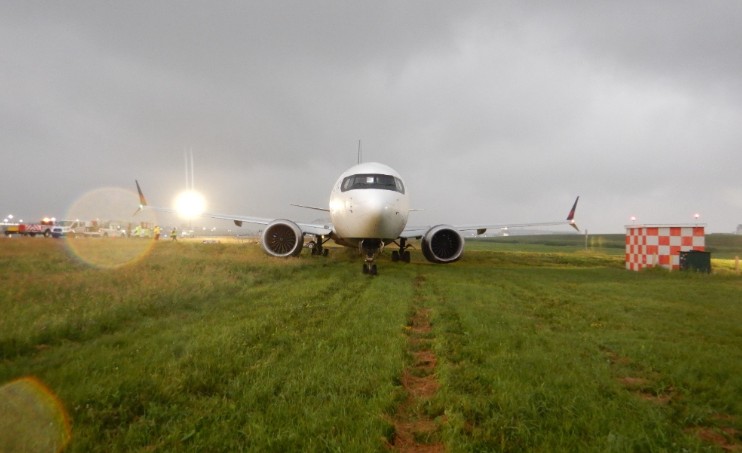
Download high-resolution photos from the TSB Flickr page.
Class of investigation
This is a class 3 investigation. These investigations analyze a small number of safety issues, and may result in recommendations. Class 3 investigations are generally completed within 450 days. For more information, see the Policy on Occurrence Classification.
TSB investigation process
There are 3 phases to a TSB investigation
- Field phase: a team of investigators examines the occurrence site and wreckage, interviews witnesses and collects pertinent information.
- Examination and analysis phase: the TSB reviews pertinent records, tests components of the wreckage in the lab, determines the sequence of events and identifies safety deficiencies. When safety deficiencies are suspected or confirmed, the TSB advises the appropriate authority without waiting until publication of the final report.
- Report phase: a confidential draft report is approved by the Board and sent to persons and corporations who are directly concerned by the report. They then have the opportunity to dispute or correct information they believe to be incorrect. The Board considers all representations before approving the final report, which is subsequently released to the public.
For more information, see our Investigation process page.
The TSB is an independent agency that investigates air, marine, pipeline, and rail transportation occurrences. Its sole aim is the advancement of transportation safety. It is not the function of the Board to assign fault or determine civil or criminal liability.