
Main-track train derailment
Canadian Pacific Railway Company, doing business as CPKC
Freight train 119-02
Mile 65.8, Brooks Subdivision
Near Brooks, Alberta
The Transportation Safety Board of Canada (TSB) investigated this occurrence for the purpose of advancing transportation safety. It is not the function of the Board to assign fault or determine civil or criminal liability. This report is not created for use in the context of legal, disciplinary or other proceedings. See Ownership and use of content. Masculine pronouns and position titles may be used to signify all genders to comply with the Canadian Transportation Accident Investigation and Safety Board Act (S.C. 1989, c. 3).
Summary
On 05 February 2024, at approximately 1624 Mountain Standard Time, mixed-merchandise freight train 119-02 of the Canadian Pacific Railway Company, doing business as CPKC, was proceeding westward on the Brooks Subdivision at about 53 mph when the trailing head-end locomotive and 17 intermodal cars (41 platforms) derailed at Mile 65.8 near Brooks, Alberta. Some of the derailed cars were carrying dangerous goods but did not breach. There were no injuries.
1.0 Factual information
1.1 The occurrence
Under section 28 of the Canadian Transportation Accident Investigation and Safety Board Act, every on-board recording is privileged. However, the TSB may make use of any on-board recording where it is necessary in the interests of transportation safety. For this reason, while the Board may refer to an on-board recording where required to support a finding and identify a substantive safety deficiency, other parties may not access or use privileged on-board recordings.
The reason for protecting on-board recordings lies in the premise that the privilege of a recording respects the privacy of operating personnel whose words and actions are captured on the recording and will also help ensure that this essential material is available for the benefit of safety investigations.
This report references content from a Locomotive Voice and Video Recorder (LVVR), which is a form of on-board recording in the rail transportation sector. For each of these references, the TSB is using the LVVR recording to substantiate some of its findings and to identify certain substantive safety deficiencies. In each case, the material has been carefully examined to ensure that the extracts used are necessary to identify causes or contributing factors of this occurrence or to identify safety deficiencies.
On 02 February 2024, mixed-merchandise freight train 119-02 of the Canadian Pacific Railway Company, doing business as CPKC, departed Montréal, Quebec, destined for Edmonton, Alberta.
On 04 February 2024, while the train was proceeding on the Ignace Subdivision in Ontario, a track engineering foreman on the wayside noticed that smoke was emanating from a traction motor on the trailing head-end locomotive (KCS 4767) and informed the train crew.
The crew determined that the smoke was coming from the locomotive’s traction motor #4. As a precautionary measure, the locomotive engineer (LE) isolated the locomotive.
The LE called the rail traffic controller (RTC) to report the situation and enquire whether he should stop the train, which was on the single main track. The RTC consulted with his immediate supervisor, the director of operations, and it was decided that the train should be brought to a stop at its current location. The RTC instructed the LE to inspect the locomotive for oil leakage or flame, to check that the axle was not locking, and to contact the designated mechanical authority—in this instance, the supervisor mechanical (locomotive), abbreviated to SML, in Winnipeg, Manitoba.Section 1.3 of CPKC’s General Operation Instructions (revised 06 September 2018) requires locomotive engineers (LEs) to inform mechanical facilities of locomotive failures and be governed by their instructions.
The LE stopped the train and inspected the locomotive as instructed. He then contacted the RTC again and indicated that he had tried to get in contact with the SML but had received no answer.
About 5 minutes later, the crew received a call from the director of operations, who indicated that, as long as the traction motor was cut outWhen a traction motor is cut out, the supply of current to the motor is disabled, rendering the motor incapable of generating either tractive or dynamic braking effort. and the smoke was dissipating, it should be fine to move the train to the next siding (Charlotte, about 6 miles further) so that it would not block traffic on the main track. The director of operations also mentioned that he would ask the SML to contact the crew.
The LE went to the cab on locomotive KCS 4767 to cut out the traction motor, which involved changing the setting of a toggle switch on the control monitor—individual traction motors can be cut out using either a TMCO or a SSCO toggle switch.The TMCO toggle switches, numbered 1 through 6 (one for each traction motor), control the setting (“In” or “Out”) of each traction motor individually (i.e., setting the TMCO 4 toggle switch to the “Out” position cuts out traction motor #4). The SSCO toggle switches, also numbered 1 through 6, control the settings of individual traction motors and their corresponding speed sensor in a single operation (i.e., setting the SSCO 4 toggle switch to the “Out” position cuts out both traction motor #4 and its corresponding speed sensor—it is not possible to cut out a speed sensor without also cutting out its traction motor). If an SSCO toggle switch is set to the “Out” position, both the traction motor and speed sensor will but cut out, regardless of the position of the TMCO toggle switch for that traction motor. The interface for cutting out traction motors and speed sensors is further discussed in section 1.17.2. In this report, cutting out a speed sensor refers to the task of using an SSCO toggle switch to cut out a traction motor and its speed sensor in a single operation. He set the TMCO 4 and TMCO 5 toggle switches to the “Out” position. He then alternated the SSCO 4 and SSCO 5 toggle switches between the “In” and “Out” position a few times, but he eventually left them set to the “In” position. These operations resulted in traction motors #4 and #5 being cut out (the LE cut out traction motor #5 as a precaution), but not their corresponding speed sensors.A speed sensor on a traction motor is designed to monitor rotational velocity of the wheel set axle and to alert locomotive engineers of potential issues with the axle, such as wheel slip, pinion slip, or locked axle. The LE returned to the lead locomotive, at which point he received a call from the SML.
The LE informed the SML of the situation and mentioned that he had cut out traction motors #4 and #5 and that the smoke was dissipating. He also indicated that he had inspected the locomotive, there was a little bit of oil around the traction motor, the axle was not locking and was rotating properly when the locomotive was slightly moved. The SML asked the crew to stand by.
After consulting with his immediate supervisor, the assistant superintendent, who was off-site, the SML came back on the call. He confirmed that the LE’s actions were correct, except that the locomotive did not need to be isolated. He also indicated that the crew could proceed with the trip but should monitor the situation. The LE then asked whether the speed sensors should also be cut out (i.e., whether the SSCO 4 and SSCO 5 toggle switches should be set to the “Out” position); the SML left the decision to the LE. The LE told the SML that he would cut them out; the SML did not object. The conversation ended and the LE returned to locomotive KCS 4767, set the SSCO 4 and SSCO 5 toggle switches to the “Out” position, and brought the locomotive back online.
The LE returned to the lead locomotive and resumed the trip. He called the RTC to inform him that the train was on its way, having received authorization from the designated mechanical authority to keep going.
To inform the subsequent crews of the situation, the LE wrote on the Crew Information Form that he had cut out traction motors #4 and #5, but he did not mention the speed sensors. For his part, the SML made an entry in the Locomotive Maintenance User InterfaceThe Locomotive Maintenance User Interface (LMUI) is a standalone application used primarily to document important mechanical and maintenance information for record-keeping purposes. It is also used by mechanical maintenance personnel for planning and follow-up repair work, as required. The recorded information can inform subsequent decision making by maintenance employees; however, it is not linked to, or fed into, in-service safety monitoring systems used by the railway for operational purposes (such as wayside inspection systems). application to document the traction motor issue; in the description, he mentioned the smoke and indicated that traction motors #4 and #5 were cut out, but he made no mention of the speed sensors.
The train continued westward, with several crew changes along the way. It passed by a locomotive maintenance facility in Winnipeg and again in Moose Jaw, Saskatchewan, but did not stop for inspection or repairs as it was not identified as needing either.
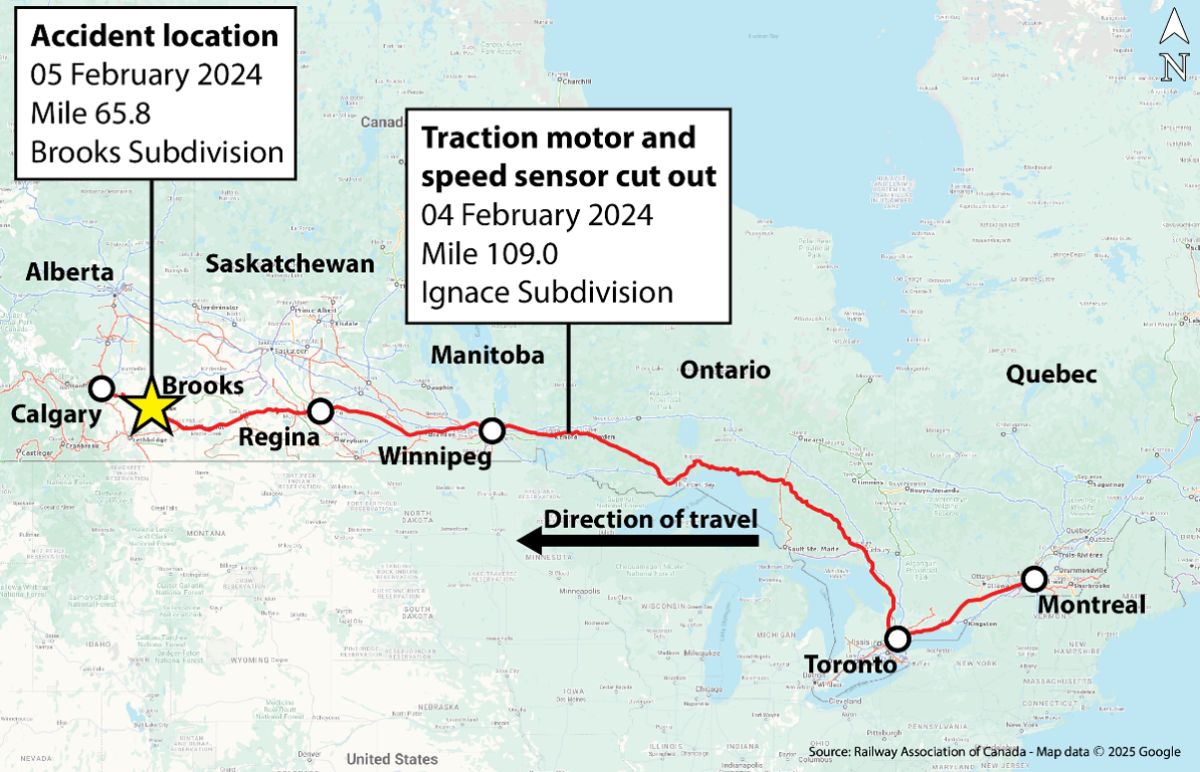
On 05 February 2024 at approximately 1624,All times are Mountain Standard Time. the train was proceeding westward on the Brooks Subdivision at about 53 mph when a train-initiated emergency brake application occurred at Mile 65.8, near Brooks, Alberta (Figure 1). Upon inspection, it was determined that the trailing head-end locomotive had derailed, as well as the first 17 rail cars (all were intermodal cars, for a total of 41 platforms). Some of the derailed cars were carrying dangerous goods but did not breach or release their contents. No one was injured.
At the time of the accident, the temperature was about –12 °C, and the sky was clear.
1.2 Site examination
The cars had derailed in an accordion fashion (Figure 2).
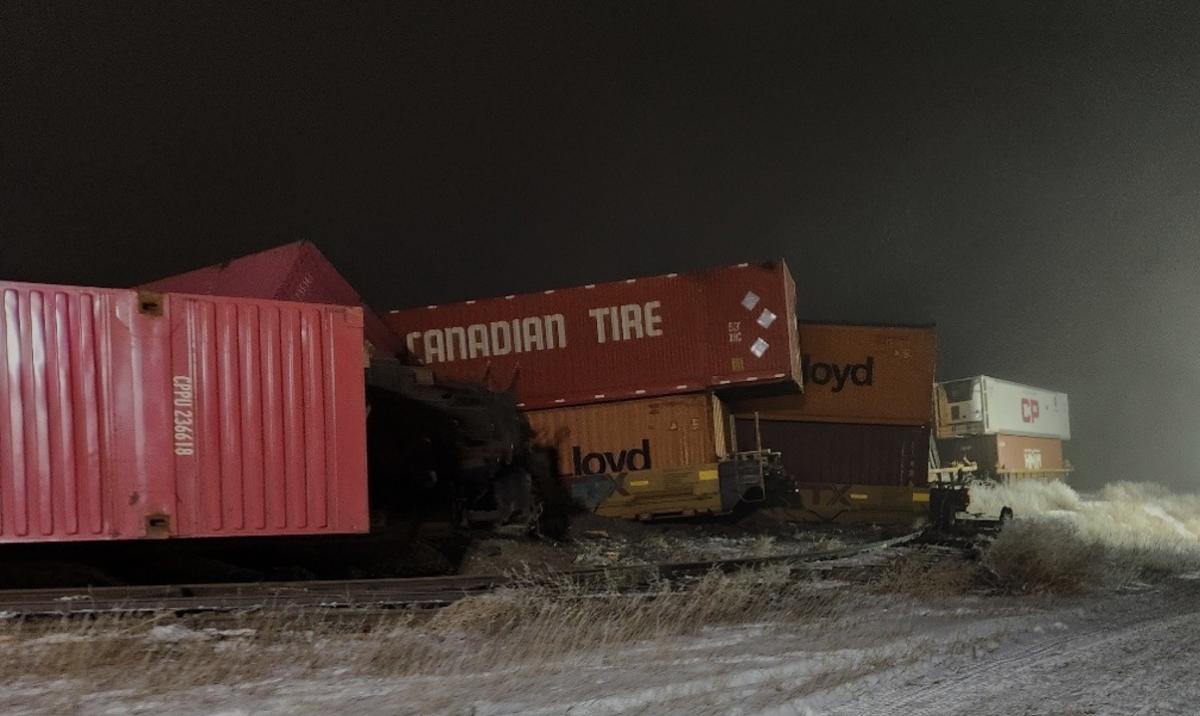
The investigation could not determine with certainty the derailment sequence. A number of broken rails were observed in the area where the train derailed. Inspection of about 3000 feet of track to the east of the derailment site revealed indications of wheels sliding on the rail head surface.
Further inspection of the train revealed that both wheels of the #4 wheel set on locomotive KCS 4767 had significant damage (Figure 3), consistent with an axle not freely rotating and intermittently locking up.
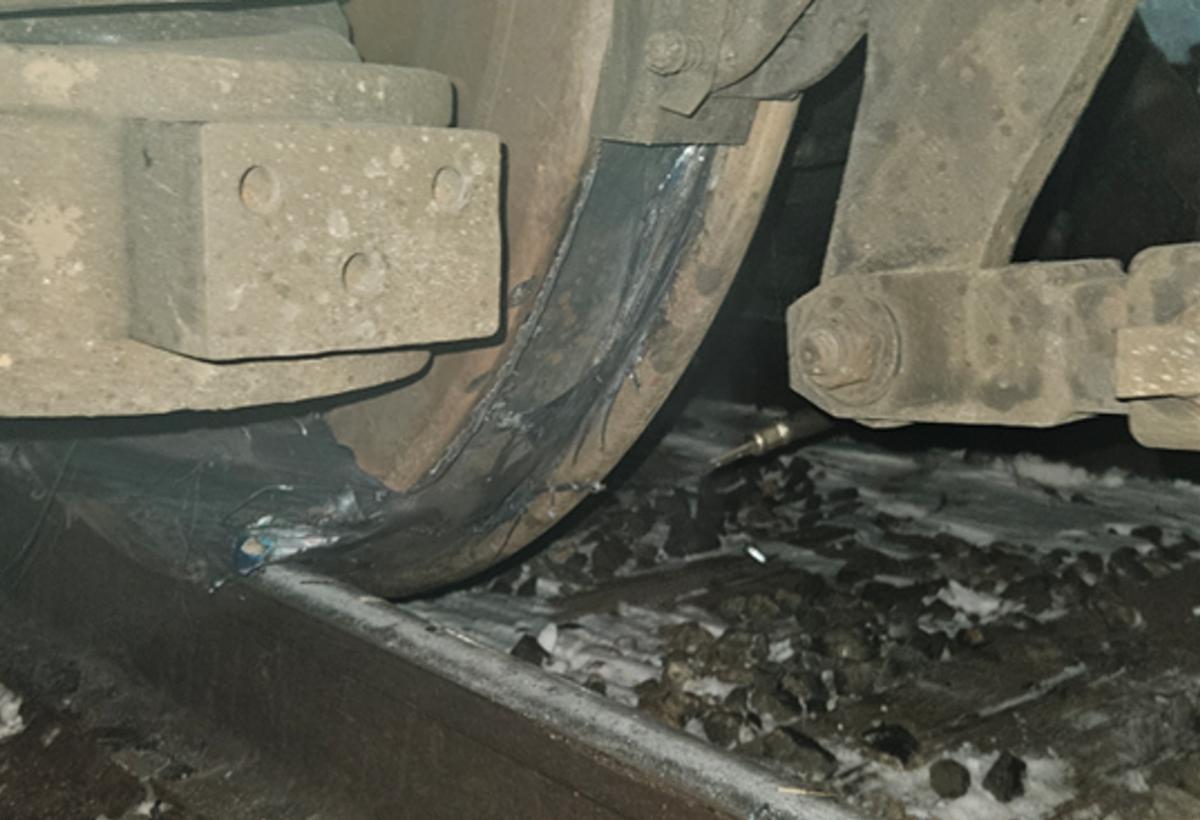
CPKC removed wheel set and traction motor assembly #4 from locomotive KCS 4767 for further examination at its repair facility in Calgary, Alberta.
1.3 Train information
At the time of the accident, the train consisted of 3 locomotives (2 at the head end and 1 in a mid-train position) and 97 rail cars (50 loaded cars and 47 empty cars). It measured 9837 feet and weighed 8859 tons. Locomotive KCS 4767, the trailing head-end locomotive, was oriented facing the rear of the train.
Locomotive KCS 4767 is a GE ES44AC series locomotive. It was manufactured in 2011 in Erie, Pennsylvania, United States, by GE Transportation. It has a 12-cylinder, 4-stroke diesel engine providing 4400 horsepower, and 6 electric alternating current traction motors. These traction motors, along with their associated axles, are numbered 1 to 6 from the front cab to the rear of the locomotive.
1.4 Personnel information
1.4.1 Train crew
The crew that was operating the train on the Ignace Subdivision and cut out the traction motors and speed sensors on locomotive KCS 4767 after it experienced a traction motor issue consisted of an LE and a conductor. Both crew members were familiar with the territory.
The LE had 20 years of work experience with CPKC, including approximately 12 years as a qualified LE, primarily operating on the Keewatin and Ignace subdivisions.
The conductor joined CPKC in October 2022 and qualified in February 2023.
According to the data collected during the investigation, the crew’s performance was not negatively affected by medical or physiological factors, including fatigue.
1.4.2 Supervisor mechanical (locomotive)
The SML started at CPKC in Winnipeg on 27 November 2023. At the time of the occurrence, he had held this position for about 2 months. Before being hired at CPKC, he had been a conductor at Canadian National Railway Company for 1 year. He had not worked in the railway industry before then.
According to the data collected during the investigation, the performance of the SML was not negatively affected by medical or physiological factors, including fatigue.
1.5 Subdivision and track information
The Brooks Subdivision extends from Mile 0.0 (Medicine Hat, Alberta) to Mile 175.8 (Calgary). Train movements are governed by the centralized traffic control system, as authorized by the Canadian Rail Operating Rules, and dispatched by an RTC located in Calgary.
1.6 Recorded information
1.6.1 Fault log for locomotive KCS 4767
Modern locomotives use automated systems to perform self-diagnosis of issues en route. The results are stored in a fault log. Fault logs may be reviewed off-line by mechanical personnel to identify main component faults or to plan maintenance activities.
Some issues identified through self-diagnosis are addressed through an automated response (such as isolating the faulty component). Others, like a locked axle, trigger an alarm to alert the LE. Still others do not initiate a response but are recorded for future review by maintenance personnel.
As part of the investigation, the fault log for locomotive KCS 4767 was reviewed. The data indicate that the first fault related to traction motor #4, a ground relay fault,A ground relay fault on a locomotive occurs when electrical current unintentionally flows from a circuit to the grounded frame of the locomotive. This can result from insulation failures, damaged wiring, or moisture intrusion, and poses risks such as electrical shock, equipment damage, or fire. was recorded at 1237 on 04 February, 32 hours before the accident. In this instance, the motor was automatically cut out and the severity level of the ground relay fault was recorded, but the fault was not displayed to the LE.
The data also showed that, when the train was stopped on the Ignace Subdivision, the motor and speed sensor for traction motors #4 and #5 were manually cut out and cut in a few times from locomotive KCS 4767 before being left cut out.
1.6.2 Wheel temperature detectors
Railways set their own thresholds for determining whether a freight car wheel is considered cold, warm, or hot, and they provide their own procedures on how to respond to these conditions. There are no thresholds for locomotive wheels; however, high temperature readings on locomotive wheels can be an indicator that an axle is not rotating freely.
A review of the data from the wheel temperature detectors on the Brooks Subdivision in the hours preceding the derailment indicates that the wheels on the #4 axle of locomotive KCS 4767 had significantly higher temperatures than the 10 other wheels on the locomotive (Table 1). The elevated temperatures for the #4 axle are consistent with the axle not rotating freely and the wheels locking up.
Mile | Wheel temperature (°F) | ||
|---|---|---|---|
L4 | R4 | Other wheels | |
11.6 | 284 | 282 | 24 to 44 |
30.8* | 126 | 70 | 24 to 44 |
50.7 | 302 | 254 | 14 to 30 |
* Shortly before passing by the detector at Mile 30.8, the train had stopped in Suffield (Mile 26.5) for about 20 minutes, which explains why the temperature readings were lower at this location for the L4/R4 wheels. The temperature of the other wheels did not drop because these wheels were already near ambient temperature. (On a wheel set in good condition, in the absence of any braking, the temperature of the wheels in motion will be slightly greater than the ambient temperature due to the contact pressure and friction that exists at the wheel-rail interface.)
1.7 Examination of the wheel set and traction motor assembly #4 for locomotive KCS 4767
On 06 February, CPKC examined the recovered wheel set and traction motor assembly #4 for locomotive KCS 4767 at its repair facility in Calgary. The TSB later examined the traction motor components and reviewed CPKC’s findings.
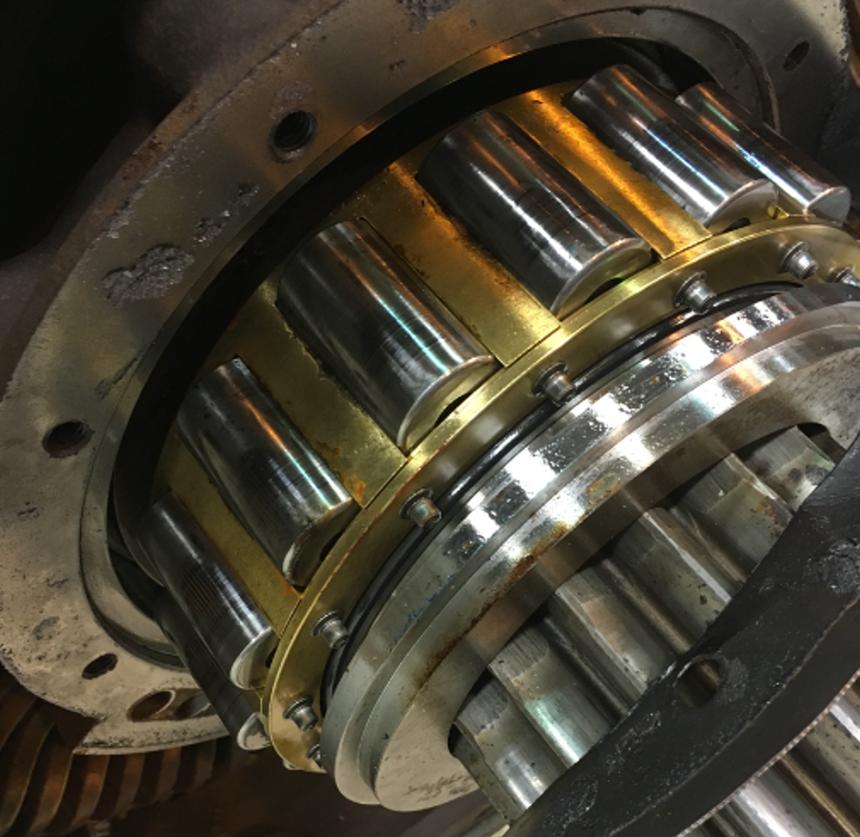
The gearcase on traction motor #4 was found to have little oil, with residue inside the bottom half of the gearcase. The pinion-end bore seal on the traction motor was also pinched. The pinched seal led to the gradual depletion of the gearcase oil, depriving the pinion-end bearing—a component that supports the rotor—of lubricant and eventually causing it to seize. Figure 4 shows a pinion-end bearing.
According to CPKC’s report, there was an incorrectly sized gearcase mounting bolt on the traction motor (Figure 5), likely installed after a slow-speed (5.6 mph) derailment that occurred in Mexico in October 2023.According to CPKC, when a locomotive derails at a speed below 6 mph, a mechanical manager (or a person designated by the mechanical manager) must perform a full inspection on site. If no defect or exception is identified, the locomotive can be released into unrestricted service. (Source: CPKC, 3355 V1E, Locomotive Regulatory Training, DL 053-09 Derailed Locomotives (CP&FRA), Article II: Derailment below 6 MPH, p. 54) When the incorrectly sized bolt was installed, it pinched the seal and provided a path for the gearcase oil to leak.
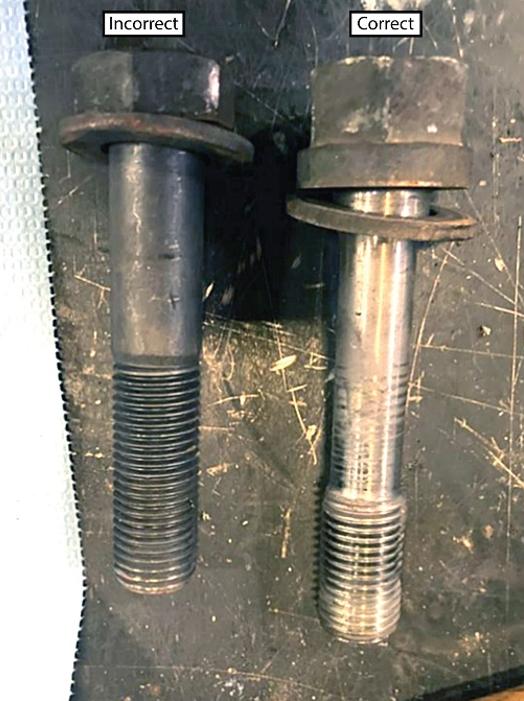
CPKC records do not indicate when the incorrect bolt was installed. However, in its conclusion, CPKC’s report indicated that the installation of the incorrect bolt likely took place during repairs after the slow-speed derailment in October 2023.
1.8 Inspections of locomotive KCS 4767 in the months preceding the derailment
1.8.1 Annual inspection
Locomotive KCS 4767 underwent an annual inspection by locomotive mechanical personnel on 03 November 2023, in a CPKC locomotive maintenance facility in San Luis Potosi, Mexico. This inspection took place a few days after the locomotive had been involved in the slow-speed derailment in October 2023.
With respect to traction motor #4, the oil level in the gearcase was checked and found to be low; 3 quarts of oil (approximately 30%) were added. There is no indication that the low oil level prompted a closer inspection of the traction motor or that the gearcase was found to be leaking oil. The inspection also did not identify the incorrect gearcase mounting bolt.
1.8.2 Pre-departure inspection
Locomotive KCS 4767 underwent a pre-departure inspection on 02 February 2024 in Montréal, which included a ground-level visual inspection of the trucks and running gear. There is no indication that the inspection revealed a leaky gearcase on traction motor #4. A traction motor gearcase is located inboard behind the wheels and is not clearly visible from the outboard side of the locomotive. Therefore, a leaky gearcase is unlikely to be detected through a pre-departure inspection.
1.9 CPKC instructions for cutting out traction motors and speed sensors
1.9.1 Instructions to train crews
Historically, CPKC’s General Operating Instructions (GOI) provided LEs with instructions regarding the task of cutting out traction motors and speed sensors.
The 2009 version included instructions for locomotives in the GE AC and the EMD SD90MAC series (locomotive KCS 4767 is a GE AC series locomotive). Different instructions are required because the interface used to cut out traction motors and speed sensors varies between locomotive models.Although the interface varies between locomotive models, the basic functionality of traction motor and speed sensor cut-out switches is the same for all diesel locomotives.
The instructions for GE AC locomotives stated, in part:
28.4 Locked Axle Protection GE AC Locomotives – Conventional or Distr Pwr Operations
Traction Motor Cut-Out Switch
If one or more traction motors are manually or automatically CUT-OUT but their speed sensors are all CUT-IN, then the locomotive may continue to operate in the lead or remote consist. Even if ISOLATED, it may remain in mid-train location. […]
Speed Sensor Cut-Out Switch This switch may be placed in the CUT-OUT position only when advised to do so by the Central Locomotive Specialist. This switch is used to cut-out a faulty traction motor speed sensor, but the corresponding traction motor MUST be cut-out as well. Speed Sensor Failure
[…]
However, if any TM [traction motor] is cut out, or if the locomotive is ISOLATED, or if the speed sensor is cut-out, then the defective locomotive may be moved to a maintenance facility at a speed not exceeding 30 MPH, marshalled in the lead consist to enable close observation. The locomotive engineer must update the Crew to Crew Form accordingly.Canadian Pacific Railway Company (CPKC), General Operating Instructions (06 July 2009, section 15: Locomotive and Train Operations, subsection 28.4, p. 199.
These instructions were removed from the next iteration of the GOI, released in 2013. The GOI in effect at the time of the occurrence, dated 2021, did not contain instructions for train crews on how to interact with the locomotive control monitor to cut out traction motors and speed sensors.
In the absence of CPKC-specific instructions, when interacting with the locomotive control monitor, LEs must rely on the information presented on the screen to understand the traction motor and speed sensor cut-out functions. More information about the control monitor and its interface as found on GE ES44AC series locomotives is provided in section 1.17.2.
CPKC’s LE training provides general instructions on traction motors and corresponding speed sensors. LEs are not provided with detailed instructions on these components and are not expected to have an in-depth understanding of their operation. In case of locomotive failures or defects, the LE must inform mechanical personnel and be governed by their instructions.
1.9.2 Instructions to mechanical personnel
When a locomotive experiences an equipment issue or fault condition in the field, a designated mechanical authority (in this occurrence, the SML in Winnipeg) is available to help the train crew with troubleshooting. In carrying out this role, employees who serve as designated mechanical authority rely on their experience and knowledge of locomotives and can refer to available troubleshooting support documents.
In CPKC locomotive maintenance facilities, mechanical personnel have access to 2 main sources of information for troubleshooting locomotives: a document known as the Locomotive Knowledge Base, and bulletins issued by CPKC referred to collectively as the maintenance regulations (these bulletins are not regulatory instruments).
1.9.2.1 Locomotive Knowledge Base
The Locomotive Knowledge Base is a large document that collates information from various sources. It provides troubleshooting information on several components, such as air brakes, end-of-train devices, and trip optimizer; this information is mostly focused on locomotives in the GE ES44AC and AC4400CW series.
With regards to traction motor and speed sensor toggle switches on GE ES44AC locomotives, the document refers to the “Switches” screen on the monitor. In particular, it indicates that
- the “Motor Cutout” option provides access to the “Motor and Speed Sensor Cutouts” screen,
- on the “Motor and Speed Sensor Cutouts” screen, the TMCO 1 to TMCO 6 toggle switches are used to cut out traction motors 1 to 6, and
- the SSCO 1 to SSCO 6 toggle switches are used to cut out the speed sensors for the corresponding traction motors 1 to 6.Canadian Pacific Railway Company, Locomotive Knowledge Base, section on ES44AC SDIS [Smart Display Integrated System] panel (last updated 29 September 2012), pp. 43–44.
No further information is provided about these toggle switches on ES44AC series locomotives, such as their purpose or the repercussions of changing the settings.
In contrast, the information provided for AC4400CW series locomotives is more detailed and specifically states that speed sensors are only to be cut out if they are faulty, and that cutting out a speed sensor removes wheel slip and locked axle protection for the corresponding traction motor:
Speed Sensor Cut–Out Switch
This switch (31) cuts out the Speed Sensor signal on all traction motors that are cut–out. This switch is only to be used to cut out faulty sensors; however, ensure that the sensor is at fault and not that it is indicating a locked axle or excessive wheel slip, etc. The sensor will only be cut out (even if switch has been thrown) if the motor cut–out switch has been thrown. Wheelslip and Locked Axle Protection are lost only for the traction motor that is cut out.Ibid, section on AC4400CW breaker panel (last updated 29 September 2012), pp. 16–17.
Several pages later, the document provides additional information on the traction motor and speed sensor cut-out features for AC4400CW locomotives. It states, in particular:
NOTE: Speed sensors do not need to be cut out on cut out motors. When the Motor Speed Sensor switch (Item 31) is in the CUT–OUT position, the speed signals from the speed sensors on all motors are ignored. […]Ibid, section on AC4400CW traction motor and speed sensor cut-outs (2012), p. 24.
Although the traction motor and speed sensor cut-out features work in a similar way on GE ES44AC and GE AC4400CW series of locomotives, the document does not specify this.
1.9.2.2 Maintenance regulations
At CPKC, the bulletins issued to mechanical personnel about locomotive maintenance are known collectively as the maintenance regulations.
As part of the investigation, the bulletins relevant to traction motors and speed sensors were reviewed.
None of the bulletins mention the toggle switches.
1.9.2.3 Instructions followed by the supervisor mechanical (locomotive)
The SML in this occurrence was not aware of the Locomotive Knowledge Base or the maintenance regulations, and hence he did not consult these references when discussing the locomotive’s traction motor issue with the train crew.
1.10 Procedures
A procedure is a detailed set of instructions for performing a specific task. Procedures improve operational safety, ensure consistency from one worker to the next, and reduce the risk of errors and omissions. It is important to tailor procedures to the knowledge level of the workers expected to execute the tasks.
Procedures can be supplemented with job aids, checklists, warnings, reminders, and visual aids such as flowcharts and pictures. These aids help workers perform tasks more efficiently by offering concise, easy-to-access information that supports the procedures.
1.11 Duties essential to safe railway operations
Under section 25 of the Railway Safety Management System Regulations, 2015 (SMS Regulations), railways are required to list the duties that are essential to safe railway operations, and the positions within the company that have the responsibility to perform those duties. Railways must also ensure that any employee who performs those duties has the required skills and qualifications to do so. Under section 27, a railway’s SMS must include a plan for ensuring that any employee who performs duties essential to safe railway operations has the required knowledge, skills, and qualifications.
In accordance with these requirements, CPKC has identified the positions responsible for performing duties essential to safe railway operations. The SML position is not included in this list.
1.12 Person in charge
Under the Railway Locomotive Inspection and Safety Rules, a person in charge is a certified person appointed by a railway company to ensure the safe conduct of an operation or the work of employees. The Rules do not specify training and qualification requirements for a person in charge. At CPKC, employees who have successfully completed the certification requirements for locomotive safety inspection are deemed qualified to act as persons in charge.
1.13 Supervisors mechanical (locomotive)
1.13.1 Role and responsibilities
At CPKC, the SML is responsible for planning and overseeing locomotive operations in maintenance facilities and yard environments. This position involves managing incoming and outgoing locomotives, addressing locomotive equipment issues or fault conditions, and ensuring all maintenance and repairs are conducted safely and efficiently according to company and regulatory standards.
Key responsibilities include scheduling a workforce, responding to locomotive equipment issues reported by train crews, and making decisions on whether locomotives are ready for operation or require further maintenance. The SML also conducts safety briefings, documents locomotive equipment issues and safety incidents, and investigates corrective actions.
The SML must communicate with management, work with unionized employees, and ensure compliance with labour agreements.
Although, CPKC requires a person in this position to have a strong understanding of locomotive systems to assess operational needs, it does not require them to have repair experience. Essential qualifications include a high school diploma or a mechanical trade certification, along with proficiency in railway operations, knowledge of CPKC systems, and strong mechanical, electrical, and planning aptitude.
When uncertain on how to resolve a specific locomotive problem, SMLs can seek advice from their immediate supervisor or other experienced personnel.
1.13.2 Training program
CPKC has an onboarding timeline for new hires in locomotive maintenance facilities. New hires can perform the regular duties of their position while completing the training modules, with the exception of any duty requiring that a certification first be obtained, such as certifications in utility vehicle safety, locomotive safety inspection, and forklift operation. There are no certification requirements for responding to calls from train crews for troubleshooting locomotive equipment issues or fault conditions.
For new hires in a managerial position, such as SML, the timeline is as follows:
- First 2 weeks: general onboarding information covering topics such as the CPKC organizational structure, policies, compensation, and the Home Safe program CPKC’s Home Safe program is an initiative that promotes safety engagement and feedback by instilling the importance of employees taking responsibility for their own safety as well as the safety of their co-workers.
- First month: 57 training modules (a combination of in-class training and online courses) covering safety and the basics of locomotive maintenance facilities, including forklift and crane use, safety protocols, and locomotive safety inspection
- 1 to 3 months: safety training and consequence leadership training
- 3 to 6 months: 28 modules (a combination of in-class training and online courses) on the various aspects of locomotives, which is essential to fulfill the locomotive troubleshooting responsibilities associated with the SML position. This component of the training program covers subjects such as locomotive mechanical and electrical theory, electronic air brake systems, and diesel engine basics. It also includes 7 to 8 weeks of on-the-job training (OJT), which encompasses the following:
- 4 weeks practising the functions related to locomotive maintenance planning (2 weeks in dispatching and 2 weeks in the locomotive maintenance facility)
- 1 to 2 weeks with tradesmen for familiarization with the various aspects of locomotive maintenance and repair
- 1 week orientation at another locomotive maintenance facility
- 6 to 12 months: courses on remote control locomotive systems, distributed power, and positive train control, as well as more OJT. OJT includes the following:
- 2 weeks in the shop track operation centre, at the end of which trainees are expected to pass a written test and demonstrate that they have obtained the necessary skills to safely operate locomotives within maintenance facility limits
- 1 day with a trainmaster for exposure to train operations
- 1 day with engineering personnel for exposure to track inspection and maintenance
Formal mentoring programs offer practical insights and guidance that structured training alone cannot provide. However, there is no formal mentoring program at CPKC where inexperienced SMLs are paired with experienced colleagues.
1.13.2.1 Training of the Supervisor mechanical (locomotive) in this occurrence
The training of the SML began on 27 November 2023, his first day on the job.
The original plan was for him to be in full-time training for the first 3 weeks. However, due to workforce shortages, he was in full-time training for only 2 of these 3 weeks. During these initial 2 weeks, he received general onboarding information and completed 30 of the 57 training modules on safety and the basics of locomotive maintenance facilities, including the required certification on locomotive safety inspection.
During his third week, the SML performed the regular duties of his position and was expected to continue taking the training modules as time allowed. During that week, he completed another 9 modules.
Over the next 2 weeks, the SML received OJT for the dispatching aspects of his responsibilities. He did not complete in-class or online training modules during that time. At the 1-month mark, he had therefore taken 39 of the 57 modules.
After the 2 weeks of OJT, the SML performed the regular duties of his position and continued taking the training modules as time allowed.
The SML worked independently for the first time after 5 weeks of training. In comparison, his immediate supervisor, who had received his training 3 years before the occurrence, had received about 4 to 6 months of OJT before he performed the duties of SML on his own.
When the LE contacted him on the day before the accident, the SML had completed 39 out of 57 training modules, covering safety and the basics of locomotive maintenance facilities, and only 2 weeks of OJT.
1.14 Learning and competency continuum
There are several established and recognized models to describe skill acquisition. According to one of them, the Dreyfus model, when learning a role, competence will develop along the following 5-stage continuum:S. E. Dreyfus and H. L. Dreyfus, Mind over Machine: The Power of Human Intuition and Expertise in the Era of the Computer (The Free Press New York, 1986), pp. 16–51.
- Novice: Learners have limited or no experience in the task environment. They rely heavily on rules and guidelines to perform tasks. Novices require clear and specific instructions to proceed and may have difficulty adapting to new or unexpected situations.
- Advanced beginner: Learners have gained a basic understanding of the fundamental concepts and principles. Advanced beginners can perform tasks with less guidance but still require structured support.
- Competent: Learners have developed a deeper understanding of the task environment. They become more efficient and organized in their approach, prioritizing relevant information, and making informed decisions.
- Proficient: Learners are experienced in the task environment. They possess a broad understanding of the principles and concepts and can effortlessly apply them in various contexts.
- Expert: Learners know what to do based on mature and practised understanding. Experts have a comprehensive understanding of the task environment, often characterized by intuitive and automatic decision making. They can adapt their approach based on the specific circumstances.
In moving across this continuum, learners proceed through a series of predictable stages where time and effort required to reach each stage can vary depending on the learner and the learning environment. When a minimal level of competence is attained, learners can be at a stage where tasks may be performed effectively but require a significant level of attentional resources. As learners become proficient or expert, tasks become more automatic and require fewer attentional resources. Practice, experience, and feedback are important factors that contribute to skill development and the progression toward expertise.
The 2 months between the start of his training and the LE’s call left the SML with very limited operational experience. He was at the novice stage of competency development for troubleshooting locomotive equipment issues.
1.15 Central locomotive specialist position
At CPKC, troubleshooting locomotive equipment issues was historically the responsibility of the Locomotive Help Desk, a group comprised of central locomotive specialists. Central locomotive specialists were highly trained and experienced in all technical aspects of locomotive operations, including the complex locomotive system interactions. They were skilled at troubleshooting and invariably had many years of hands-on experience with locomotives. They were centralized in the railway company’s operations centre and provided support across its network, rather than being assigned to a specific region.
In the 2014–2015 timeframe, CPKC eliminated the position of central locomotive specialists. The responsibilities of central locomotive specialists were transferred to SMLs, who are regional personnel primarily responsible for locomotive management in maintenance facilities and yards. SMLs are not required to have the same depth of locomotive-specific expertise or experience as central locomotive specialists. No specialized locomotive training was provided to bridge the technical difference in knowledge and experience that existed between the 2 positions.
The central locomotive specialist position continues to exist at other railway companies.
1.15.1 Risk assessment related to the elimination of the central locomotive specialist position
Risk assessments are a cornerstone of a fully effective safety management system (SMS). SMS is an internationally recognized framework that allows companies to identify hazards, manage risks, and make operations safer—ideally before an accident occurs. An SMS improves safety by building on existing processes, demonstrating corporate due diligence, and growing the overall safety culture.
The SMS framework has been part of Canadian railway operations since 2001, when SMS regulations were first introduced. These regulations required that railway companies have a process for identifying safety issues and concerns, including significant changes to railway operations, as well as a process for evaluating risks and classifying them by means of a risk assessment.Transport Canada, SOR/2001-37, Railway Safety Management System Regulations, section 2, paragraph (e), at https://laws-lois.justice.gc.ca/eng/Regulations/SOR-2001-37/20060322/P1TT3xt3.html (last accessed 29 January 2026). The 2001 SMS regulations did not clarify the circumstances under which risk assessments must be conducted. However, in 2010, Transport Canada published a guide on SMS to support railways in developing, implementing, and enhancing their SMS system.Transport Canada, A Guide for Developing, Implementing and Enhancing Railway Safety Management Systems (TP 15058E), November 2010, at https://publications.gc.ca/collections/collection_2010/tc/T33-23-2010-A-eng.pdf (last accessed on 29 January 2026) This guide stated, in particular, that risk assessments must be conducted when there are significant changes to operations. Although the guide provided some examples of what constitutes a significant change in railway operations, including major organizational transitions and major operational changes (such as new commuter lines and speed changes), the term was not defined in either the guide or the regulations. Based on these examples, the elimination of the central locomotive specialist position did not require a risk assessment.
In 2015, the SMS regulations were amended to explicitly require risk assessments when a proposed change to railway operations may affect the safety of the public or personnel, or the protection of property or the environment. Examples provided included changes to employee responsibilities and duties.
The elimination of the central locomotive specialist position
- reassigned safety-critical troubleshooting responsibilities from a small group of dedicated, highly specialized experts centralized in a Locomotive Help Desk function to a broader group of SMLs—employees who are not required to have in-depth mechanical knowledge of locomotive or repair experience—located across the network.
Under the 2015 SMS regulations, such changes require that a risk assessment be performed. However, this requirement is not retroactive and hence CPKC was not required to perform a risk assessment on the prior decision to eliminate the central locomotive specialist position.
1.16 Decision making and cognitive biases
Decision making in general is a cognitive process that involves identifying and choosing a course of action from several alternatives.American Psychological Association, APA Dictionary of Psychology, at https://dictionary.apa.org/decision-making (last accessed on 01 October 2025). Decision making can be defined as the correspondence between information and response,C. D. Wickens and J. G. Hollands, Engineering Psychology and Human Performance, third edition (Psychology Press, 1999), p. 294. involving 4 stages: gathering information, processing this information, making a decision, and then acting upon that decision. There are several factors that can affect decision making: for example, information gathered may be incorrect or incomplete; competing tasks may hinder the gathering and processing of information; or decision makers may be affected by cognitive biases when processing that information. These factors can result in the selection of a choice that is less than ideal.
Cognitive biases are unconscious and systematic errors in thinking that occur when people process and interpret information in their environment, influencing their decisions and judgments.S. Da Silva, R. Gupta and D. Monzani, “Editorial: Highlights in psychology: cognitive bias, Frontiers in Psychology, Vol. 14 (02 July 2023). One of these cognitive biases, called authority bias, is the tendency to attribute greater accuracy or credibility to an authority figure’s opinion, regardless of its actual content.J. E. Korteling and A. Toet, “Cognitive biases” in Encyclopedia of Behavioural Neuroscience, second edition. (Elsevier, 2022), pp. 610–619. This bias can also arise when someone is perceived as an authority figure or credible due to their title, attire, or the context in which they present information.R. B. Cialdini, Influence: The psychology of persuasion (Harper Collins, 2009), pp. 157–177. When someone is perceived as credible, others may automatically trust their opinion without thorough evaluation, particularly when time and resources are limited.
1.17 Human-machine interface design
Human-machine interface design involves developing systems that facilitate interaction between humans and machines. This entails developing both physical controls, like buttons, levers, and switches, and computer-based interfaces that enable operators to receive information and operate equipment.
1.17.1 Locomotive computer-based systems
In locomotive information technology, the human-machine interface serves as the connection between locomotive systems and the operator of those systems. It includes computer-based interfaces designed for monitoring and managing the locomotive. These interfaces present information about locomotive performance, diagnostics, and communications, enabling operators to make informed decisions and manage operational tasks.
The Human Factors Guidelines for Locomotive Cabs report,J. Multer, R. Rudich, and K. Yearwood, Human Factors Guidelines for Locomotive Cabs, U.S. Department of Transportation, Federal Railroad Administration, report DOT/FRA/ORD-98/03 (November 1998). produced by the U.S. Federal Railroad Administration, is a comprehensive guide aimed at improving the working conditions and safety within locomotive cabs. Developed through extensive research and industry consultation, it focuses on human factors design considerations and operational issues related to the locomotive cab environment, covering topics such as heating, noise, vibration, seating, visibility, and the integration of information technology.
Section 5 of the report specifies the following human factors design guidelines for computer-based systems:
- The layout of the system should engage the way the operator conceptualizes the operation of the system. Matching the representation of the system to the way the operator processes information makes it easier to learn.
- For systems with many choices, the designer must decide whether to display all the items on one screen or organize the information on several screens. Several principles may guide the designer, including organizing by logical grouping and frequency of use, chronological ordering, and importance of items.
- The amount of information should be minimized by only displaying what is necessary to the operator.
- Highlighting is an effective method for attracting the operator’s attention to critical items. A variety of techniques can be used to code information and vary the emphasis of that information. Critical, abnormal, or updated data should be highlighted using underlining, flashing, colour, shape, size, or brightness.
- Where possible, the system should be designed to prevent errors from occurring. The system should minimize the effect of errors by making them difficult to commit and by making it easy to recover from them when they do occur. The system should detect the error and offer simple comprehensible methods for handling the error.
- Error messages should be specific (task oriented), concise as possible, and written from the operator’s perspective. Use language that the operator will understand. The visual format and placement as well as the grammatical form, terms, and abbreviations should be consistent throughout the system. Use the active voice to tell the operator what needs to be done.
- Consistency is an essential element in developing ergonomically sound designs. Consistency in design facilitates learning and remembering how the system operates, reduces the likelihood of errors, and results in faster operation. Consistency in design helps the operator to better understand how the system works and maintain situational awareness regarding what the system is doing.
1.17.2 Control monitor on locomotives in the ES44AC series
Locomotives in the ES44AC series, such as locomotive KCS 4767, have a control monitor. To interface with the feature for managing the task of cutting out a traction motor and its speed sensor on this monitor, operators start by navigating to the “Switches” screen (Figure 6).
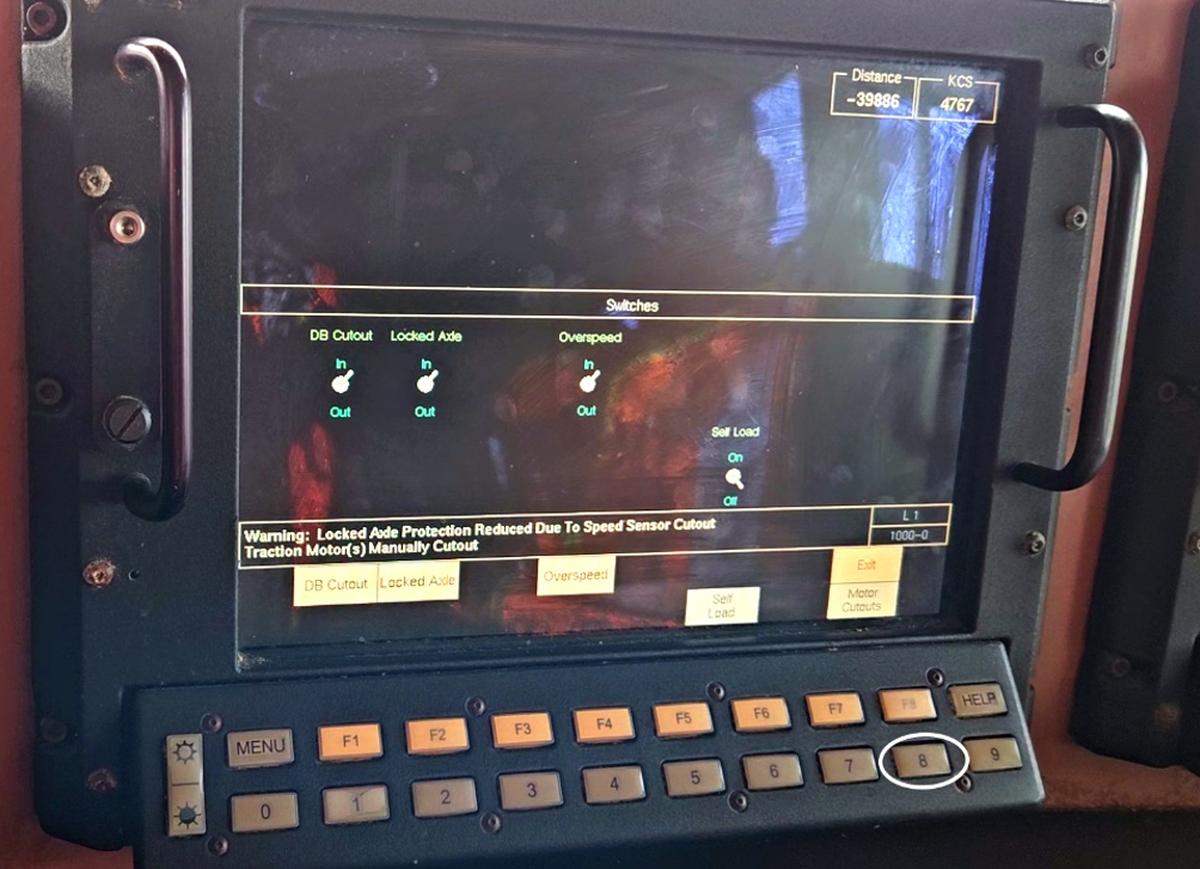
On the “Switches” screen, an option labelled “Motor Cutouts” provides access to the functionality for cutting out traction motors and speed sensors. To select this option, the operator must press the number 8 on the keyboard (the 8 hard key). This takes the operator to a screen labelled “Motor and Speed Sensor Cutouts” (Figure 7).
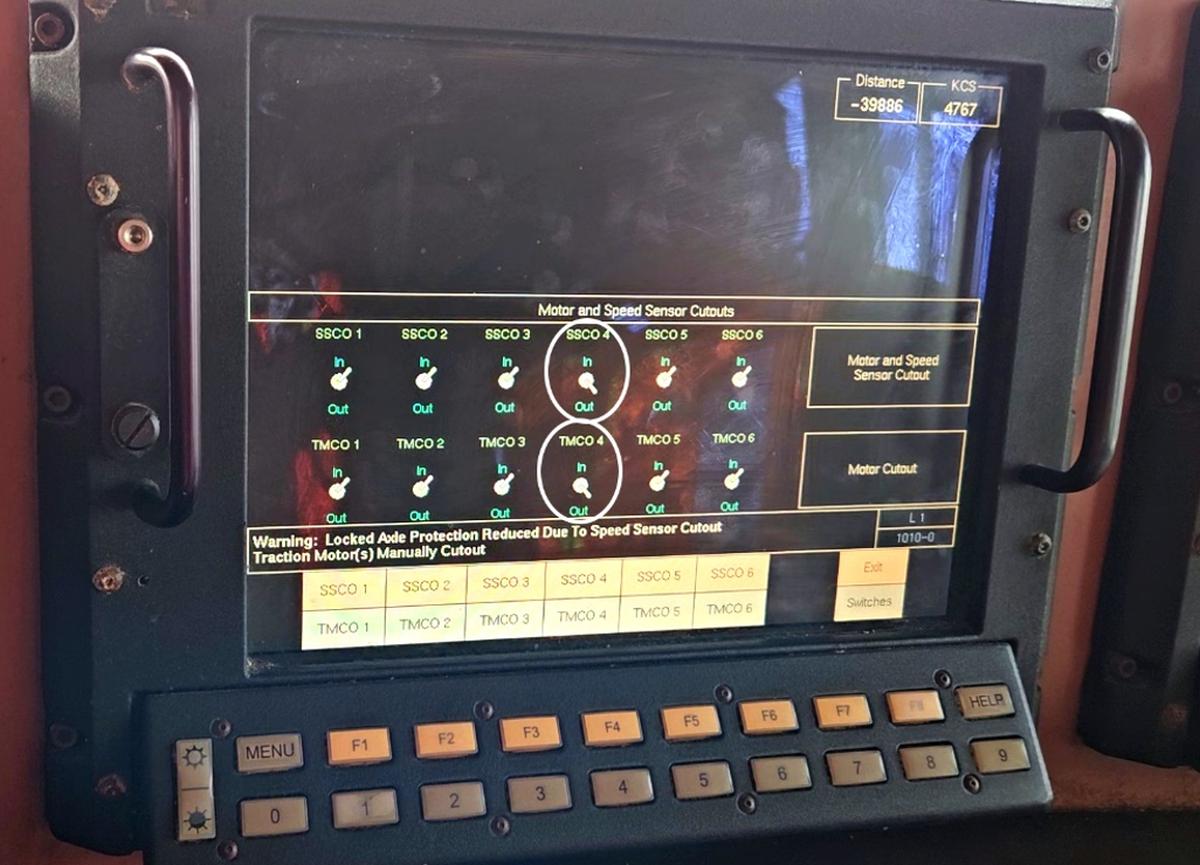
The “Motor and Speed Sensor Cutouts” screen displays the status of the motor cutout toggle switches in one row and the status of the motor and speed sensor cutout toggle switches in a separate row. The top row shows the toggle switches for each of the 6 speed sensors (SSCO 1 to SSCO 6), while the bottom row shows the toggle switches for each of the 6 traction motors (TMCO 1 to TMCO 6). The position of a toggle switch indicates the status of the component it represents: a switch pointing upward to the “In” position indicates that the component is cut in, while a switch pointing downward to the “Out” position indicates that the component is cut out. In Figure 7 above, the toggle switches for speed sensor #4 and corresponding traction motor #4 are pointing downward, indicating that they have been cut out.
To the right of each row of toggle switches, a text box provides additional information. The text box to the right of the SSCO toggle switches reads “Motor and Speed Sensor Cutout” while the text box to the right of the TMCO toggle switches reads “Motor Cutout.” This is to indicate that traction motors can be cut out independently of speed sensors, but cutting out a speed sensor automatically cuts out the corresponding traction motor.
The procedure to cut out a traction motor, or a speed sensor with the corresponding traction motor, is as follows:
- To cut out a traction motor, press the numbered key that corresponds to the traction motor. For example, press the 4 hard key to cut out traction motor #4.
- To cut out a speed sensor (and consequently the corresponding traction motor), press the numbered key prefixed with an F that corresponds to the speed sensor. For example, press the F4 hard key to cut out the combination of speed sensor #4 and traction motor #4.
The system will display a confirmation prompt; for instance, the prompt to confirm cutting out traction motor #6 reads “Cut out Tractor Motor 6?” (Figure 8). In response, the operator must press the F4 hard key for Yes (or F8 to Cancel).
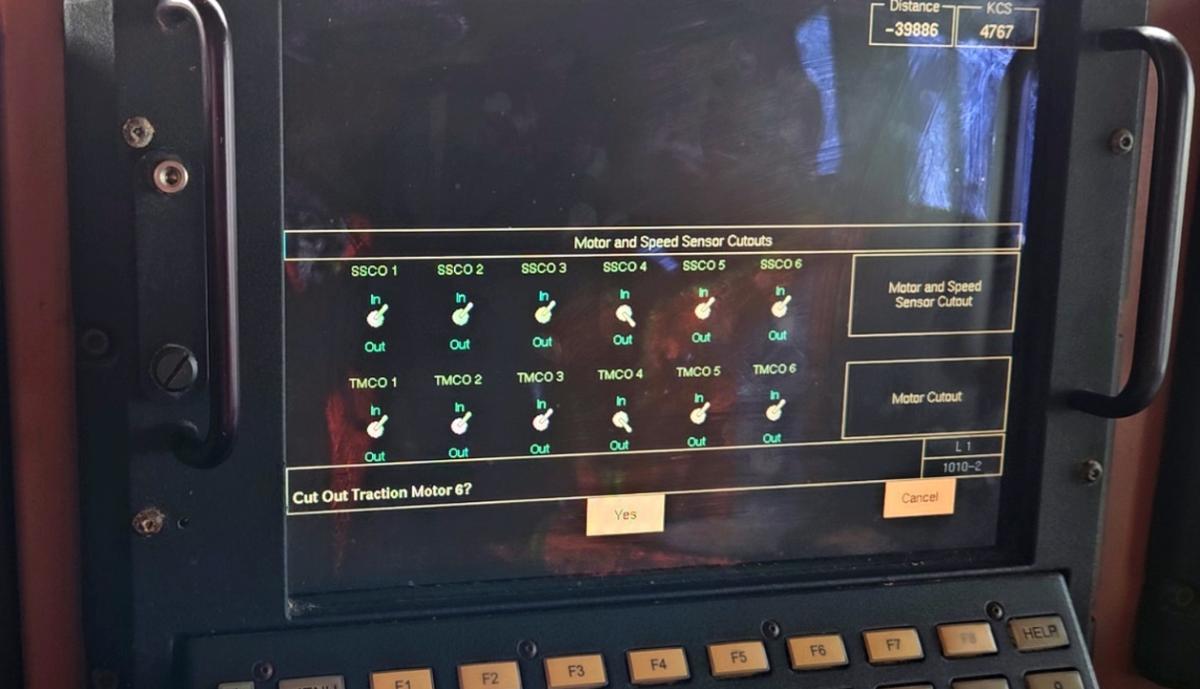
The operator can then review the screen to confirm that the selected component has been successfully cut out.
1.17.2.1 Warnings and contextual information
Warnings should be uniquely formatted and displayed before the associated action is taken.D. Wieringa, C. Moore, and V. Barnes, Procedure Writing, Principles and Practices, second edition (Battelle Press, 1998), pp. 151–160. On both the “Switches” and the “Motor and Speed Sensor Cutouts” screens, messages and warnings are presented in a text box at the bottom, without additional visual emphasis to capture the operator’s attention. The warning “Locked Axle Protection Reduced Due To Speed Sensor Cutout,” which informs the operator of the potential consequences of cutting out a speed sensor, is continuously displayed in the text box. The only exception occurs when the system displays a confirmation prompt for a cut-out operation. For the warning to be effective, it should be presented concurrently with the prompt.
Warnings should use active voice and negative imperative instructions for clear communication.Ibid. The wording of the warning is ambiguous. It can be misinterpreted to mean that the speed sensor has been cut out and hence the locked axle protection reduced, when, in reality, it is information to indicate that cutting out a speed sensor reduces locked axle protection. The warning uses the passive voice and does not explicitly alert the operator that speed sensors must not be cut out when dealing with traction motor issues or faults unrelated to the operation of the speed sensor.
Furthermore, the “Motor and Speed Sensor Cutouts” screen does not provide contextual information or a message prompt to inform operators about the specific cases requiring a speed sensor cut out, nor is there any safeguard in place to restrict access and prevent unintentional disabling of the wheel set’s locked axle protection—a safety-critical feature that is disabled when a speed sensor on a traction motor is cut out.
2.0 Analysis
The train (mixed-merchandise freight train 119-02 of the Canadian Pacific Railway Company, doing business as CPKC) was handled in accordance with regulations and company instructions. No track defects in the vicinity of the occurrence were found to be causal or contributory.
Post-occurrence inspection determined that the axle on the L4/R4 wheel set on the trailing head-end locomotive (KCS 4767) had locked, causing damage to the wheels. Locked axle protection is provided by a speed sensor on each traction motor; these sensors monitor the rotational velocity of the axles and are designed to alert locomotive engineers (LEs) if an axle locks.
On 04 February 2024, the day before the derailment, the train had to be stopped on the Ignace Subdivision in Ontario due to smoke emanating from traction motor #4 on locomotive KCS 4767. As part of the actions taken in response to this event, the speed sensor on traction motor #4 was cut out. Consequently, when a locked axle condition later developed on the locomotive, no alarm was emitted.
The analysis will focus on the following:
- factors affecting the performance of the supervisor mechanical (locomotive), abbreviated to SML, and the LE when they responded to the smoke emanating from locomotive KCS 4767 while the train was operating on the Ignace Subdivision;
- the SML training program;
- the elimination of the central locomotive specialist position;
- the absence of instructions on cutting out speed sensors on GE ES44AC series locomotives;
- the effectiveness of the interface design of the locomotive control monitor; and
- communications and dissemination of operational information.
2.1 The occurrence
On 05 February 2024, the train was proceeding westward on the Brooks Subdivision when the trailing head-end locomotive and the first 17 cars in the consist derailed around Mile 65.8 near Brooks, Alberta.
After the occurrence, it was determined that axle #4 of locomotive KCS 4767 had locked up, causing significant damage to the wheels, which led to a track failure and the derailment. Based on the site examination, the investigation could not determine with certainty the derailment sequence.
Subsequent examination of the wheel set and traction motor assembly #4 determined that an incorrect bolt pinched the traction motor’s pinion-end bore seal. The pinched seal led to the gradual depletion of the gearcase oil, depriving the pinion-end bearing from lubricant. This loss of lubrication eventually caused the bearing to seize, resulting in a locked axle condition. It could not be determined why an incorrectly sized bolt was installed.
A review of the locomotive’s repair history revealed that it had been involved in a slow-speed derailment at CPKC in Mexico in October 2023. It is likely that an incorrectly sized bolt was installed on traction motor #4 during the repairs made after this derailment. After these repairs, the locomotive was released into unrestricted service. It underwent its annual inspection a few days later. Although the inspection was performed in accordance with requirements, the incorrectly sized bolt was not identified or replaced.
Findings as to causes and contributing factors
The axle of wheel set #4 on the trailing head-end locomotive (KCS 4767) of CPKC train 119-02 seized; the resulting damage to the wheel set caused a track failure and derailment at Mile 65.8 of the Brooks Subdivision near Brooks, Alberta.
Subsequent to a slow-speed derailment of KCS 4767 in Mexico in October 2023, an incorrect bolt was installed on the gearcase of traction motor #4, which pinched the seal on the gearcase and led to a loss of lubrication on the pinion-end bearing, causing it to seize.
To protect against a locked axle condition, each traction motor is equipped with a speed sensor. These sensors are designed to alert LEs of potential issues with an axle, such as wheel slip, pinion slip, or locked axle. When a speed sensor is cut out, it does not emit these alerts.
In this occurrence, traction motor #4 on locomotive KCS 4767 showed signs of mechanical issues when the train was travelling on the Ignace Subdivision in Ontario on 04 February. A track engineering foreman on the wayside noticed smoke emanating from a traction motor and informed the train crew. In response, after the crew confirmed that the smoke was from traction motor #4, the LE informed the rail traffic controller. After further discussion with the director of operations, the LE stopped the train and went to the control monitor of locomotive KSC 4767 to cut out the traction motor. This involved changing the setting of a toggle switch—individual traction motors can be cut out using either a TMCO toggle switch (which cuts out only the traction motor) or an SSCO toggle switch (which cuts out both the traction motor and its corresponding speed sensor). He set the TMCO 4 and TMCO 5 toggle switches to the “Out” position. He then alternated the SSCO 4 and SSCO 5 toggle switches between the “In” and “Out” position a few times. Unsure of the right course of action, the LE left the SSCO toggle switches in the “In” position until he could discuss the matter with the designated mechanical authority (the SML in Winnipeg, Manitoba, in this occurrence).
CPKC’s LE training provides general instructions on traction motors and corresponding speed sensors. LEs are not provided with detailed instructions on these components and are not expected to have an in-depth understanding of their operation. CPKC instructions to LEs do not contain information on the purpose of speed sensors or how to change the settings. According to CPKC’s General Operating Instructions, when a locomotive has an equipment issue, LEs must contact the designated mechanical authority and be governed by their instructions.
Once in contact with the SML, the LE indicated that he had cut out traction motors #4 and #5 and that the smoke was dissipating. The SML, who was new to the role, consulted his immediate supervisor, the assistant superintendent, before confirming that this was the correct course of action. He also indicated that the crew could proceed with the trip but should monitor the situation.
The LE then asked whether the speed sensors should also be cut out (i.e., if the SSCO toggle switches for traction motors #4 and # 5 should be set to the “Out” position). This time, the SML did not consult his supervisor and instead deferred the final decision to the LE. The LE told the SML that he would cut them out; the SML did not object. The conversation ended and the LE went to the control monitor on locomotive KCS 4767 and set the SSCO 4 and SSCO 5 toggle switches to the “Out” position, which cut out traction motors #4 and #5 and their speed sensors.
When time and resources are limited, people tend to place undue trust in the opinion of someone perceived as credible without conducting a thorough evaluation. In this occurrence, the SML viewed the LE as having direct, hands-on knowledge of traction motor and speed sensor cut-out procedures. As a result, the SML did not seek further guidance from his supervisor, particularly since he had not been previously informed about the importance of speed sensors or the conditions under which they should remain operational.
Cutting out the speed sensors removed an important line of defence to protect against locked axle conditions. However, neither the LE nor the SML fully understood the implications of this action. When the LE recorded the traction motor issue on the Crew Information Form, he made no mention of the speed sensors. Likewise, when the SML made an entry in the Locomotive Maintenance User Interface application to document the traction motor issue, he made no mention of the speed sensors.
Finding as to causes and contributing factors
The speed sensors on traction motors #4 and #5 of locomotive KCS 4767—sensors designed to monitor axle rotation and provide warning of a locked axle condition—were cut out the day before the derailment. Therefore, no alarm was triggered when the pinion-end bearing seized on traction motor #4 and the axle locked.
2.2 Training of the supervisor mechanical (locomotive)
The SML position was not designated by CPKC as a position performing duties essential to railway operations; therefore, sections 25 and 27 of the Railway Safety Management System Regulations, 2015 did not apply.
The Railway Locomotive Inspection and Safety Rules do not specify training or qualification requirements for a person in charge, but CPKC considers employees certified in locomotive safety inspection to be qualified for that role.
CPKC has an onboarding timeline for employees newly appointed to managerial positions, including SMLs, which outlines the sequence and duration of required training. In this occurrence, the SML’s training was affected by workforce shortages, resulting in only 2 weeks of full-time training instead of the planned 3 weeks. By the end of the first month, he had completed 39 of the 57 modules covering the certification on locomotive safety inspection and the basics of locomotive maintenance facilities, but he had not yet started the modules on the mechanical aspects of locomotives, which cover essential information for troubleshooting locomotives. He had completed only 2 weeks of on-the-job training (OJT) for the dispatching aspects of his responsibilities. He was therefore still at the novice stage of competency development and had limited operational experience when the LE called him on the day before the accident.
The SML worked independently for the first time after 5 weeks of training. In comparison, his immediate supervisor, who had received his training 3 years before the occurrence, had received about 4 to 6 months of OJT before working alone.
In CPKC locomotive maintenance facilities, mechanical personnel have access to 2 main sources of information for troubleshooting locomotives: a document known as the Locomotive Knowledge Base, and bulletins issued by CPKC referred collectively as the maintenance regulations (these bulletins are not regulatory instruments). The SML was not aware of these resources, and he did not consult them when discussing the locomotive traction motor issue with the LE.
The limited training left the SML underprepared to make independent, informed decisions. As a result, he relied on ad hoc advice from more experienced personnel. Being new to the position and unfamiliar with the safety-critical feature of speed sensors, the SML did not recognize the potential consequences of cutting them out.
Finding as to causes and contributing factors
The SML did not have in-depth knowledge of, or training on, speed sensors, a safety-critical feature. The absence of this specific technical knowledge meant that he was unaware of the potential consequences of cutting out speed sensors.
To ensure that railway personnel responsible for troubleshooting locomotive technical problems have the knowledge and skills needed to safely do so, it is essential that they complete the training program and gain experience through the OJT program. CPKC’s onboarding program is structured to provide progressive learning over 12 months, covering the basics of locomotive maintenance facilities, locomotive systems, and OJT. However, new hires can perform regular duties while still in training. Since SMLs can respond directly to calls for locomotive troubleshooting, those who have not completed key modules—such as those on mechanical aspects of locomotives—may struggle with decision making and be ill-equipped to respond effectively.
Additionally, the absence of a formal mentorship program further limits knowledge transfer and support, increasing the likelihood of operational errors and safety risks. Formal mentorship offers practical insights and guidance that structured training alone cannot provide. Without this ongoing support, SMLs may have difficulty managing complex situations or making informed decisions. Further, the task of providing technical support on safety-critical locomotive systems necessitates expert-level knowledge and experience. While training and mentorship may narrow the gap for new employees, it may not be reasonable to expect inexperienced employees to safely perform this task in all circumstances.
To mitigate these risks, it is imperative to prioritize the completion of training modules, establish a structured mentorship program, and monitor the progress of new hires throughout their training. It is particularly essential that SMLs complete the training modules on the key aspects of locomotives and the corresponding OJT before they begin troubleshooting locomotive issues encountered by LEs en route.
Finding as to risk
If employees responsible for troubleshooting locomotive systems do not receive training on all applicable systems before assuming troubleshooting responsibilities, they can provide incorrect or inadequate technical support and direction, increasing the risk of accidents.
Finding: Other
Even with training on all key aspects of locomotives, employees also must gain experience through OJT to reach the stage of competency required to provide informed technical support on safety-critical locomotive systems.
2.3 Elimination of the central locomotive specialist position
Historically, troubleshooting locomotive issues encountered by LEs en route at CPKC was the responsibility of central locomotive specialists. Central locomotive specialists had in-depth knowledge of all major locomotive systems and many years of hands-on troubleshooting and repair experience.
When the central locomotive specialist position was eliminated in the 2014–2015 timeframe, SMLs assumed many of the central locomotive specialists’ responsibilities. However, their role is broader, encompassing oversight of locomotive management in maintenance facilities and yards. While SMLs require general mechanical aptitude, they are not expected to have the same depth of locomotive-specific expertise or experience as central locomotive specialists. Their training covers general locomotive maintenance facilities operations, safety modules, and basic locomotive systems but does not provide the same level of proficiency developed by central locomotive specialist over years of field experience. No specialized locomotive training or transitional measures were introduced to address this knowledge gap.
Without centralized locomotive specialists, less experienced personnel had to troubleshoot failures they were not fully equipped to recognize, often under time pressure. This represented an operational change that directly affected personnel responsibilities and the decisions they were expected to make.
Finding as to risk
When specialist duties are transferred to a position occupied by an individual that is not specialized in those duties, unless technical training, mentoring, and operational experience are provided to bridge the gaps that exist between the 2 positions, there is an increased risk that these duties will not be performed to the level required for safe railway operations.
The railway safety management system (SMS) regulatory framework highlights the need for risk assessments when organizational transitions or operational changes occur. The 2001 SMS regulations required railway companies to have a process for identifying safety issues and concerns, including significant changes to railway operations, as well as a process for evaluating risks and classifying them by means of a risk assessment. Although the 2001 SMS regulations did not explicitly define what constituted a “significant change,” Transport Canada’s 2010 guidance document (Guide for Developing, Implementing and Enhancing Railway Safety Management Systems) provided examples of significant changes requiring a risk assessment process, including major organizational transitions and major operational changes (such as new commuter lines and speed changes). Based on these examples, the elimination of the central locomotive specialist position did not require a risk assessment.
When railway SMS regulations were updated in 2015, the circumstances in which railways must conduct a risk assessment were explicitly stated. Under the updated regulations, a risk assessment is required when a proposed change to railway operations may affect the safety of the public or personnel, or the protection of property or the environment. Explicit examples included changes in employee responsibilities. The elimination of the central locomotive specialist position, and the reassignment of their responsibilities, was clearly a change to employee responsibilities. However, the requirement to conduct a risk assessment was not retroactive and hence CPKC was not required to perform a risk assessment on the prior decision to eliminate the central locomotive specialist position.
Findings: Other
The SMS regulations enacted in 2001 did not define what constituted a significant change to operations that warranted risk assessments.
CPKC did not consider that the elimination of the central locomotive specialist position was a significant change to its operations, and therefore it did not conduct a risk assessment.
2.4 CPKC instructions relative to cutting out speed sensors
Clear and complete written instructions are essential to ensure consistent understanding and execution of tasks. Without such instructions, personnel are left with no authoritative information on how to handle specific situations. This absence can result in inconsistent practices and a reliance on individual judgment rather than on standardized procedures, increasing the likelihood of error.
In this occurrence, neither the LE nor the SML fully understood the implications of cutting out the speed sensors, and neither had access to clear instructions to guide their decision.
Historically, CPKC’s General Operating Instructions (GOI) provided LEs with instructions regarding the operation of cutting out traction motors and speed sensors. However, these instructions were no longer present in the GOI in effect at the time of the occurrence. In the absence of CPKC-specific instructions, LEs must instead rely on the Locomotive Maintenance User Interface to interact with the traction motor and speed sensor cut-out functions. However, this interface provides no contextual information or a message prompt to explain when a speed sensor cut-out should be performed, or the operational consequences of doing so.
In CPKC locomotive maintenance facilities, mechanical personnel, including SMLs, rely primarily on 2 sources of information for troubleshooting locomotives: the Locomotive Knowledge Base, and company-issued bulletins collectively referred to as the maintenance regulations.
- The Locomotive Knowledge Base compiles information from various sources, but it provides little information on tasks related to speed sensors for locomotives in GE ES44AC series, such as the occurrence locomotive. While it mentions the TMCO and SSCO toggle switches, it does not explain when they should be used, or their operational consequences. The document includes more detailed information on cutting out speed sensors for AC4400CW series locomotives, noting, for example, that locked axle protection is lost when the speed sensor is cut out. However, it does not explain whether these instructions also apply to GE ES44AC series locomotives, despite the functional similarities.
- Similarly, the bulletins that form part of the maintenance regulations make no mention of the TMCO and SSCO toggle switches, their purpose, or their use.
The absence of clear instructions for cutting out speed sensors on GE ES44AC series locomotives did not support the LE and the SML in making an informed decision. Consequently, they were unaware that cutting out the speed sensors would disable locked axle protection, a safety-critical feature that detects and alerts the crew to wheel slip, pinion slip, or a locked axle.
Finding as to causes and contributing factors
CPKC’s reference documents for troubleshooting locomotive issues did not provide clear instructions on the purpose of speed sensors and the implications of cutting them out. Therefore, neither the LE nor the SML had the necessary information to make an informed decision when locomotive KCS 4767 experienced traction motor issues while operating on the Ignace Subdivision.
2.5 Locomotive control monitor interface design
The interface design of a locomotive control monitor affects how effectively operators can manage and interact with the locomotive systems. An optimal locomotive control monitor interface should facilitate clear, intuitive interactions, providing train crews with the necessary contextual information to make informed decisions. This includes clear display of warnings and guiding instructions for operational procedures, such as cutting out speed sensors.
With respect to cutting out traction motors and speed sensors, the interface varies depending on the locomotive model. For locomotives in the GE AC series, such as locomotive KCS 4767, the feature is accessed from a control monitor. The procedure includes navigating to the “Motor and Speed Sensor Cutouts” screen on the monitor, then pressing the hard key associated with the motor, or combination of traction motor and speed sensor, to be cut out. For instance, to cut out traction motor #4, the operator would press the hard key numbered 4; to cut out traction motor #4 and its corresponding speed sensor, the operator would press the F4 hard key instead.
In this occurrence, when the locomotive had en route issues on the Ignace Subdivision, the LE accessed the control monitor, cut out the traction motors by pressing on the numbered hard keys, then pressed the numbered hard keys prefixed with an F a few times, which cut out and cut back in both the traction motors and their corresponding speed sensors. The LE’s interactions indicate that he was uncertain whether cutting out speed sensors was the right course of action.
When the LE later asked the SML whether the speed sensors should be cut out and the SML deferred the decision to him, he chose to cut them out. Cutting out a speed sensor on a traction motor disables the wheel set’s locked axle protection (a safety-critical feature); however, the screen did not provide contextual information or a message prompt to inform operators about the specific cases requiring a speed sensor cut out, nor did it warn operators not to cut out the speed sensor when there is a traction motor fault. It also did not restrict access to the safety-critical feature, such as requiring the operator to enter a password. As a result, the interface provided no safeguards to prevent the LE from unintentionally disabling the locked axle protection.
According to the Human Factors Guidelines for Locomotive Cabs report produced by the U.S. Federal Railroad Administration, a locomotive control monitor interface should be designed to prevent errors where possible, make them difficult to commit, and minimize their impact by providing clear detection and easy recovery methods.
Finding as to causes and contributing factors
The interface for cutting out speed sensors on locomotive KCS 4767 did not provide contextual information or a safeguard to prevent unintentional disabling of locked axle protection. Consequently, the interface did not support the LE in making an informed decision about cutting out the speed sensor, nor did it prevent his unintentional disabling of this safety-critical feature.
The investigation identified other interface design issues within the occurrence locomotive control monitor that increase the risk of operational errors. One significant issue is the ineffective emphasis placed on warnings; for instance, the warning “Locked Axle Protection Reduced Due To Speed Sensor Cutout” is presented at the bottom of the screen in a passive voice and uses the same colour and font size as less critical information. This reduces the warning’s visibility and impact, making it more likely that train crews will overlook it. Critical information should be positioned before the relevant step and highlighted using flashing, colour differentiation, size, or brightness to effectively draw the LEs attention and direct them to the necessary actions.
Additionally, the “Motor and Speed Sensor Cutouts” screen layout places the toggle switches for cutting out speed sensors on the top row, above those for cutting out traction motors. Given that speed sensors must remain functional when traction motors are cut out for safety reasons, this arrangement contradicts the operational logic. The layout should align with the LE’s understanding of the system’s operation by organizing information logically, based on frequency of use, chronology, and importance, while minimizing content to only what is necessary.
Furthermore, consistency in design enhances learning, reduces errors, speeds up operation, and enables LEs to focus on their tasks rather than on how the interface works. However, the existence of multiple locomotive series, each with unique interfaces to access the traction motor and speed sensor cut-out feature, complicates transitions between systems for LEs and increases cognitive demand.
To mitigate these issues, it is essential to incorporate human factors considerations into the design of locomotive control monitors. Designing interfaces that align with human cognitive and perceptual abilities can reduce the likelihood of errors, improve operator efficiency, and enhance overall safety.
Finding as to risk
If locomotive control monitor interfaces are not designed in accordance with human factors design guidelines, there is a risk of increased operator response times and potential errors in critical situations.
2.6 Communications and information dissemination
Effective communication of information is crucial in rail operations for risk management. If hazards and conditions affecting safety are not communicated clearly, employees may be unaware and unable to mitigate risks properly. After any incident, it is essential to communicate risks and necessary maintenance actions to ensure safe operations and prevent compromised rail safety.
To inform the subsequent crews of the issue with locomotive KCS 4767 that occurred while the train was on the Ignace Subdivision, the LE wrote on the Crew Information Form that he had cut out traction motors #4 and #5, but he made no mention verbally or in writing that the corresponding speed sensors had also been cut out. Without this information, subsequent LEs were unaware of the disabled speed sensors, which are crucial for monitoring traction motor functions and detecting locked axle conditions. Consequently, subsequent LEs were not alerted to the escalating issue with the traction motor.
Similarly, when the SML made an entry in the Locomotive Maintenance User Interface application to document the traction motor issue, he did not mention that the speed sensors had been cut out. Consequently, locomotive KCS 4767 was not identified as needing inspection or repairs, and hence the train was not required to stop at any of the locomotive maintenance facilities on its route.
Finding as to causes and contributing factors
Neither the LE nor the SML indicated that the speed sensors had been cut out when they documented the actions taken in response to the issue with traction motor #4 on locomotive KCS 4767 on the day before the derailment. This omission resulted in a critical gap in information transfer to subsequent LEs and mechanical personnel, ultimately having an impact on follow-up actions taken to manage the locomotive’s issue.
3.0 Findings
3.1 Findings as to causes and contributing factors
These are the factors that were found to have caused or contributed to the occurrence.
- The axle of wheel set #4 on the trailing head-end locomotive (KCS 4767) of CPKC train 119-02 seized; the resulting damage to the wheel set caused a track failure and derailment at Mile 65.8 of the Brooks Subdivision near Brooks, Alberta.
- Subsequent to a slow-speed derailment of KCS 4767 in Mexico in October 2023, an incorrect bolt was installed on the gearcase of traction motor #4, which pinched the seal on the gearcase and led to a loss of lubrication on the pinion-end bearing, causing it to seize.
- The speed sensors on traction motors #4 and #5 of locomotive KCS 4767—sensors designed to monitor axle rotation and provide warning of a locked axle condition—were cut out the day before the derailment. Therefore, no alarm was triggered when the pinion-end bearing seized on traction motor #4 and the axle locked.
- The supervisor mechanical (locomotive) did not have in-depth knowledge of, or training on, speed sensors, a safety-critical feature. The absence of this specific technical knowledge meant that he was unaware of the potential consequences of cutting out speed sensors.
- CPKC’s reference documents for troubleshooting locomotive issues did not provide clear instructions on the purpose of speed sensors and the implications of cutting them out. Therefore, neither the locomotive engineer nor the supervisor mechanical (locomotive) had the necessary information to make an informed decision when locomotive KCS 4767 experienced traction motor issues while operating on the Ignace Subdivision.
- The interface for cutting out speed sensors on locomotive KCS 4767 did not provide contextual information or a safeguard to prevent unintentional disabling of locked axle protection. Consequently, the interface did not support the locomotive engineer in making an informed decision about cutting out the speed sensor, nor did it prevent his unintentional disabling of this safety-critical feature.
- Neither the locomotive engineer nor the supervisor mechanical (locomotive) indicated that the speed sensors had been cut out when they documented the actions taken in response to the issue with traction motor #4 on locomotive KCS 4767 on the day before the derailment. This omission resulted in a critical gap in information transfer to subsequent locomotive engineers and mechanical personnel, ultimately having an impact on follow-up actions taken to manage the locomotive’s issue.
3.2 Findings as to risk
These are the factors in the occurrence that were found to pose a risk to the transportation system. These factors may or may not have been causal or contributing to the occurrence but could pose a risk in the future.
- If employees responsible for troubleshooting locomotive systems do not receive training on all applicable systems before assuming troubleshooting responsibilities, they can provide incorrect or inadequate technical support and direction, increasing the risk of accidents.
- When specialist duties are transferred to a position occupied by an individual that is not specialized in those duties, unless technical training, mentoring, and operational experience are provided to bridge the gaps that exist between the 2 positions, there is an increased risk that these duties will not be performed to the level required for safe railway operations.
- If locomotive control monitor interfaces are not designed in accordance with human factors design guidelines, there is a risk of increased operator response times and potential errors in critical situations.
3.3 Other findings
These findings resolve an issue of controversy, identify a mitigating circumstance, or acknowledge a noteworthy element of the occurrence.
- Even with training on all key aspects of locomotives, employees also must gain experience through on-the-job training to reach the stage of competency required to provide informed technical support on safety-critical locomotive systems.
- The Railway Safety Management System Regulations enacted in 2001 did not define what constituted a significant change to operations that warranted risk assessments.
- CPKC did not consider that the elimination of the central locomotive specialist position was a significant change to its operations, and therefore it did not conduct a risk assessment.
4.0 Safety action
4.1 Safety action taken
4.1.1 CPKC
On 07 February 2024, Canadian Pacific Railway Company, doing business as CPKC, issued a mechanical locomotive bulletin to all locomotive facilities. This bulletin explains the critical role of traction motor speed sensors in monitoring motor functions and detecting locked axle conditions, specifying that speed sensors must not be cut out when dealing with traction motor issues.
The bulletin further indicates that traction motor speed sensors can only be disabled in specific cases, such as when a dummy wheel set (i.e., a wheel set without the motor) has been applied in that position, or when the traction motor had its pinion cut and the speed sensor has been disconnected or removed.
Affected locomotives must be monitored for proper wheel rotation and noise, and the Crew Information Form must be updated as necessary.
The bulletin also details the use of toggle switches for traction motor and speed sensor cut-outs, accessible through the locomotive control monitor, and advises to only disable speed sensors under mechanical guidance.
In addition, CPKC implemented a Mechanical Locomotive Support Desk, a dedicated 5-person team of operations support coordinators, which has taken over the locomotive troubleshooting responsibilities previously held by supervisors mechanical (locomotive). This team’s sole responsibility is to respond to locomotive service interruption calls from Canada and the United States. The change became effective April 2024.
This report concludes the Transportation Safety Board of Canada’s investigation into this occurrence. The Board authorized the release of this report on 21 January 2026. It was officially released on 24 February 2026.