Collision with terrain
Northwestern Air Lease Ltd.
BAE Systems Jetstream 3212, C-FNAA
Fort Smith Airport (CYSM), Northwest Territories, 0.7 NM NW
The Transportation Safety Board of Canada (TSB) investigated this occurrence for the purpose of advancing transportation safety. It is not the function of the Board to assign fault or determine civil or criminal liability. This report is not created for use in the context of legal, disciplinary or other proceedings. See Ownership and use of content. Masculine pronouns and position titles may be used to signify all genders to comply with the Canadian Transportation Accident Investigation and Safety Board Act (S.C. 1989, c. 3).
Executive summary
At 0641 Mountain Standard Time on 23 January 2024, during the hours of darkness, the Northwestern Air Lease Ltd. British Aerospace P.L.C. Jetstream Model 3212 aircraft (registration C-FNAA, serial number 929) departed Fort Smith Airport (CYSM), Northwest Territories, on an instrument flight rules flight to Diavik Aerodrome (CDK2), Northwest Territories, with a captain, a first officer, and 5 passengers on board. Shortly after departure from Runway 30 at CYSM, the aircraft began a descent, collided with trees 0.5 nautical miles (NM) past the end of the runway, and subsequently impacted terrain 0.6 NM from the end of the runway and 0.1 NM left of the extended runway centreline. The captain, the first officer, and 4 of the passengers were fatally injured. One passenger, who had been ejected from the aircraft during the accident sequence, received minor injuries. The emergency locator transmitter activated, and a signal was received by the Canadian Mission Control Centre. The aircraft was destroyed, and a post-impact fire consumed much of the aircraft’s fuselage.
The investigation determined that during departure, the captain intentionally kept a low pitch attitude and a high airspeed to remove possible snow accumulation on the aircraft. As a result, the aircraft’s departure profile was closer to the ground than it would be on a standard departure. Then, when the captain and first officer attempted to raise the landing gear, the combination of an outside air temperature colder than approximately −20 °C and the air load on the landing gear from the increased speed resulted in 1 of the main landing gear units, likely the left unit, not fully retracting. Following the first officer’s call to reduce airspeed, the captain reduced engine power to reduce the aircraft’s speed and allow the main landing gear to fully retract. As a result of the decreased power, the aircraft entered an inadvertent descent at 140 feet above ground level. The captain and first officer were likely preoccupied with the abnormal main landing gear indication and the aircraft’s airspeed and did not notice the aircraft’s loss of altitude until immediately before impact. As a result, the aircraft impacted trees and terrain 10 seconds after the descent began.
The investigation also examined factors that may not have been causal or contributing to this occurrence but could pose a risk to the transportation system in the future.
The investigation found that an issue involving the left main landing gear unit and its tendency to not fully retract had not been recorded in the aircraft’s journey log. If pilots do not record all aircraft defects in the aircraft’s technical records, maintenance personnel may not address them, increasing the risk that the aircraft will be dispatched for flight in an unsafe condition.
An aircraft take-off performance analysis completed by the TSB laboratory indicated that the occurrence aircraft’s flight performance was not significantly degraded by negative aerodynamic factors related to critical surface contamination. Critical surface contamination therefore did not contribute to the aircraft’s collision with the trees. However, if pilots do not ensure that an aircraft’s critical surfaces are clear of contaminants before flight, there is a risk that aircraft performance will be degraded.
The roles and responsibilities of both the pilot flying and the pilot monitoring must be clearly defined to improve both pilots’ performance. The investigation determined that the monitoring roles and responsibilities during a departure were not explicitly defined in Northwestern Air Lease Ltd.’s manuals. If the roles and responsibilities of the pilot flying and pilot monitoring are not well defined, their monitoring of the aircraft may not be effective, increasing the risk that they will not observe and correct deviations from the intended flight path.
Checklists are critical information resources that provide pilots with procedural guidance for operating an aircraft. They provide predetermined solutions to various situations and they account for risk factors that may not be readily apparent during normal operations or during an abnormal or emergency situation. The data collected during the investigation indicate that historically, pilots did not reference the abnormal checklist after they had observed the abnormal landing gear indication. If pilots do not follow the procedures recommended by the aircraft manufacturer, there is a risk that an aircraft will enter an undesired state due to inappropriate or incorrect actions being performed.
The investigation determined that the pilots at Northwestern Air Lease Ltd. who flew Jetstream aircraft were well aware of an issue with the occurrence aircraft’s main landing gear, which, in certain circumstances, would not lock in the retracted position. Because this issue did not arise on every flight, the consensus within the company was that it did not constitute a flight safety concern that warranted being entered in the aircraft’s technical records. Additionally, a simple and informal adaptation (or workaround) had been developed by the pilots to make the main landing gear lock in the retracted position. Given that this workaround had consistently produced successful results on other flights conducted before the occurrence and had allowed the pilots on those flights to continue without any further issues, it reinforced the benign nature of both the issue and the adaptation. However, if adaptations of standard operating procedures are accepted and normalized, but are not formally implemented within a company, there is a risk that inconsistent interpretation of procedures between pilots could impair shared situational awareness and crew resource management effectiveness.
In October 2024, Northwestern Air Lease Ltd. amended the standard operating procedures manual for the Jetstream series 3100 and 3200 aircraft to clarify specifically how and when pilots should address both abnormal and emergency situations during a flight.
1.0 Factual information
1.1 History of the flight
Cockpit voice recordings
Annex 13 to the Convention on International Civil Aviation requires States conducting accident investigations to protect cockpit voice recordings.International Civil Aviation Organization (ICAO), Annex 13 to the Convention on International Civil Aviation, Aircraft Accident and Incident Investigation, 13th Edition (July 2024), paragraph 5.12. Canada complies with this requirement by making all on-board recordings—including those from cockpit voice recorders (CVR)—privileged in the Canadian Transportation Accident Investigation and Safety Board Act. While the TSB may make use of any on-board recording in the interests of transportation safety, it is not permitted to knowingly communicate any portion of an on-board recording that is unrelated to the causes or contributing factors of an accident or to the identification of safety deficiencies.
The reason for protecting CVR material lies in the premise that these protections help ensure that pilots will continue to express themselves freely and that this essential material is available for the benefit of safety investigations. The TSB has always taken its obligations in this area very seriously and has vigorously restricted the use of CVR data in its reports. Unless the CVR material is required to both support a finding and identify a substantive safety deficiency, it will not be included in the TSB’s report.
To validate the safety issues raised in this investigation, the TSB has made use of the available CVR information in its report. In each instance, the material has been carefully examined to ensure that it is required to advance transportation safety.
At approximately 0500All times are Mountain Standard Time (Coordinated Universal Time minus 7 hours), unless otherwise indicated. on 23 January 2024, the captain arrived at the facility of Northwestern Air Lease Ltd. (Northwestern Air Lease) at Fort Smith Airport (CYSM), Northwest Territories, to prepare the British Aerospace P.L.C. Jetstream Model 3212 aircraft for instrument flight rules (IFR) flight Polar 738 to Diavik Aerodrome (CDK2), Northwest Territories, and back, the purpose of which was to transport 5 Diavik Diamond Mine employees to the mine. The flight was conducted under Subpart 704 of the Canadian Aviation Regulations (CARs).
At approximately 0530, the first officer (FO) arrived at the facility to participate in the flight preparations. Given that it was snowing when both the captain and the FO arrived at the hangar, the captain, at approximately 0535, requested the company’s ground crew to “cold soak”“Cold soaking” an aircraft is a process used when snow is actively falling. When a cold soak is carried out, the hangar doors are opened but the aircraft is left inside so that the aircraft structure cools to the point where the falling snow will not melt and stick to it. the aircraft for 20 minutes before removing it from the hangar and fuelling it for the flight on the main apron. In the interest of safety, the ground crew elected to cold soak the aircraft for an additional 15 minutes, removing it from the hangar at approximately 0610. The aircraft was then fuelled to maximum capacity (3200 pounds of fuel). The fuel used to fill the aircraft was stored in an above-ground tank, and the overnight temperature at Fort Smith had been approximately −20 °C. During the fuelling process, ground crew made several inspections of the wings’ upper surfaces to check whether any of the falling snow was adhering to them. No adhesion was observed. The fuelling was completed at 0628.
The aircraft was then towed approximately 150 feet to the airport terminal to facilitate passenger boarding and baggage loading. While the passengers were boarding the aircraft, the captain, who would be the pilot flying (PF) for the 1st leg of the trip, performed a visual and tactile inspection of the left wing’s leading edge for snow adhering to the aircraft. The captain then boarded the aircraft and the entrance door was closed. The captain and FO proceeded to work through the aircraft’s before-start checklist and started the engines at 0633. After the engines were started, the FO commented to the captain on the apparent increase in intensity of the falling snow. As part of the after-start checklist, the aircraft’s de-ice system was checked, and no abnormalities were noted. During this time, snow accumulation was observed on the outboard leading edge of the wing.Northwestern Air Lease’s company operations manual (COM) requires a qualified person to conduct an inspection of the critical surfaces for critical surface contamination immediately prior to takeoff. (Source: Northwestern Air Lease Ltd., Company Operations Manual, Edition 2, Amendment 8 [08 December 2022], Chapter 8: Operating Procedures, Section 8.12.1: Definitions, p. 8-33.) Concerned by the possibility of snow accumulation on the aircraft, the captain told the FO that velocity would be required to blow the light snow off the aircraft during the takeoff.
The after-start checklist was completed, and the captain and FO commenced the taxi checklist at 0636. As part of the taxi checklist, the flaps were set to the take-off position of 10°. The captain performed a take-off briefing, and the aircraft departed the main apron via Taxiway A and backtracked on Runway 30 to the threshold for departure. The stall protection system was tested and line-up checks were completed uneventfully. At 0641, during the hours of darkness, the take-off run on Runway 30 commenced. The FO called “70 knots”; the captain acknowledged. Shortly afterwards, the FO called “V1”The aircraft manufacturer defines V1 as the take-off decision speed. This is the point at which it is decided whether a takeoff will be continued or aborted. (Source: BAE Systems, Manual Reference Number MOM P1-006, Jetstream 3200 Series Manufacturers Operating Manual, Part 1: Flying, Revision 05 [15 March 2023], Chapter 0: Introduction, Glossary 2: Definitions, p. 0-4-1.) and then “Rotate”, and the captain rotated the aircraft off the runway surface. Seven seconds later, the FO called “Positive rate” during the climb, and the captain called for the landing gear to be retracted. The FO then queried the captain on whether he would like continuous engine ignition to be selected; the captain answered in the affirmative, and the FO selected continuous for the ignition.
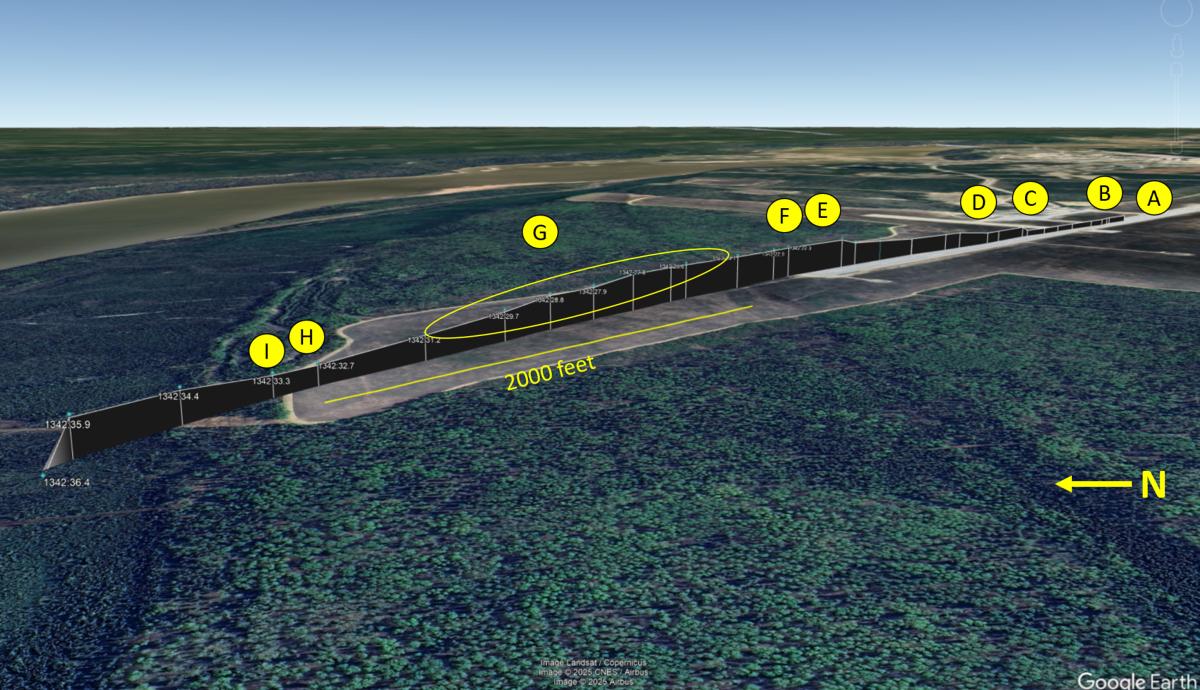
Eight seconds later, and at a height of approximately 100 feet above ground level (AGL), the FO observed an abnormal landing gear indication and notified the captain. Two seconds later, the FO called for the captain to reduce the speed; the captain acknowledged, and 2 brief changes in propeller rpm occurred within 6 seconds. During the initial climb, the captain maintained a shallow climb angle and attitude, the aircraft’s speed increased to approximately 165 knots indicated airspeed (KIAS), and the aircraft reached a maximum height of approximately 140 feet AGL (Appendix A, Figure A1). At this point, the aircraft began a shallow descent. Six seconds later, the FO observed that the aircraft was losing altitude and called “Descending”. One second later, the terrain awareness and warning system (TAWS) began to produce an aural alert and, simultaneously, the aircraft impacted trees 0.5 nautical miles (NM) past the end of Runway 30. During this impact, the left-wing structure was compromised, resulting in a fireball.
Approximately 3 seconds after the aircraft’s initial collision, the aircraft impacted additional trees and then terrain 0.6 NM from the end of Runway 30 and 0.1 NM left of the extended runway centreline (Appendix A, Figure A2). During the final portion of the accident sequence, 1 passenger was ejected from the aircraft (the seat and safety belt remained in the aircraft) and received minor injuries. The captain, FO, and remaining 4 passengers received fatal injuries. The aircraft was destroyed by impact forces and a fuel-fed post-impact fire, which consumed the majority of the aircraft’s fuselage and the centre portion of the wing. The 406 MHz emergency locator transmitter (ELT) activated, and a signal was received by the Canadian Mission Control Centre in Trenton, Ontario, which relayed the signal information to the Joint Rescue Coordination Centre (JRCC).
1.2 Injuries to persons
There were 2 flight crew members and 5 passengers on board the aircraft. Table 1 outlines the degree of injuries received.
Degree of injury | Crew | Passengers | Persons not on board the aircraft | Total by injury |
|---|---|---|---|---|
Fatal | 2 | 4 | – | 6 |
Serious | 0 | 0 | – | 0 |
Minor | 0 | 1 | – | 1 |
Total injured | 2 | 5 | – | 7 |
1.3 Damage to aircraft
The aircraft was destroyed as a result of impact forces and the post-impact fire.
1.4 Other damage
The aircraft collided with trees and the ground in a forested area, causing localized disruption to the forest in the impact zone and debris field.
The aircraft had departed CYSM with approximately 3200 pounds of Jet A fuel on board. The majority of this fuel was consumed in the post-impact fire; however, a portion of it contaminated the forest floor during the accident sequence.
1.5 Personnel information
Captain | First officer | |
|---|---|---|
Pilot licence | Airline transport pilot licence - aeroplane | Commercial pilot licence - aeroplane |
Medical expiry date | 01 June 2024 | 01 February 2025 |
Total flying hours | 8277.0 | 717.3 |
Flight hours on type | 627.3 | 467.2 |
Flight hours in the 24 hours before the occurrence | 5.1 | 0.0 |
Flight hours in the 7 days before the occurrence | 17.3 | 18.2 |
Flight hours in the 30 days before the occurrence | 17.3 | 29.6 |
Flight hours in the 90 days before the occurrence | 110.5 | 143.3 |
Flight hours on type in the 90 days before the occurrence | 110.5 | 143.3 |
Hours on duty before the occurrence | 1.5 | 1 |
Hours off duty before the work period | 13.5 | 72 |
Both the captain and the FO held the appropriate licences and ratings for the flight in accordance with existing regulations.
1.51. Captain
The captain was hired by Northwestern Air Lease on 01 December 2022. He obtained his type rating on the Jetstream series 3200 on 22 December 2022. In addition to his Jetstream series 3200 type rating, the captain also held ratings on the Jetstream 3100, Convair 580, Lockheed L-188 Electra, Lockheed L-1011 TriStar, Canadair Regional Jet, and Boeing 737-600, -700, and -800 series aircraft. The captain also held a flight engineer licence with ratings on the Douglas DC-8, the Lockheed L-188 Electra, and the Lockheed L-1011 TriStar. During the occurrence flight, the captain was seated in the left seat of the cockpit and was the PF.
Following a review of the captain’s training records, the investigation determined that he had completed all of the required company initial and recurrent training, including:
- Jetstream 3100 Initial Training
- BA31/32 Transition (Differences) Training
- Controlled Flight into Terrain (CFIT) Avoidance Training
- Emergency Procedures Training for Pilots (for the Jetstream series 3100 and 3200)
- Aeroplane Surface Contamination Training
- Airborne Icing Training
- Crew Resource Management Training (initial and recurrent)
1.5.2 First officer
The FO obtained his commercial licence with a multi-engine class rating in December 2021. He was hired by the dispatch department of Northwestern Air Lease on 17 January 2023. He completed his pilot proficiency check for the Jetstream series 3100 and 3200 on 23 May 2023 and subsequently began flying on a full-time basis for the company as an FO on these aircraft types. On the occurrence flight, he was seated in the right seat of the cockpit and was the pilot not flying (PNF).Northwestern Air Lease’s standard operating procedures manual for Jetstream series 3200 aircraft uses the term “pilot not flying” instead of the currently used and commonly accepted term, “pilot monitoring”. (Source: Northwestern Air Lease Ltd., Standard Operating Procedures Jetstream 3200, Amendment #4 [05 December 2019], Section 2: Checklist and Cockpit Procedures, p. 2-1.). For more information on the difference between these terms, refer to 1.17.4 Crew resource management training in this report.
A review of the FO’s training records revealed that he had completed all of the required company initial and recurrent training, including the same training stated above for the captain.
1.6 Aircraft information
1.6.1 General
Manufacturer | British Aerospace P.L.C.* |
|---|---|
Type, model, and registration | Jetstream Model 3212, C-FNAA |
Year of manufacture | 1991 |
Serial number | 929 |
Certificate of airworthiness date | 13 May 2013 |
Total airframe time | 24 405.9 hours |
Engine type (number of engines) | Honeywell Aerospace TPE-331-12UHR (2) |
Propeller type (number of propellers) | MT-Propeller GmbH MTV-27 (2) |
Maximum allowable take-off weight | 16 204 lb (7350 kg) |
Recommended fuel types | Jet A, A1, and Jet B |
Fuel type used | Jet A1 |
* BAE Systems (Operations) Ltd., trading as BAE Systems Regional Aircraft currently holds the type certificate for the aircraft type.
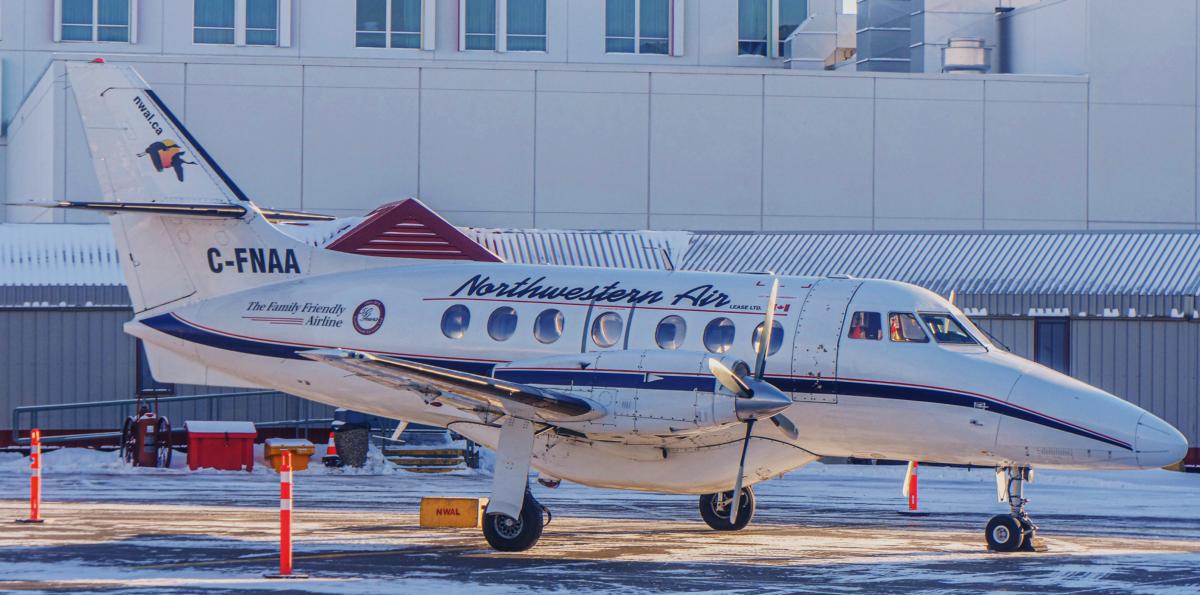
The Jetstream Model 3212 is an all-aluminum, pressurized, light-transport aircraft certified for a maximum capacity of 19 passengers and 2 pilots. It is powered by 2 Honeywell Aerospace fixed-shaft turboprop engines, each producing 1020 shaft horsepower (Figure 1). During takeoff and initial climb, the engines operate at 100% gas generator rpm, which corresponds to a propeller rotation of 1591 rpm. In normal forward flight mode, engine/propeller rpm is regulated by the propeller governor. Because the system is predominantly mechanical in nature, there can be minor variations in propeller rpm depending on how quickly power lever adjustments are made. The occurrence aircraft was modified by the installation of 2 MT-Propeller 5-bladed, constant-speed, fully reversible propellers of composite construction. It was also equipped with hydraulically retractable landing gear.
The aircraft was approved to operate under both day and night visual flight rules (VFR) and IFR and in known or forecast icing conditions when the required equipment for these conditions was installed and operable. The aircraft was equipped with a TAWS and, as required by regulation, a CVR.
The aircraft was acquired by Northwestern Air Lease in 2013 and received its certificate of airworthiness from Transport Canada (TC) on 13 May 2013.
There were no recorded defects outstanding at the time of the occurrence. The aircraft’s take-off weight was calculated to be 14 988 pounds, and the centre of gravity was within the prescribed limits.
1.6.2 Landing gear
The landing gear on Jetstream series 3200 aircraft is electrically controlled and hydraulically actuated. The left and right main landing gear retraction systems each consist of a retracting and extending hydraulic ram (radius rod), which incorporates the landing gear downlock mechanism, and an uplock assembly to hold the main landing gear in the retracted position. The nose landing gear retraction system consists of a hydraulic ram for retracting and extending the nose landing gear, as well as separate downlock and uplock assemblies.
The status/position of the landing gear is indicated to the pilots by a series of red and green lights on the landing gear position indicator, located forward of the gear selector (Figure 2). Each of the 3 green lights illuminates to indicate that its respective landing gear unit is locked in the extended (down) position. When 1 or more of the 3 red lights are illuminated, this is an indication that their respective landing gear units are neither locked in the down position nor fully retracted. When the landing gear units are fully retracted, all lights on the landing gear position indicator are extinguished. The published maximum airspeed at which the aircraft can safely be flown with the landing gear extended (VLE) or being operated (VLO) is 160 KIAS.
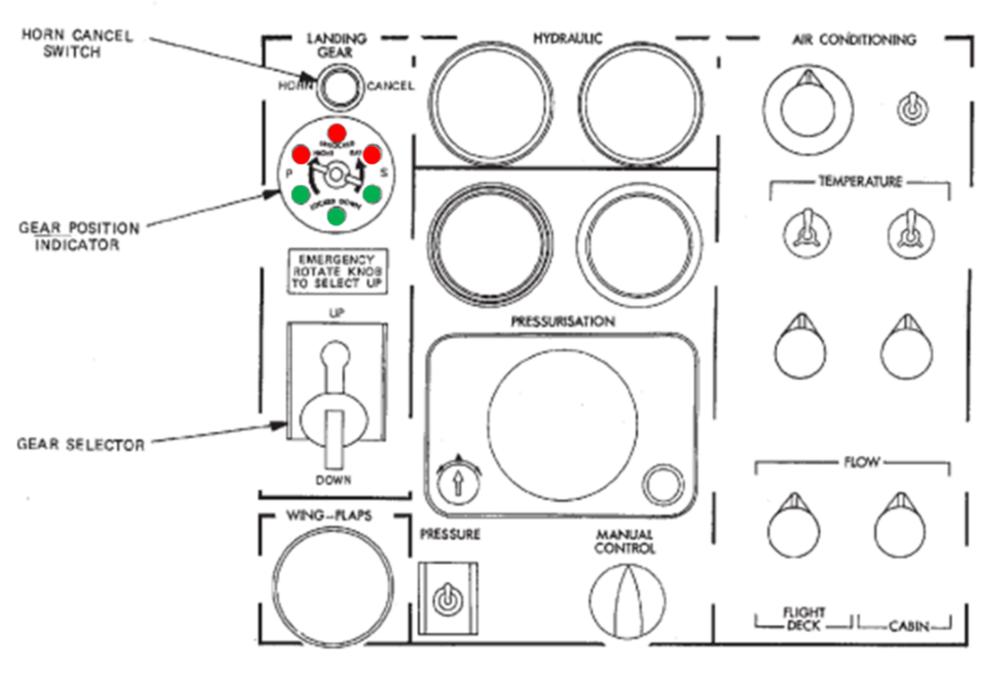
When the pilots want to retract the landing gear after takeoff, they move the landing gear selector switch to the retracted position by pulling on the handle and moving it to the UP position. The landing gear selector valve then ports hydraulic fluid, under main system pressure, through various hydraulic components to the retraction side of the landing gear actuating system. When the landing gear begins to retract, the green lights extinguish and the red lights illuminate on the landing gear position indicator. When the landing gear units are fully retracted and locked in the retracted position by their respective landing gear uplocks, the red lights extinguish and no lights on the landing gear position indicator are illuminated. If any of the 3 landing gear units do not lock in the retracted position, the respective red lights remain illuminated.
1.6.2.1 Landing gear maintenance history
A review of the occurrence aircraft’s maintenance history for the 12 months preceding the accident was completed, with particular emphasis placed on any maintenance activity involving the landing gear. The following maintenance actions, related to an operational check (retraction and extension in the hangar) of the main landing gear system performed by Northwestern Air Lease’s maintenance team, were recorded:
- The landing gear operational check was completed on 30 August 2023 at 24 274.3 hours total airframe time and 30 204 airframe cycles as part of a scheduled right main landing gear leg assembly replacement.
- Gear swingsLanding gear swings are conducted when maintenance has been performed on the aircraft’s landing gear. They involve energizing the hydraulic system in the hangar and operating the landing gear through retraction and extension cycles to confirm the system’s operability. were carried out as part of maintenance work completed on the right main landing gear door on 04 October 2023 at 24 296.3 hours and 30 252 cycles.
- The left main landing gear uplock micro-switch was tightened as required, and gear swings were carried out on 06 October 2023, at 24 297.1 hours and 30 253 cycles.
- The right radius rod (retract actuator) was replaced with a serviceable unit because the original was due for overhaul. Gear swings were performed and the work was released on 30 October 2023 at 24 307.8 hours and 30 264 cycles.
- The left radius rod was replaced with an overhauled unit because the original had been removed to service another aircraft. Gear swings were carried out after the radius rod installation. The maintenance activity was released on 07 November 2023 at 24 322.5 hours and 30 280 airframe cycles.
During these maintenance activities, no issues were identified with the operation of the landing gear system’s retraction or extension.
The investigation determined that there had been an intermittent issue with the left main landing gear unit, in that it did not fully retract when outside temperatures were colder than approximately −20 °C and when the landing gear was under air load at indicated airspeeds exceeding approximately 140 KIAS. However, this information was not found recorded in any of the aircraft’s technical records. The investigation determined that the Jetstream pilots within Northwestern Air Lease had developed an informal procedure to address the issue. According to this informal procedure, the PF increases the pitch angle of the aircraft to bleed off airspeed down to approximately 140 KIAS, at which point the landing gear locks in the retracted position, the landing gear position indicator lights extinguish, and the pilots can then continue the flight as usual.
1.6.2.2 Aircraft journey log
The aircraft’s journey log was reviewed for the 12 months of documentation before the occurrence. No defects were recorded by any of the company’s pilots in relation to an issue with the retraction of the landing gear after departure. In those 12 months, the aircraft accrued 601.4 hours total airframe time and 527 airframe cycles.
1.6.3 Terrain awareness and warning system
As required by regulation,Transport Canada, SOR/96-433, Canadian Aviation Regulations, subsection 704.71(2). the aircraft was equipped with a SandelCurrently Nighthawk Flight Systems, Inc. ST3400 TAWS/radio magnetic indicator (RMI) that met the standards of Technical Standard Order (TSO) C151b in accordance with a supplemental type certificate (STC)Transport Canada, Supplemental Type Certificate No. C-LSA14-087/D: Installation of Garmin GPS 400W and Sandel ST3400 TAWS/RMI System (issued 22 May 2014). issued to Northwestern Air Lease. The STC covered the installation of a Garmin global positioning system (GPS) 400W and the Sandel ST3400 TAWS/RMI. In addition, the TAWS met the enhanced altitude accuracy requirements in CARs Standard 551, section 551.102.
The ST3400 TAWS/RMI is a self-contained instrument that is designed to replace an existing RMI and provide both RMI functionality and TAWS functionality. Terrain protection is enabled during all phases of flight, and terrain information is displayed on a full-colour instrument screen. The unit uses GPS, barometric altitude, radar altitude, and other relevant data, combined with information from its own internal database, to provide pilots with relevant terrain information and warnings.
The ST3400 TAWS/RMI’s built-in caution and warning system provides visual and aural alerts, including all of the standard ground proximity warning system alerts, as well as new enhanced terrain alerts and various advisories. The unit is integrated into the aircraft’s existing systems, including those for the aircraft’s landing gear and flaps, to provide warnings for these systems should their associated components not be in the appropriate condition for a given phase of flight.
1.6.3.1 Altitude loss after takeoff or missed approach
One of the ground proximity warning system alerts emitted by the ST3400 TAWS/RMI is the ALAT (altitude loss after takeoff or missed approach) Mode 3B alert, which uses radar altitude and barometric altitude to detect an accumulated loss of altitude following a takeoff or missed approach. The alert uses the height above take-off altitude. Although the unit was destroyed by the post-impact fire, the TSB laboratory completed an analysis of the system’s capabilities to determine which aural terrain alert had been produced by the unit and provided to the captain and FO immediately before the aircraft’s impact with the trees. The analysis relied on the unit’s design parameters as well as altitude data obtained from the aircraft’s automatic dependent surveillance - broadcast (ADS-B) system to determine the expected response from the TAWS during the occurrence flight.
Based on the analysis of the TAWS system and the data available to the investigation, the ALAT Mode 3B alert (an aural and visual alert) was expected to have been triggered during the occurrence flight. This expected alert coincided with the TAWS aural alert that was heard on the CVR recording. Therefore, it was determined that the ST3400 TAWS/RMI unit had functioned as designed in accordance with its certification requirements.
1.6.4 Aircraft flight operations
1.6.4.1 Abnormal checklist
The aircraft flight manual (AFM)The Jetstream Series 3200 Flight Manual Model No. 3212 (the AFM) is a document approved by the United Kingdom Civil Aviation Authority on behalf of Transport Canada for Canadian-registered aircraft. It contains information applicable to that specific serial number of aircraft and provides guidance for pilots on how to operate it. The data contained therein is based on the multi-part manufacturers operating manual (MOM). (also called the manufacturers operating manual [MOM]) consists of 3 separate documents (Part 1, Part 2, and Part 3) produced by the aircraft manufacturer. In the AFM for Jetstream series 3200 aircraft, BAE Systems defines an abnormal procedure as “[…] recommended procedures for use in the event of malfunctions which are not serious enough to be classified as emergencies.”BAE Systems, Jetstream Series 3200 Flight Manual Model No. 3212, General Amendment G9 (April 2022), Section 1: Flight Manual, p. 0-1-2. BAE Systems has published the Jetstream Series 3200 Emergency & Abnormal Checklist for the Jetstream series 3200 aircraft, which is available in its MOM (Part 3).BAE Systems, Manual Reference Number MOM-3-HP4.18, Jetstream Series 3200 Emergency & Abnormal Checklist, Manufacturers Operating Manual Part 3, Revision 3 (15 March 2023). The emergency and abnormal checklist is also published as the quick reference handbook (QRH), a stand alone document for flight crew to quickly reference should an abnormal aircraft condition present itself while in flight.
In the introduction of the checklist, the manufacturer breaks down the actions to be taken by the pilots during 3 aircraft states:
- Aircraft stationary
- Aircraft taxiing
- Aircraft takeoff (ground roll)
In the description for the 3rd aircraft state, the manufacturer lists specific circumstances, including an engine failure indication, in which the pilots are to stop during a takeoff. For all other situations, the following statement is made: “For other warnings, continue the take-off, when safely airborne carry out any memory actions required, consult the checklist (if applicable), and MOM Part 1.”Ibid., Introduction.
The checklist has a section, Card 39,Ibid., Card 39., BAE Systems, Jetstream Series 3200 Flight Manual Model No. 3212, General Amendment G9 (April 2022), Chapter 4: Abnormal Procedures, Section 9 – Hydraulics, Landing Gear & Flaps, Landing gear selector lever up – landing gear not locked up, p. 4-9-4. detailing how the pilots are directed to handle a situation in which the landing gear, when selected up, does not go into the fully up and locked position, as indicated by the illuminated red lights on the landing gear position indicator. The procedure, which the manufacturer has published in both the MOM (Part 3) and the Jetstream Series 3200 Flight Manual Model No. 3212, can apply to any individual landing gear unit or to all of them, as appropriate.
The following is a summary of the steps required:
- Confirm that the landing gear selector lever is in the UP position.
- If the landing gear retracts normally, as indicated by the absence of any illuminated lights on the landing gear position indicator, continue the flight. If 1 or more red or green indicator lights are illuminated, proceed to step 2.
- Place the landing gear selector in the DOWN position.
- If all 3 green lights on the landing gear position indicator are illuminated, indicating that the landing gear are down and locked, do not recycle the landing gear. Proceed to step 3.
- Land at the nearest suitable airfield.
1.6.4.2 Icing conditions
The AFM for Jetstream series 3200 aircraft states that icing conditions can exist anytime the following 2 conditions are present:
- the total outside air temperature on the ground and for takeoff is 10 °C or colder, or the indicated outside air temperature in flight is 10 °C or colder; and
- visible moisture is present in any form on any airport manoeuvring area (e.g., standing water, slush, surface snow, or ice) or in the atmosphere (e.g., cloud, fog, rain, sleet, snow, or ice crystals).Ibid., Chapter 3: Conditional Procedures, Section 10 – Ice & Rain Protection, p. 3-10-1.
1.6.4.3 Continuous ignition system
Jetstream series 3200 aircraft are equipped with a continuous ignition system. The system provides the pilots with the ability to manually turn the engine ignition system on and have it operate continuously until they deactivate the system.
The AFM directs the pilots to select the continuous ignition systemIbid., p. 3-10-4. if there is a late selectionLate selection refers to a delay in the activation of the aircraft’s de-icing or anti-icing systems that occurs when ice accumulates on the aircraft but the pilots do not notice it right away. of the engine/elevator ice protection system.
1.6.5 Installation of automatic dependent surveillance - broadcast
In November 2023, the existing transponders on the occurrence aircraft were replaced with Garmin GTX 335DR ADS-B transponders, which incorporate ADS-B technology. ADS-B broadcasts information about the aircraft’s location and speed when the aircraft is operating. These data were critical in providing the investigation with flight-path data for the occurrence flight that would have been otherwise unavailable.
1.6.6 Take-off performance
The occurrence aircraft’s take-off performance data for 3 of its previous departuresThe investigation did not determine which pilots were operating the aircraft during these departures. from Runway 30 at CYSM were compiled using ADS-B information. These 3 takeoffs were then averaged and plotted against the occurrence take-off profile for comparison based on height (Figure 3) and ground speed (Figure 4).
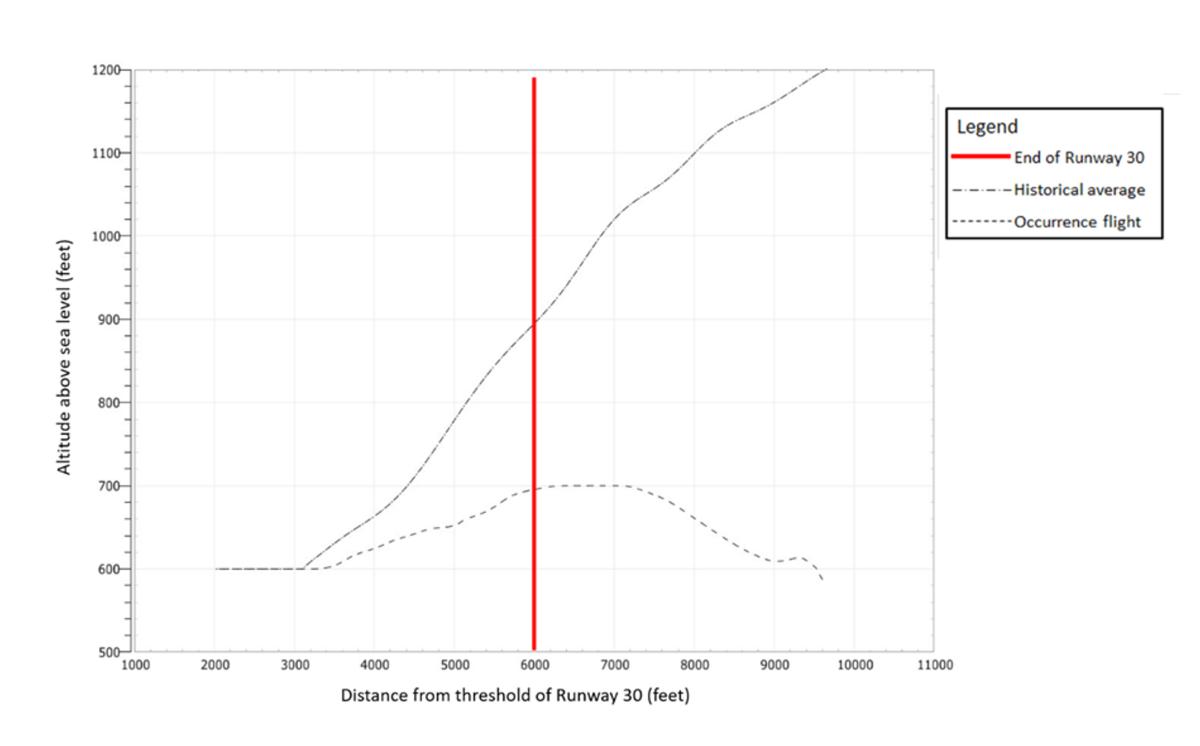
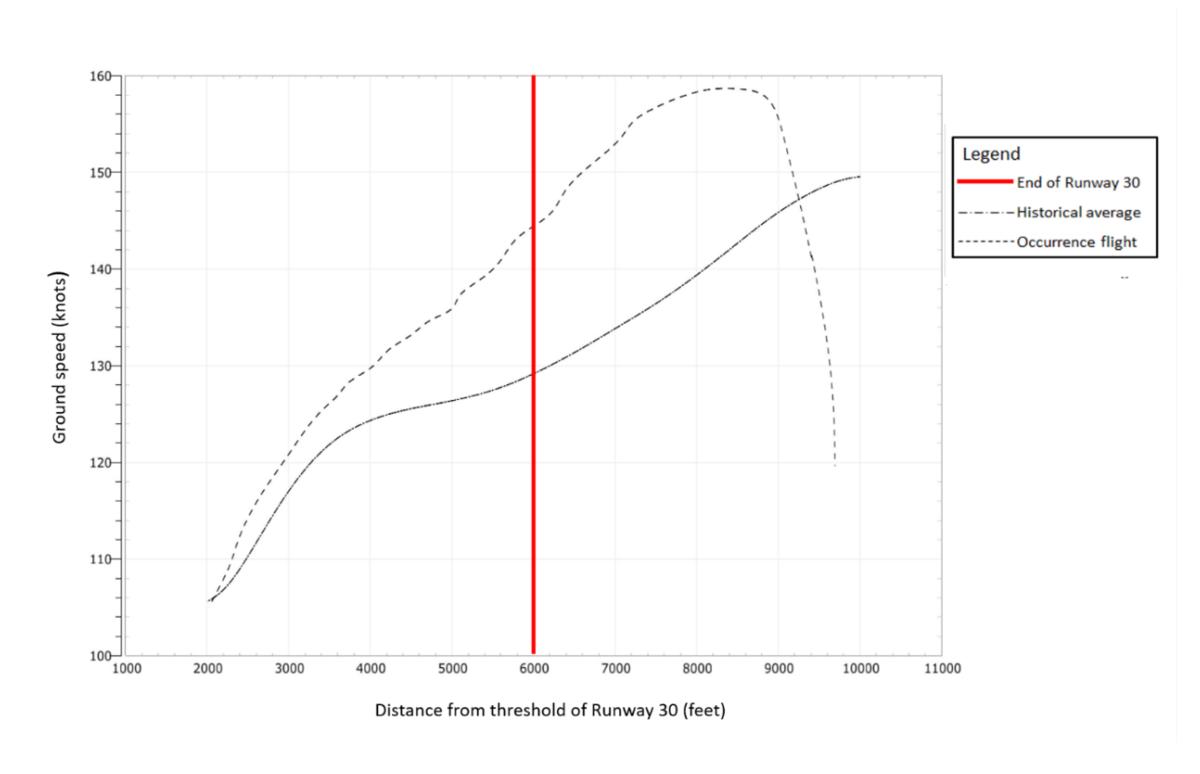
During the occurrence flight, the aircraft departed Runway 30 with an approximate headwind of 2 to 3 knots. During the takeoff, by the time the aircraft reached the end of Runway 30 it had reached a height of approximately 100 feet AGL (700 feet above sea level [ASL]) and a ground speed of 145 knots. By comparison, the average height reached by the end of the runway, based on 3 of the occurrence aircraft’s previous takeoffs, is 280 feet AGL (880 feet ASL), with an average ground speed of 128 knots.
Based on the available data, the aircraft manufacturer completed its own aircraft take-off performance analysis in support of the investigation. The analysis determined that, during the occurrence takeoff, the aircraft had attained a positive pitch attitude of approximately 5°. The aircraft manufacturer’s aircraft operating manual states that an 8° to 10° nose-up pitch attitude should be established for the initial climb.BAE Systems, Manual Reference Number MOM P1-006, Jetstream 3200 Series Manufacturers Operating Manual, Part 1: Flying, Revision 05 (15 March 2023), Chapter 16: Flight Guide, Section 10: Take-off, p. 16-1-5.
1.7 Meteorological information
1.7.1 Limited weather information system
A limited weather information system (LWIS) is an automated weather information and broadcasting system installed at small airports. As its name implies, an LWIS is a more basic system compared to an automated weather observation system (AWOS). It observes and reports only the following:
- Wind direction and speed
- Temperature and dew point
- Altimeter setting
An LWIS was installed at CYSM, and it was operating on the day of the occurrence. At 0600, the CYSM LWIS reported the following conditions:
- Winds from 300° true (T) at 2 knots
- Temperature −19 °C and dew point −22 °C
- Altimeter setting 29.75 inches of mercury
At 0700, the CYSM LWIS reported the following conditions:
- Winds from 290°T at 3 knots
- Temperature −19 °C and dew point −22 °C
- Altimeter setting 29.75 inches of mercury
Although the LWIS does not have the capability of reporting falling snow and neither the 0600 nor the 0700 broadcast included this information, falling snow was present at CYSM from before the time of the aircraft’s removal from the hangar until the time of the aircraft’s departure.
Snow had been falling in the region for several hours before the aircraft’s departure from CYSM. Although the falling snow was not indicated in the LWIS reports available to the captain and FO before the flight, the flight crew had observed the snowfall while driving to the airport. The captain therefore requested that the aircraft be cold soaked in preparation for the flight. The snowfall and potential accumulation also came up as a conversation point between the captain and FO several times while they worked through the various aircraft checklist items before departure.
1.7.2 Graphic area forecast
The graphic area forecast issued at 0428 and valid at the time of departure indicated:
- Overcast ceiling based at 4000 feet to 6000 feet ASL and topped at 20 000 feet ASL
- Visibility varying from 2 to 5 statute miles in light snow
- Local ceilings of 1500 feet AGL
- Occasional altocumulus castellanus clouds to 22 000 feet ASL, producing visibilities of ¾ to 1 statute mile in light snow showers, with ceilings of 1000 feet AGL
1.7.3 Surveillance footage
Closed-circuit television (CCTV) surveillance cameras were mounted on the terminal building at CYSM. One camera was facing the fuelling area and another was directed at the terminal apron, where passengers boarded the aircraft. The falling snow was observed in the video files recovered from both cameras. When the captain and FO started the aircraft’s engines, the snow that had accumulated on the ground in the vicinity of the aircraft quickly blew away in the prop wash of both engines, exposing the black asphalt surface. The CCTV surveillance cameras also captured video of the fireball that was created during the aircraft’s initial impact with the trees at the end of the runway clearway.
During the investigation, a photo of the outboard section of the aircraft’s right wing, which had been taken by 1 of the passengers before departure and posted on a social media website, was sent to the TSB. It indicated wing surface contamination due to snow. The actual amount of snow was unable to be determined; however, the de-ice boot (composed of black rubber) on the wing’s leading edge was covered in snow.
1.8 Aids to navigation
Not applicable.
1.9 Communications
There were no known communication difficulties.
1.10 Aerodrome information
CYSM is owned and operated by the Government of Northwest Territories. It is a certified aerodrome located on the south side of the Slave River, west of the town of Fort Smith, Northwest Territories. The airport is at an elevation of 673 feet ASL and has 2 intersecting runways. Runway 03/21 is approximately 1800 feet long and 100 feet wide, and its surface is a combination of gravel and asphalt. Runway 12/30 is considered the main runway. Measuring 6001 feet long and 100 feet wide, it is 100% asphalt and certified to Aircraft Group Number IIIB.Aircraft Group Number IIIB, or AGN IIIB, indicates that the taxiway and runway are free of obstacles for aircraft with a wingspan up to but not including 36.00 m.
The terrain extending approximately 2800 feet past the paved departure end of Runway 30 is cleared of trees in a swath that is approximately 1000 feet wide. There were no sources of cultural or natural light in the departure path of Runway 30. The airport does not have a control tower; however, it does have a community aerodrome radio station operated by trained personnel. On the day of the occurrence, the station began operations at 0700.
The CYSM airport authority does not have aircraft de-icing or anti-icing capabilities.
1.11 Flight recorders
The aircraft was equipped with a CVR, which had a recording capacity of 30 minutes; its recorded data included the occurrence flight. The CVR data were successfully downloaded and contained good-quality audio. The last CVR intelligibility check was completed 27 July 2023.
The aircraft was not equipped with a flight data recorder (FDR), nor was one required by regulation. As a result, the only aircraft performance data that were acquired, apart from information from the ADS-B, came from the CVR; these data consisted of propeller rpm and nose wheel speed (converted to ground speed), as recorded on the cockpit area microphone.
As part of its analysis of the aircraft’s performance, the TSB laboratory was able to produce a chart (Appendix A, Figure A1) combining the CVR data and the aircraft’s ADS-B data to assist the investigation in understanding the timeline of events before the accident.
1.12 Wreckage and impact information
The aircraft impacted the tops of trees located 0.5 NM (3050 feet) beyond the end of Runway 30, at a height of approximately 40 feet. The broken treetops indicated that the aircraft was in a wings-level attitude at the time of the initial impact. Fuel was smelled at this location by ground search personnel early in the search effort, and several pieces of the aircraft, primarily consisting of aircraft fairings and propeller spinner pieces, were found.
After the initial impact with the trees, the aircraft continued to travel on a heading of 300°T before impacting terrain 680 feet past the edge of the cleared area and coming to rest. Following this impact, the fuselage and empennage remained together, but both the left and right wings broke away from the fuselage and travelled forward of the fuselage location. The engines were still partially attached to their respective wings; however, some of the engine mounting structures were broken. All propeller blades from both propellers were broken at the hubs.
Both the main cabin entrance door and the emergency exit were found in the closed position when examined at the accident site.
1.12.1 Engine examination
Both of the occurrence aircraft’s engines were removed from the wreckage and transported to the facility of the manufacturer (Honeywell Aerospace), in Phoenix, Arizona, United States, where they were completely disassembled for a detailed examination with the TSB in attendance. The examination revealed that the first stage compressor impellers of both engines had damage consistent with that caused by the ingestion of foreign objects. Earthen debris was found in the gas path of both engines through both stages of the compressor and both stages of the diffuser, as well as in the combustion liners. Earthen debris was also found completely plugging some of the cooling holes in the combustion chambers. Additionally, aluminum spatter was found in all 3 power turbine stages. These observations are consistent with the engines rotating at the time of impact. No evidence was found of any pre-impact faults with either engine.
There was no evidence to indicate that a malfunction of the engines had contributed to the accident.
1.12.2 Propeller examination
On both propellers, all of the blades had broken off from the hub during the accident sequence, but the hub remained in place. Both propeller hubs were removed during the engine examination. They were then shipped to the service facility of the manufacturer (M-T Propeller GmbH) in DeLand, Florida, United States, for a detailed examination. A representative from the U.S. National Transportation Safety Board attended the examination on behalf of the TSB. The damage to both propeller assemblies as well as the pitch change mechanism was consistent with that incurred during the accident sequence. The blades were found at an angle that was consistent with the take-off phase of flight.
There was no evidence indicating that a propeller malfunction had contributed to the accident.
1.13 Medical and pathological information
There was no indication that the flight crew’s performance was negatively affected by medical or physiological factors, including fatigue.
1.14 Fire
Owing to the fact that the aircraft had departed with full fuel (3200 pounds), there was a significant fuel-fed post-impact fire that consumed the majority of the fuselage and the centre portion of the wing.
1.15 Survival aspects
The JRCC initially contacted Northwestern Air Lease at 0656, approximately 14 minutes after the aircraft’s impact with terrain, to notify the company of an ELT activation. At that time, the JRCC provided the initial location coordinates with which the company could begin a ground search for the aircraft. The JRCC notified the Royal Canadian Mounted Police (RCMP), which deployed local assets, in addition to personnel from the local Canadian Ranger patrol, to the area for the initial ground-based search and rescue efforts. Also, the JRCC dispatched Canadian Armed Forces search and rescue assets. At approximately 1015, the sole survivor was located by ground search personnel. He was subsequently transported by snowmobile to the search staging area, where an ambulance was waiting; he arrived at 1038. Meanwhile, a Canadian Armed Forces search and rescue aircraft had arrived in the area at approximately 1030, and search and rescue technicians then parachuted into the accident location, arriving at the site at approximately 1115.
Although the vertical impact forces from the aircraft’s collision with terrain resulted in fatal injuries to 6 of the 7 occupants, these impact forces were likely survivable. It is likely that because the surviving occupant (a passenger) was wearing his safety belt loosely as the aircraft broke up during the accident sequence, he was ejected from the wreckage into an area of bush, receiving minor injuries.
The severity of the injuries to the captain, FO, and remaining passengers could not be determined owing to the extent to which the aircraft had been consumed by the post-impact fire. For the same reason, it could not be determined why none of these occupants had been able to escape from the aircraft.
1.15.1 Emergency locator transmitter
The occurrence aircraft was equipped with a Kannad 406 MHz automatic fixed ELT (part number S1840501-01) that was certified to meet the requirements of TSO-C126a and TSO-C142a. Upon the aircraft impacting the terrain, it transmitted a signal to multiple satellite constellations. The JRCC received initial location coordinates that were approximately 7.8 NM from the actual accident site because of the accident site’s location relative to the orbiting COSPAS-SARSATThe COSPAS-SARSAT system is an international network consisting of satellites in low-altitude earth orbit and geostationary earth orbit that receive radio signals from distress radio beacons and re-transmit that data to various rescue coordination centres located around the world. satellites, which were both coming into the view of the ELT and leaving its view. During subsequent satellite passes over the accident area, a progressively more accurate location of the accident site could be provided to the search and rescue assets.
1.16 Tests and research
1.16.1 TSB laboratory reports
The TSB completed the following laboratory reports in support of this investigation:
- LP011/2024 – NVM [non-volatile memory] Data Recovery – Flight Tracker
- LP021/2024 – Video Analysis
- LP025/2024 – CVR Recovery and Analysis
- LP026/2024 – ADS-B Data Analysis
- LP039/2024 – ELT Analysis
- LP044/2024 – TAWS System Analysis
- LP045/2024 – Fuel Analysis
- LP055/2024 – Flap Actuator Examination
1.17 Organizational and management information
1.17.1 Company overview
Northwestern Air Lease is based in Fort Smith, and at the time of the occurrence, it held an air operator certificate issued by TC for operations conducted under Canadian Aviation Regulations (CARs) subparts 702 (Aerial Work), 703 (Air Taxi Operations), and 704 (Commuter Operations). The company operated a fleet of single- and multi-engine aircraft and provided chartered flights and daily scheduled flights to northern communities in Alberta and the Northwest Territories. In January 2025, the company ceased CARs Subpart 704 flight operations.
Northwestern Air Lease also holds an approved maintenance organization certificate that authorizes it to conduct maintenance on its fleet of aircraft. Under the certificate, the company is authorized to carry out all non-specialized maintenance on the Jetstream series of aircraft.
1.17.1.1 Company de-icing equipment
Northwestern Air Lease’s only piece of aircraft de-icing equipment suitable for the Jetstream aircraft that had the ability to apply de-icing fluid was a converted pickup truck with a tank and a boom. In the past, this pickup truck had been used to de-ice aircraft before departure. However, sometime in the months before the occurrence, the truck had become unserviceable and had not been repaired.
1.17.2 Company operations manual
Northwestern Air Lease’s company operations manual (COM) provides guidance material, policies, and procedures for operations personnel to follow in the performance of their duties.
Section 8.12 of the COM addresses the company’s policy with regard to ice, frost, and snow contamination of the aircraft’s critical surfaces and describes the company’s ground icing program. A critical surface is described as “the wings, control surfaces, propellers, horizontal stabilizers, vertical stabilizers, or any other stabilizing surface of an aircraft.”Northwestern Air Lease Ltd., Company Operations Manual, Edition 2, Amendment 8 (08 December 2022), Chapter 8: Operating Procedures, Section 8.12.1: Definitions, p. 8-32.
This section of the COM describes the 2 types of inspections that are performed:
“Critical surface inspection” - a pre-flight and for some aeroplanes a tactile inspection of critical surfaces conducted by a qualified person to determine if they are contaminated by frost, ice, or snow. During ground icing conditions, this inspection is mandatory.
“Pre-take-off Contamination inspection” - is an inspection conducted by a qualified person, immediately prior to take-off, to determine if an aircraft's critical surfaces are contaminated by frost, ice, or snow. This inspection is mandatory.Ibid., p. 8-33.
After discussing the possible effects of critical surface contamination on aircraft performance, the following cautionary note is included as a reminder to pilots:
Note: All contamination must be removed prior to departure. If a clean aircraft for departure cannot be assured, the only acceptable alternative is to cancel or postpone the flight until conditions are acceptable and the aircraft is free of contaminates.Ibid.
1.17.2.1 Aircraft defects
Chapter 9 of the COM addresses aircraft requirements. With respect to aircraft defects, it states the following:
The Certificate of Airworthiness of an aircraft is not in force unless the equipment, systems and instruments prescribed in the applicable airworthiness standard and all required equipment are functioning correctly.
The Certificate of Airworthiness of an aircraft is also not in force if the aircraft has any malfunction or defect unless the details of the malfunction or defect are recorded in the journey log and unmistakeable warning is given at the flight crew station by removing, placarding or tagging the affected item.Ibid., Section 9.3.4: Aircraft Defects, p. 9-9.
The chapter further states that after the conclusion of any flight in a company aircraft, all defects will be recorded in the aircraft’s journey log. In addition, after making such an entry, the pilot-in-command will inform company maintenance personnel of the defect, and the journey log will be turned over to the maintenance department.Ibid., Section 9.3.5: General Rules, p. 9-9.
1.17.3 Jetstream series 3200 standard operating procedures manual
Northwestern Air Lease has also published a standard operating procedures (SOPs) manual, titled Standard Operating Procedures Jetstream 3200, for pilots to use while carrying out duties related to the operation of the aircraft. This manual contains SOPs for pilots to follow in normal, abnormal, and emergency situations. The SOPs manual is meant to “augment” rather than supersede the content provided by the manufacturer in its AFM, with which aircraft operations must comply.Northwestern Air Lease Ltd., Standard Operating Procedures Jetstream 3200, Amendment #4 (05 December 2019), Preamble, p. 1-2.
The SOPs manual also contains numerous operational procedures that are derived from the MOM. Section 3 of the SOPs manual covers the normal procedures that pilots are to follow. Section 3.7.3 in particular outlines the process to be followed when the captain, as PF, is performing the takeoff. It directs the captain to smoothly attain a pitch attitude of between 8° and 10° nose up.Ibid., Section 3.7.3: Captain Take-Off, p. 3-24. One of the notes included in this section defines the positive rate, a call to be made by the PNF, as an indication that the pitch attitude is 10° nose up, with both the vertical speed indicator and the altimeter increasing. Another note indicates that the initial pitch attitude is the first critical item in establishing the correct climb profile.Ibid.
Section 4 of the SOPs manual provides procedures for abnormal and emergency situations. However, it does not address all of the possible situations and conditions that pilots can encounter. The section does not define or discuss critical phases of flight,For further information about critical phases of flight, refer to 1.18.2 Critical phase of flight in this report. nor does it describe which procedures should be used when an unusual situation occurs during these phases. For example, no guidance is offered for a situation involving an abnormal aircraft condition that presents itself after takeoff but below 500 feet AGL.
The manufacturer updated the MOM in April 2022 to include a new procedure to be followed by pilots in situations when the landing gear has been selected up but there is an indication that 1 or more of the landing gear units are not up. This change was incorporated into the QRH checklists that were carried on board the aircraft; however, it was not reflected in the latest version of the operator’s SOPs manual being used at the time of the occurrence.
1.17.3.1 Pilot monitoring role
According to the Flight Safety Foundation, the primary role of the pilot monitoring (PM) during all phases of flight, including takeoff, is to monitor the aircraft’s path and immediately warn the PF if a deviation is detected.Flight Safety Foundation, A Practical Guide for Improving Flight Path Monitoring (November 2014), p. 4. Furthermore, if there is insufficient time to warn the PF, the PM must be prepared to act quickly if there is a deviation from a procedure or the flight path, or if the PF becomes incapacitated. Although the PM does not handle the flight controls, the PM plays a crucial role in the overall safe operation of the aircraft.
According to Northwestern Air Lease’s SOPs, as the PF advances the power levers through 60% torque, the PNF (the term used by Northwestern Air Lease to describe the same role as a PM) will set the target engine torque for takeoff. After confirming that 100% engine rpm has been reached and all engine parameters are satisfactory, the PNF calls “Gauges green and parallel, Airspeed alive”. Once a speed of 70 KIAS has been reached, the PNF must call “70 knots”; finally, once the decision speed (V1) has been reached, the PNF shall call “Rotate”.Northwestern Air Lease Ltd., Standard Operating Procedures Jetstream 3200, Amendment #4 (05 December 2019), Section 3.7.3: Captain Take-Off, p. 3-24. Given that a takeoff occurs quickly, the PNF’s attention should be directed to the right place at the right time, and the PNF should spend enough time monitoring the flight’s progress and completing all of the tasks required for the take-off roll.
Northwestern Air Lease defines the roles of the captain and FO in its COM; however, the operator does not define the monitoring roles of the PF and PNF during departure in that manual or in its SOPs.
1.17.4 Crew resource management training
As required by regulation,Transport Canada, Commercial Air Services Standards, Standard 724: Commuter Operations: Aeroplanes, subsection 724.115(38). Northwestern Air Lease provides both initial and recurrent crew resource management (CRM)For more information about the concept of crew resource management (CRM), refer to section 1.18.6 Crew resource management in this report. training to pilots. Both the captain and the FO had completed all of this training before the occurrence. Pilots complete initial and recurrent CRM training through a TC-approved combination of:
- an online training program developed by a third-party training provider; and
- an in-classroom case study discussion led by 1 of the company’s captains.
To better understand the CRM training provided to Northwestern Air Lease’s pilots, the investigation reviewed the company’s initial and recurrent CRM training programs.
The CRM topics in the online training program are presented as standalone presentations ranging from 7 to 30 slides. The investigation noted that the material in these presentations is generic and primarily theoretical in nature, rather than customized to address specific risks faced by Northwestern Air Lease’s pilots. Likewise, the online training provides limited operational strategies that pilots can use to mitigate the risks associated with their crew pairings (for example, the perceived or established difference in authority between pilots involved in an operation, referred to as an authority gradient) or with their operating environment.
Subsection 724.115(38) of the Commercial Air Services Standards requires an operator’s CRM training to “include areas of operations that may lead to particular difficulties or involve unusual hazards”.Transport Canada, Commercial Air Services Standards, Standard 724: Commuter Operations: Aeroplanes, subsection 724.115(38).
Due to the nature of the occurrence, the investigation focused its review on elements of the CRM training modules that included factors identified during the investigation, namely pilot decision making, communication, threat and error management (TEM), and workload management. The following observations were made:
- The TEM module identifies the following 5 “countermeasures”: checklists, briefings, callouts, SOPs, and personal strategies.Empress Aero [presentation slides], “Threat and Error Management”, slide 4. The module explains that anticipating a thunderstorm, for instance, and briefing a response to it in advance is a TEM strategy, but the module does not expand on how to use the other 4 countermeasures or elaborate on what constitutes a personal strategy.
- The TEM module also states that “flight crews must apply skills and knowledge acquired through training and operational experience.”Ibid., slide 7. It does not, however, specify what those specific skills are or how they are to be used in a CRM context.
- The TEM module includes a 5-step process for managing threats; however, the module does not provide an example of how Northwestern Air Lease’s pilots could use it operationally in the cockpit, and the process is not formalized in the company’s SOPs.
- The workload management module is made up of 9 slides. It provides some definitions and generic guidance related to prioritizing, delegating, and planning, and warns of the dangers of interruptions and distractions. The module also identifies the takeoff and initial climb as a period of high workload; however, no CRM strategies are provided to help pilots deal with the challenges that may be encountered (e.g., interruptions or distractions) during this phase of flight.
- The workload management module uses the terms “pilot flying (PF)” and “pilot not flying (PNF)”.Ibid. “Workload Management”, slide 5. In 2017, TC published the Pilot Proficiency Check and Aircraft Type Rating Flight Test Guide (Aeroplane), which replaces the term “pilot not flying (PNF)” with the term “pilot monitoring (PM)”.Transport Canada, TP 14727E, Pilot Proficiency Check and Aircraft Type Rating Flight Test Guide (Aeroplane), First Edition, Revision 1 (June 2017), Definitions. This was done to better reflect the PM’s responsibility for actively “monitoring the current and future projected flight path […] of the aircraft in a multi-crew cockpit.”Ibid.
1.17.5 Safety management system
Although it was not required by regulation at the time of the accident, Northwestern Air Lease had in place a safety management system (SMS) that incorporated an online reporting system whereby company personnel could submit a safety report to the company’s safety committee.
On 26 March 2023, an SMS report was entered into the computer system for a flight involving another Jetstream aircraft in the company’s fleet (registration C-GNAQ) for which the indicator light for the right main landing gear unit would not extinguish after takeoff.
The company completed a risk analysis and root cause analysis for the event. The risk severity was assessed as a 1 (slight injury to people, little damage to company assets, and little impact to the reputation of the company), the risk probability was assessed as a 3 (somewhat probable), and the risk band was assessed as low.
In the Audit Finding Response file, the Corrective Action Plan section stated the following:
This can occur when the airspeed on the BAE32 is rising to 160IAS [KIAS] in the climb. Usually reducing the speed in the climb to 140 but not less than 130 will reduce the air resistance and the gear will pop up into the bay and catch the up-locks.
All Pilots to be informed of this and mentioned in training.Northwestern Air Lease, Audit Finding Response: CYHY 904 gear retract light would not go out, 08 May 2023.
The Corrective Action Taken section stated: “Pilots informed and Maintenance informed. SMS manager has a report from Maintenance informing him of the problem and the repair. Reported to be added to the system.”Ibid.
A review of the material in the training document supplied to the investigation did not find any references to the note and associated procedure stated in Corrective Action Plan section of the Audit Finding Response. Additionally, there was no indication that the procedure had been communicated to company pilots via a company memo or pilot meeting minutes.
1.17.6 Adaptations of standard operating procedures
SOPs and checklists are critical information resources that provide procedural guidance to pilots for the operation of any aircraft. They assist with pilot decision making (PDM) and the establishment of shared mental models between the pilots of multi-crew aircraft, and they provide pilots with predetermined successful solutions to various situations by accounting for risk factors that may not be readily apparent to a pilot during normal operations or an abnormal/emergency situation.
Although it is impossible to develop checklists or procedures for all possible contingencies, following the appropriate checklist or procedure will provide pilots with the safest and most efficient course of action in most cases. However, if checklist and procedural discipline is not taught, practised, reinforced, and monitored, there is a risk that pilots will deviate from prescribed procedures or respond inappropriately to unusual situations.
People rarely follow rules or instructions precisely. They do so for reasons and in ways that make sense to them given their circumstances, knowledge, and goals.S. Dekker, The Field Guide to Understanding ‘Human Error’, Third Edition (Ashgate Publishing, 2014), pp. 82-83.
While policies and SOPs are prescribed by a company to set boundaries for safe operations, pilots may experiment with the boundaries to become more productive or to achieve a specific goal. This experimentation leads to adaptations of procedures and to a shift beyond the prescribed boundaries described in the SOPs, towards unsafe practices.J. Rasmussen, "Risk management in a dynamic society: a modeling problem," Safety Science, Vol. 27, Issue 2/3 (1997), p. 197. Without intervention, the communication of successful adaptations between pilots will tend to lead to their spread throughout an organization.
Such adaptations are unlikely to be recognized as deviations by those within the group employing them. The adaptations slowly become normal behaviour, and the risk associated with them is unlikely to be recognized.S. Dekker, Drift Into Failure (Ashgate Publishing, 2011), p. 111. This tendency has been described as the normalization of deviance.D. Vaughn, The Challenger Launch Decision: Risky Technology, Culture, and Deviance at NASA, Enlarged Edition (University of Chicago Press, 2016), Preface to the 2016 Edition, p. xii. ,The normalization of deviance model was originally coined by sociologist Diane Vaughan in The Challenger Launch Decision: Risky Technology, Culture, and Deviance at NASA (University of Chicago Press, 1996). “Deviance” refers to conditions or behaviours that are outside normal performance standards, and “normalization” refers to the gradual process by which these conditions or behaviours become accepted as the normal practice within an organization. In the occurrence described in this investigation report, the “deviance” in “normalization of deviance” refers to local adaptations to (“deviations from”) prescribed procedures specified by original equipment manufacturers. Without regular supervision, education, and enforcement of the expected boundaries, people are likely to continue to adapt procedures until the actual unsafe boundary is found through the occurrence of a minor or major accident.
Within Northwestern Air Lease, the number of pilots who had been assigned to fly the Jetstream aircraft in the company’s fleet was relatively low. At the time of the accident, there were 4 captains and 4 FOs assigned to the Jetstream aircraft. As a result, the adaptation to change how the aircraft was operated to overcome the intermittent issue with the landing gear retraction was informally communicated among these pilots, including the captain and FO involved in the occurrence flight. The investigation determined that although the procedure was not reflected in the company’s SOPs, the pilots were aware of it.
The main landing gear issue could not be replicated during maintenance activities performed before the occurrence flight because it had emerged only in certain circumstances of low temperature (below approximately −20 °C) and airspeeds higher than approximately 140 KIAS. In these conditions, if the fault appeared, pilots could successfully complete the landing gear retraction sequence if airspeed was reduced below 140 KIAS. The local adaptation allowed them to continue a flight without a requirement to use the Landing Gear Selector Lever Up – Landing Gear Not Locked Up abnormal procedure checklist in the Jetstream Series 3200 Flight Manual Model No. 3212, which instructs pilots to land at the nearest suitable airfield (which would likely involve returning to the point of departure) if a landing gear retraction issue is detected based on the steps outlined.
Given the short duration of the flight, and that the issue occurred immediately after take-off, the occurrence captain and FO did not have time to refer to the abnormal procedure checklist to address the main landing gear retraction issue.
1.18 Additional information
1.18.1 Aircraft critical surface contamination
1.18.1.1 Clean aircraft concept
On 10 March 1989, an Air Ontario Fokker F-28 MK 1000 aircraft crashed on departure from Dryden, Ontario, just beyond the end of the runway. On board were 65 passengers and 4 crew members. Three crew members and 21 passengers died as a result of the crash. The aircraft was destroyed in the post-impact fire.
A Commission of Inquiry into this accident made several recommendations to address the safety deficiencies identified during the investigation. One of these recommendations was the following:
The Department of Transport immediately develop and promulgate an Air Navigation Order applicable to all aircraft that would prohibit take-offs when any frost, snow, or ice is adhering to the lifting surfaces of the aircraft, and the Department of Transport provide guidelines to assist aviation personnel in conforming to the amended orders.Commission of Inquiry into the Air Ontario Crash at Dryden, Ontario, Final Report (1992), Volume III, p. 1203 – MCR 2.
The Department of Transport responded to this recommendation by publishing an amendment to the Air Regulations. This new regulation, published in the Canada Gazette on 21 November 1990,Air Regulation 540.2(5), Canada Gazette, Part II, Vol. 124, No. 24. subsequently became CAR 602.11(2): “No person shall conduct or attempt to conduct a take-off in an aircraft that has frost, ice or snow adhering to any of its critical surfaces.”
As a result of this recommendation, there now exists an array of administrative defences in place to ensure that pilots and other operational persons“Operational persons” can include company maintenance personnel, aircraft fuelling personnel, baggage handling personnel, or others who have received training in accordance with company procedures. understand the need to ensure that, before any takeoff is attempted, the aircraft is “clean”, meaning free from critical surface contamination. This is called the “clean aircraft concept”.
1.18.1.2 Direction from Transport Canada
1.18.1.2.1 Canadian Aviation Regulations
The CARs provide the regulatory grounds for the implementation of the clean aircraft concept. As stated in CAR 602.11:
(1) In this section, critical surfaces [emphasis in original] means the wings, control surfaces, rotors, propellers, horizontal stabilizers, vertical stabilizers or any other stabilizing surfaces of an aircraft, as well as any other surfaces identified as critical surfaces in the aircraft flight manual.
(2) No person shall conduct or attempt to conduct a take-off in an aircraft that has frost, ice or snow adhering to any of its critical surfaces.
[…]
(4) Where conditions are such that frost, ice or snow may reasonably be expected to adhere to the aircraft, no person shall conduct or attempt to conduct a take-off in an aircraft unless
[…]
(b) for aircraft that are operated under Subpart 5 of Part VII, the operator has established an aircraft inspection program in accordance with the Operating and Flight Rules Standards, and the dispatch and take-off of the aircraft are in accordance with that program.
[…]
(6) Where, before commencing take-off, a crew member of an aircraft observes that there is frost, ice or snow adhering to the wings of the aircraft, the crew member shall immediately report that observation to the pilot-in-command, and the pilot-in-command or a flight crew member designated by the pilot-in-command shall inspect the wings of the aircraft before take-off.Transport Canada, SOR/96-433, Canadian Aviation Regulations, section 602.11 (as amended 09 December 2020).
1.18.1.2.2 Operating and Flight Rules Standards
The Operating and Flight Rules Standards lay out the specific methods that operators need to follow to comply with the associated regulations. Regarding the inspection program required under CARs subparagraph 602.11(4)(a)(ii), the introduction to Standard 622.11 – Ground Icing Operations states the following:
In order to operate an aircraft under icing conditions in accordance with the requirements of Canadian Aviation Regulations (CAR) Section 602.11, an operator must have a Ground Icing Program (GIP) as specified in these standards and the dispatch and take-off of the aircraft shall comply with that GIP. These Standards specify the program elements, for both operations and training which shall be addressed in an operator's GIP and described in the appropriate operator's manuals.Ibid., Standard 622.11: Ground Icing Operations, Division I - General, section 1.0: Introduction (as amended 09 December 2020).
The standard lists the program elements that must be included in the operator’s ground icing operations program and manuals, and what must be included within the elements. These elements are the operator’s management plan, the aircraft de-icing/anti-icing procedures, the holdover timetables, the aircraft inspection and reporting procedures, and the training and testing.
As part of the inspection requirements within 1 of the elements, the standard states: “It is the PIC [pilot-in-command]’s responsibility to ensure that aircraft critical surfaces are not contaminated at take-off.”Ibid., Division II - Procedures, section 8.2: Inspection Reporting (as amended 09 December 2020).
1.18.1.2.3 Transport Canada’s Guidelines for Aircraft Ground Icing Operations
The intent of Guidelines for Aircraft Ground Icing Operations, a TC publication (TP 14052), is to provide operators with guidance material that they can use in the creation of a ground icing program tailored to their specific operation. The document defines contamination as “[…] any frost, ice, slush or snow that adheres to the critical surfaces of an aircraft.”Transport Canada, TP 14052E, Guidelines for Aircraft Ground Icing Operations, Edition 9 (October 2024), Chapter 18: Glossary.
Chapter 12 of the publication highlights some of the operational issues that may arise in ground icing conditions, including issues related to typical meteorological conditions in Canada. It warns pilots of the hazards posed by cold dry snow (or ice crystals) falling on a cold dry wing of an aircraft and advises them to take the appropriate precautions based on the circumstances they encounter:
Conditions are encountered whereby cold dry snow (or ice crystals) are falling onto the cold wing of an aircraft. The wind often causes the snow (or ice crystals) to swirl and move across the surface of the wing and it is evident that the snow (or ice crystals) is not adhering to the wing surface. Under these circumstances the application of deicing/anti-icing fluid to the wing of the aircraft would likely result in the snow (or ice crystals) sticking to the fluid. Under such operational conditions it may not be prudent to apply fluids to the wing.
However, if snow or ice crystals have accumulated at any location on the wing surface it must be removed prior to take-off. It cannot be assumed that snow or ice crystals on a wing will “blow off” during the take-off.Ibid., section 12.1.6: Cold Dry Snow (or Ice Crystals) Falling on a Cold Dry Wing.
1.18.2 Critical phase of flight
Although TC does not have a definition of critical phase of flight, the U.S. Federal Aviation Administration (FAA) and the European Union Aviation Safety Agency do. In the case of airplanes, the latter describes the critical phase of flight as: “[…] the take-off run, the take-off flight path, the final approach, the missed approach, the landing, including the landing roll, and any other phases of flight as determined by the pilot-in-command or commander.”European Union Aviation Safety Agency (EASA), Commission Regulation (EU) No 965/2012 of 5 October 2012 laying down technical requirements and administrative procedures related to air operations pursuant to Regulation (EC) No 216/2008 of the European Parliament and of the Council (as amended 14 August 2024), Annex I: Definitions for terms used in Annexes II to VIII. From the perspective of human performance, and in particular, effective reaction time, the take-off run and subsequent take-off flight path are particularly critical owing to the aircraft’s low altitude and airspeed. Collectively, these dynamic conditions represent a relatively brief yet critical window of risk given the short window of time in which pilots are generally able to perceive abnormal situations through visual or auditory cues, comprehend those abnormalities, and apply corrective action in a timely and effective manner.
1.18.3 Flight path monitoring
In November 2014, following a study into the factors leading to ineffective flight path monitoring, the Flight Safety Foundation published 20 recommendations in A Practical Guide for Improving Flight Path Monitoring. According to this guide, monitoring consists of observing and interpreting an aircraft’s flight path, configuration, and the state of the automated systems and the other pilot. This means that pilots must direct their attention to the right place at the right time, and take enough time to observe and interpret information, rather than simply glancing at it quickly.Flight Safety Foundation, A Practical Guide for Improving Flight Path Monitoring (November 2014), Section 1.2: Defining Monitoring [italics in original], p. 3.
Monitoring is required by both the PF and the PM, regardless of the seat in which each is sitting. Monitoring must be carried out during all phases of flight, including before and after takeoff. It is often performed concurrently with other tasks such as operating aircraft controls, making data entries, and communicating with air traffic control.
To enhance the performance of PMs, the Flight Safety Foundation recommended that operators clearly define the monitoring roles and responsibilities of each pilot in its documents. The example below is given in the guide:
[…] The PF’s primary responsibility is to control and monitor the aircraft’s flight path (including monitoring the flight guidance automated systems, if engaged). The PF is secondarily responsible for monitoring non-flight path actions (radio communications, aircraft systems, other crewmembers and other operational activities) but he/she must never allow this to interfere with his or her primary responsibility, controlling and monitoring the flight path.
[…] The PM’s primary responsibility is to monitor the aircraft’s flight path (including auto flight systems, if engaged) and to immediately bring any concern to the PF’s attention. The PM is secondarily responsible for accomplishing non-flight path actions (radio communications, aircraft systems, other operational activities, etc.) but he/she must never allow this to interfere with his/her primary responsibility, monitoring the flight path.Ibid., Recommendation 2: Clearly define the monitoring role of each pilot, p. 18.
1.18.4 Pilot task prioritization
A widely recognizedAviation Publishers Co. Ltd., From the Ground Up, 30th Edition (2023), Part 5: General Airmanship, Section 10.6.8: Avoiding VFR into IMC, p. 323. philosophy in aviation for the prioritization of tasks includes the following imperatives in order of importance:
- Aviate
- Navigate
- Communicate
- Manage
This principle has been discussed in other TSB reportsTSB aviation investigation reports A11H0002, A10C0060, and A09A0016. and is fundamental to the safe operation of aircraft, regardless of their size or complexity. It is so important that in 2013, an article in Safety First, the magazine published by the Product Safety Department of Airbus Industries, was dedicated to communicating the importance of this principle and its imperatives.
As section 3.1.1 of the article states:
The Pilot Flying (PF) must focus on flying the aircraft [emphasis in original] by controlling and/or monitoring the pitch attitude, bank angle, airspeed, thrust, sideslip, heading etc. to capture and maintain the desired vertical and lateral flight path.Airbus S.A.S., “The Golden Rules for Pilots Moving from PNF to PM,” in Safety First: The Airbus Safety Magazine, Issue 15 (January 2013), pp. 5-7.
1.18.5 Informal knowledge
Informal knowledge is generated and shared among a specific group of people based on their personal experience, expertise, and skill. However, due to its informal nature, informal knowledge remains unknown to others outside of that group. In operational settings, informal knowledge differs from structured guidance in that it consists of uncodified information specific to the manner in which the user group operates in various circumstances. In instances where technical information or guidance is either unavailable or unclear, applying informal knowledge to specific situations may allow work teams to achieve their operational goals and, consequently, value is transferred to the whole operation.
In northern Canada, CARs Subpart 704 pilots operate in a complex environment that presents various challenges: 24-hour charter schedules, repeated flights in instrument meteorological conditions (IMC), and operations out of aerodromes that have limited weather-reporting capabilities and insufficient aircraft de-icing facilities. In this environment, pilots gain knowledge and experience in a number of ways: codified company training, regulatory standards, and the application of local knowledge from pilots who have developed skills in a particular operation. This knowledge and experience are then passed down to newer, less experienced pilots during the normal course of aircraft operations.
As research on the subject of adaptivity in commercial aviation has demonstrated,
There is a nuanced interplay between experience and expertise in resolving inherent contradictions. […] [P]ilots navigate complex scenarios by drawing on deep domain knowledge and practical wisdom. […] By adapting to the unpredictable and often messy details that extend beyond the scope of manuals, they craft adaptive strategies. These include the creation of homemade standard operating procedures (SOPs) and the establishment of personal minimums guided by heuristics and intuition. Collectively, these codes reveal a landscape where adherence to rules conflicts with the need for flexible, context-sensitive action, essential for maintaining safety and efficiency in the face of aviation’s complex challenges.R. Steen, J.E. Norman, J. Bergström, G.F. Damm, “Dark knights: Exploring resilience and hidden workarounds in commercial aviation through mixed methods,” Safety Science, Vol. 175 (24 March 2024), p. 5.
All Northwestern Air Lease captains and FOs assigned to fly the Jetstream series 3200 aircraft were aware that immediately after takeoff, the landing gear on the occurrence aircraft could behave abnormally when selected to retract in outside air temperatures below approximately −20 °C and at airspeeds above approximately 140 KIAS. Occasionally, in these specific conditions, the landing gear did not fully retract during the initial climb-out phase of flight.
The aircraft manufacturer’s guidance material instructs pilots to follow the Landing Gear Selector Lever Up – Landing Gear Not Locked Up abnormal procedure in such situations. However, as an internal and undocumented response to receiving an abnormal main landing gear position indication, Northwestern Air Lease Jetstream pilots had developed a workaround that involved reducing the aircraft’s airspeed below 140 KIAS by increasing the pitch anglePilots can control the aircraft’s airspeed by using the elevator control to alter the pitch angle of the fuselage into oncoming airflow. Pitching up generally lowers airspeed, given that energy is traded for a gain in altitude, whereas pitching down decreases altitude and generally increases airspeed that can be managed with a reduction of engine power. of the aircraft while maintaining the preselected power settings. The reduction of airspeed then allowed the main landing gear to lock in the retracted position, extinguishing the red lights on the landing gear position indicator inside the cockpit. With the abnormal behaviour of the landing gear rectified in this manner, the flight could then carry on normally.
A reduction of airspeed to rectify the landing gear’s abnormal behaviour was a company-accepted adaptation that was not documented in a formal procedure within the company. The maintenance team was aware of this specific issue with the occurrence aircraft but had been unable to recreate it in the hangar. In addition, the aircraft had not exhibited this issue in the hangar when operational checks of the landing gear retraction system had been performed as part of routine maintenance.
Due to the inconsistent nature of the main landing gear issue,
- neither the defect itself nor the in-flight corrective action was recorded in the occurrence aircraft’s journey log;
- among the Jetstream pilots, the issue was an unsurprising occurrence that could be anticipated, given the presence of a combination of specific conditions; and
- these pilots likely did not consider the transitory fault to warrant a dedicated abnormal or emergency checklist to resolve it, given that reducing airspeed was a feasible and simple solution that was consistently effective.
1.18.6 Crew resource management
The objective of CRM is to improve flight safety by increasing cooperation and decision making in a multi-crew aircraft. CRM is widely accepted as the use of all human, hardware, and information resources available to pilots to ensure safe and efficient flight operations.Transport Canada, Development and Implementation of an Advanced Qualification Program (AQP) (May 2010), Definitions, at https://tc.canada.ca/en/aviation/commercial-air-services/approved-check-pilot-acp-advanced-qualification-program-aqp/development-implementation-advanced-qualification-program-aqp (last accessed on 02 February 2026).
In a multi-crew aircraft, such as the Jetstream Model 3212, pilots must successfully interact with each other, their aircraft, and their environment using checklists and company SOPs to effectively manage the flight, changing conditions, threats, errors, or undesired aircraft states that may be encountered.
As described in the FAA’s Advisory Circular (AC) 120-51E,
measurements of the impact of CRM training show that after initial indoctrination, significant improvement in attitudes occurs regarding crew coordination and flight deck management. In programs that also provide recurrent training and practice in CRM concepts, significant changes have been recorded in flight crew performance during line-oriented flight training (LOFT) and during actual flight. CRM-trained crews operate more effectively as teams and cope better with nonroutine situations.
[…] Research also shows that when there is no reinforcement of CRM concepts by way of recurrent training, improvement in attitudes observed after initial indoctrination tends to disappear, and individuals’ attitudes tend to revert to former levels.Federal Aviation Administration (FAA), Advisory Circular (AC) 120-51E: Crew Resource Management Training (22 January 2004).
Researchers have recommended that future CRM training should be based on the underlying premise that error is inevitable and cannot be entirely eliminated. They see CRM “as a set of error countermeasures with three lines of defense.”R. L. Helmreich et al., The Evolution of Crew Resource Management Training in Commercial Aviation (1999), University of Texas at Austin Human Factors Research Project 235. The 1st defence is avoiding errors, the 2nd defence is trapping errors before they lead to adverse consequences, and the 3rd defence is mitigating the consequences of errors that occurred but were not trapped.
Modern CRM theory and training now include this premise, and TC defines contemporary CRM as a method that:
integrates technical skill development with communications and crew coordination training and operational risk management by applying threat and error management (TEM) concepts.Transport Canada, Advisory Circular (AC) 700-042: Crew Resource Management (CRM) (Issue 02: 14 March 2020), section 2.3: Definitions and Abbreviations, at https://tc.canada.ca/en/aviation/reference-centre/advisory-circulars/advisory-circular-ac-no-700-042 (last accessed on 02 February 2026).
1.18.6.1 Threat and error management
TEM is considered a key component of effective CRM as a support structure for effective decision making. As an objective framework, TEM enhances pilot resilience for both predicted and unexpected events and can be used by pilots to conduct risk assessments before and after takeoff. In addition, TEM has several other potential applications, including organizational safety management.
TEM allows pilots to:
- manage a range of situations they either foresee or encounter that could increase the safety risk associated with a flight;
- analyze the development of situations that culminated in an occurrence;
- examine the key elements of threats, errors, and undesired aircraft states; and
- outline countermeasures that have been shown to be effective in managing those elements.
The key principles of TEM are anticipation of, recognition of, and recovery from threats and errors. It advocates carefully analyzing potential hazards and taking appropriate steps to avoid, trap, or mitigate threats and errors before they lead to an undesired aircraft state.
A pilot may trap an error by identifying and correcting it, exacerbate an error by making a subsequent error, or have no effect on the error as a result of either not detecting it or ignoring it.International Civil Aviation Organization (ICAO), document no. 9803, Line Operation Safety Audit (LOSA), First Edition (2002), p. 2-4.
The most common behaviours that manage errors effectively include vigilance, assertiveness, and inquiry. Although threats and errors occur in the majority of flight segments, they rarely carry significant consequences because they are effectively managed by the pilots. The effective management of risks on the flight deck is inextricably linked to effective CRM. When managing errors,
[r]egardless of the type of error, an error’s effect on safety depends on whether the flight crew detects and responds to the error before it leads to an undesired aircraft state and to a potential unsafe outcome. This is why one of the objectives of TEM is to understand error management (i.e., detection and response), rather than solely focusing on error causality (i.e., causation and commission). From the safety perspective, operational errors that are timely detected and promptly responded to (i.e., properly managed), errors that do not lead to undesired aircraft states, do not reduce margins of safety in flight operations, and thus become operationally inconsequential. In addition to its safety value, proper error management represents an example of successful human performance, presenting both learning and training value.D. Maurino, “Threat and Error Management (TEM),” presented at the Canadian Aviation Safety Seminar, Vancouver, BC (April 2005).
In this occurrence, the TEM training provided to Jetstream pilots at Northwestern Air Lease was generic in nature and not incorporated into the Jetstream SOPs.
1.18.6.2 Monitoring and cross-checking
Attention is a limited cognitive resource that must be carefully managed, particularly during periods of high workload and/or stress. One of the key benefits of a multi-crew aircraft is the ability to divide the task workload between 2 pilots, reducing the attentional demands on each individual pilot. For example, during a takeoff in IMC, a period of high workload, the PF can focus on critical tasks, such as maintaining an effective instrument scan, while the PM carefully monitors the flight profile and, as required, tends to secondary tasks, such as switch activation.
Problems can arise when something unexpected occurs (e.g., a warning light), given that the pilots’ attention may be directed towards, and become focused on, the distraction. During a critical phase of flight, distractions must be carefully managed through communication and the delegation of duties in accordance with the universally accepted axiom of “aviate, navigate, communicate, and manage”. An occurrence involving Eastern Air Lines, Inc. flight 401, in which a Lockheed L-1011 aircraft collided with terrain near Miami International Airport (KMIA), Florida, U.S., in 1972,U.S. National Transportation Safety Board (NTSB), Aircraft Accident Report NTSB/AAR-73-14, Eastern Air Lines, Inc. L-1011, N310EA, Miami, Florida, December 29, 1972 (14 June 1973). was one of the earliest to highlight the need for CRM training. In that accident, the unintentional descent of the aircraft into the Florida Everglades occurred while the captain, FO, and flight engineer were preoccupied with a burnt-out lightbulb in the nose landing gear position indicating system. This case study has been used for decades in CRM training to highlight what can happen if pilots’ attention is diverted from their primary task, which is aviating (that is, flying the aircraft). For this reason, modern CRM training programs emphasize the importance of workload management and a clear delegation of duties to ensure the safety of a flight. One of the best ways to formalize CRM skills, such as the division of duties, is to embed them in company SOPs and then evaluate pilots for adherence to these SOPs. This can be done either during simulator training or in the aircraft. Through practice and reinforcement, CRM skills become ingrained in pilots as they carry out their duties.
1.18.7 Pilot decision making
PDM is a cognitive process used by pilots that involves identifying and choosing a course of action from a variety of alternatives. Generally, PDM occurs in a dynamic environment and includes 4 steps: gathering information, processing information, making a decision, and acting on that decision. To do this successfully in multi-crew aircraft, pilots create a shared mental model.T. L. Seamster, R. E. Redding, and G. L. Kaempf, Applied Cognitive Task Analysis in Aviation (Ashgate Publishing, 1997). A pilot’s mental model depends largely on comprehension of the current circumstance and how it may relate to previous experience. As a result, the experience, skills, and knowledge that the pilot uses in any given situation represent critical components in the decision making.
As a companion to a shared mental model, situational awareness is a construct that describes the factors that influence the attention of pilots in a multi-crew aircraft, and as such, it is integral to PDM. Situational awareness is defined as “the perception of the elements in the environment within a volume of time and space, the comprehension of their meaning, and the projection of their status in the near future.”M. R. Endsley, “Design and Evaluation for Situation Awareness Enhancement,” in Proceedings of the Human Factors Society: 32nd Annual Meeting (Santa Monica, California: 1988), pp. 97-101.
There are various risks that can affect PDM: for example, environmental cues may be ill perceived, data gathered may be incorrect or incomplete, competing tasks may hinder the gathering and processing of these data into information, or decision makers may be affected by physiological or cognitive biases when processing the resulting information.
Key components of CRM, such as TEM, act as defences designed to support safe and effective PDM, in addition to the use of checklists and SOPs, and more broadly, the regulatory structure that surrounds an operation. The complexity surrounding CARs Subpart 704 operations in Canada means that at times, defences cannot account for every operational eventuality. With a common understanding of the environment around them, pilots can effectively anticipate and coordinate their actions in an efficient manner so that any emerging threats or surprises can be managed safely.
SOPs and checklists are critical information resources that provide procedural guidance to pilots for the operation of an aircraft. They assist with PDM and the establishment of shared mental models by providing pilots with predetermined successful solutions to various situations and by accounting for risk factors that may not be readily apparent to pilots during normal operations or an abnormal/emergency situation.
In a multi-crew aircraft, success in achieving any goal requires aligned mental models between pilots. Invariably, effective communication plays a critical role in the alignment of these mental models; this is especially true during time-critical events (e.g., engine failures, inadvertent flight into IMC), when a timely reaction is critical. Formulating a plan includes accounting for contingencies, and this is done when pilots share critical concerns and information.
In this occurrence, the captain and FO agreed to expedite their departure from the apron and conduct the takeoff as soon as practical due to concerns over the rate at which snow was accumulating on the aircraft. In so doing, they worked through their checklists in an expedited fashion before taking position on Runway 30. They worked together cooperatively at a quick tempo to achieve their combined goals of departing as soon as practicable (given the snowfall and presumed accumulation) and conducting their adapted departure technique involving a shallow climb to ensure a faster-than-normal climb speed to blow off any accumulated snow.
1.18.8 Procedural adaptations
Adaptations (also referred to as workarounds) in dynamic industries like commercial aviation have traditionally been regarded as deliberate violations of SOPs, and if such actions were repeated over time, the behaviour was categorized as a normalization of deviance (i.e., deviating from SOPs). Late in the 20th century, some branches of behavioural science came to recognize that due to the complexity surrounding the nature of these industries (including the CARs Subpart 704 operations sector of commercial aviation), workarounds may represent a normal means to reconcile competing priorities and achieve operational goals. Despite this new perspective, the construct of workarounds and normalization of deviance ultimately describes a form of alternate practice that may go unassessed and be thought to represent negligible risk, no matter how slight the difference is between the established procedure and the workaround.
Human factors literatureD. English and R. Branaghan, “An empirically derived taxonomy of pilot violation behavior,” in Safety Science, Vol. 50, Issue 2 (February 2012), pp. 199-209. describes 4 separate types of adaptations dependant on frequency in the workplace: routine, situational, optimizing, and exceptional. While routine adaptations are repeated over time and seen as frequent departures from the SOPs, situational and optimizing adaptations are viewed as reactions to limited resources and to pressure to achieve a specific goal, respectively.
Exceptional adaptations are similarly defined as deviations from written procedures that occur in rare or special circumstances (for example, an adapted airspeed on takeoff for the purpose of causing light snow to blow off of the aircraft’s wing). People generally make such adaptations when they are problem solving in unusual situations while trying to achieve a specific goal. Because exceptional adaptations emerge from rare contexts, it can be difficult to develop specific defences to address this behaviour, aside from CRM and TEM.
When adaptations of any type are performed with no obvious adverse consequences, they can persist and become a standard, local practice. Depending on context, adapting various aspects of work has the potential to become normalized if the adaptations help achieve a specific goal and no adverse issues are detected from them. However, these adaptations can erode safety margins that the standard procedures were originally intended to provide. As seemingly benign adaptations become normalized, it becomes less likely that the people who apply them will recognize the safety risks that they pose, especially if the adaptations are unassessed against known risks.
1.18.9 Previous TSB recommendations
1.18.9.1 TSB Recommendation A18-02
As part of the TSB’s investigation of a 2017 accident in which an Avions de Transport Régional (ATR) 42-320 aircraft operated by West Wind Aviation L.P. lost control and collided with terrain,TSB Air Transportation Safety Investigation Report A17C0146. the Board recommended that
the Department of Transport collaborate with air operators and airport authorities to identify locations where there is inadequate de-icing and anti-icing equipment and take urgent action to ensure that the proper equipment is available to reduce the likelihood of aircraft taking off with contaminated critical surfaces.
TSB Recommendation A18-02
In its latest response, dated September 2024, TC reiterated that it agrees with Recommendation A18-02.
As TC explained, its De-ice in Northern and Remote Communities working group concluded that a register of de-icing equipment, recommended by the TSB, was ineffective as a risk mitigation measure. This was due to the dynamic nature of the industry, where de-icing equipment is typically provided by third-party contractors based on demand rather than being permanent fixtures.
TC continues to engage with industry stakeholders through various channels, such as the Canadian Aviation Safety Collaboration Forum (CASCF), the Air Taxi Safety Campaign, and the Aviation Safety Letter. At the April 2024 CASCF, critical surface contamination was a major topic of discussion, and further engagement was planned for the Standing Committee on Operations Under Icing Conditions meetings in October 2024. These forums are crucial for sharing information on aircraft de-icing and anti-icing and addressing operational challenges.
Additionally, TC is integrating this recommendation into the Air Taxi Safety Campaign, with upcoming working groups focusing on key areas related to surface contamination, including human factors and operational pressures. The outcomes of these discussions will be shared across the aviation sector for broader applicability. TC has also stated that it will be conducting ground icing operations compliance inspections at northern remote aerodromes, adding this inspection to its yearly surveillance plan, and providing training to its inspectors on aircraft de-icing and anti-icing practices.
In its March 2025 assessment of TC’s response, the TSB acknowledged TC’s plans to engage with industry stakeholders and conduct ground icing compliance inspections. However, the TSB disagreed with TC’s conclusion that a register of de-icing equipment was ineffective as a risk mitigation measure. The safety deficiency identified in Recommendation A18-02 is that there is an increased likelihood of aircraft taking off with frost, ice, or snow adhering to any critical surface at locations where de-icing and anti-icing equipment is not available or is inadequate. If TC identifies these locations, with the collaboration of air and airport operators, and takes urgent action to ensure the equipment is available, there is a potential to substantially mitigate the risk associated with the safety deficiency identified in the recommendation.
Without ensuring that operators are providing this equipment, pilots are susceptible to repeating the actions that occurred leading up to the 2017 accident, and the risks associated with the safety deficiency will remain.
Therefore, the Board was unable to assess TC’s response to Recommendation A18-02.TSB Recommendation A18-02: De-icing and anti-icing equipment, at https://www.bst-tsb.gc.ca/eng/recommandations-recommendations/aviation/2018/rec-a1802.html (last accessed on 02 February 2026).
1.18.9.2 TSB Recommendation A18-03
Following the same accident, the Board also recommended that
the Department of Transport and air operators take action to increase compliance with Canadian Aviation Regulations subsection 602.11(2) and reduce the likelihood of aircraft taking off with contaminated critical surfaces.
TSB Recommendation A18-03
In September 2024, TC provided its most recent response to this recommendation. TC indicated that it agrees with this recommendation and reported that it continues to evaluate the impact of its targeted campaigns on ground icing and explore additional inspection approaches. It has shared information gathered during these campaigns with the industry at the spring 2024 CASCF and through the Aviation Safety Letter. TC also stated that it has incorporated this recommendation (along with Recommendation A18-02) into the Air Taxi Safety Campaign, and that it anticipates, as a result of this campaign, new ideas and recommendations for best practices, improvements, and regulatory changes.
TC also mentioned its National Oversight Plan, in which it continues to apply safety and risk-based surveillance methods that support balanced resource use through a focus on priority areas of safety concern, including the completion and assessment of a targeted inspection of ground icing operations. In addition, a quarterly reporting dashboard is now being shared with the Analysis and Occurrence, Planning and Reporting committee, ensuring continuous improvement in addressing de-icing and anti-icing challenges in northern and remote communities.
In its March 2025 assessment of TC’s response, the TSB recognized that some action has been taken by TC to communicate the risks associated with the safety deficiency identified in Recommendation A18-03. The TSB was encouraged by TC’s planned actions aimed at increasing compliance with subsection 602.11(2) of the CARs, such as compliance inspections, and acknowledged TC’s National Oversight Plan and quarterly reporting dashboard. However, the TSB expressed concern that the risk associated with the de-icing and anti-icing challenges identified by TC in northern and remote communities in winter 2021-2022 has not yet been substantially mitigated.
The TSB stated that TC’s proposed actions, when implemented, have the potential to substantially reduce risk by raising awareness and increasing compliance with the regulation, thereby reducing the likelihood of aircraft taking off with contaminated critical surfaces. However, until these actions are completed, the risks associated with the safety deficiency identified in Recommendation A18-03 remain.
Therefore, the Board considered the response to Recommendation A18-03 to show Satisfactory Intent.TSB Recommendation A18-03: Compliance with Canadian Aviation Regulations subsection 602.11(2), at https://www.tsb.gc.ca/eng/recommandations-recommendations/aviation/2018/rec-a1803.html (last accessed on 02 February 2026).
2.0 Analysis
During the aircraft performance analysis that was completed for the occurrence flight, it was determined that the aircraft was not significantly underperforming due to contaminated critical surfaces. However, the procedural adaptation that the captain and first officer (FO) applied to ensure a “clean” aircraft (i.e., increasing the aircraft’s speed on takeoff to blow freshly fallen snow off of its critical surfaces) did contribute to the aircraft’s non-standard climb profile after rotation. The aircraft’s climb was also affected by their response to the abnormal landing gear indication encountered during the takeoff.
The analysis will therefore focus on the maintenance and equipment of the aircraft, the risk of contamination of the aircraft’s critical surfaces, and the aircraft’s performance during takeoff. It will also examine various human factors issues, along with the company’s procedures.
2.1 Aircraft maintenance history
A review of the occurrence aircraft’s journey log was completed for the 12 months of operation preceding the accident. It was found that the issue involving the left main landing gear unit and its tendency to not fully retract had not been recorded in the aircraft’s journey log either as a defect or as an entry reporting a landing conducted at the nearest suitable airport after the aircraft’s departure, an action that is required by the abnormal checklist for a landing gear retraction problem.
In the 12 months preceding the accident, the aircraft’s landing gear had been functionally checked by Northwestern Air Lease Ltd. (Northwestern Air Lease) maintenance personnel in the company hangar on 5 separate occasions as part of various unrelated maintenance actions. On all recorded occasions, no faults were observed, and the aircraft was released back into service. It was determined over the course of the investigation that the maintenance department at Northwestern Air Lease had been aware of the intermittent problem related to the left main landing gear unit, but the maintenance department had not rectified the issue because of the difficulty of replicating the environmental conditions in which pilots experienced it during aircraft operations.
It was found that Northwestern Air Lease company management, maintenance personnel, and Jetstream pilots did not perceive the main landing gear retraction issue to be a significant safety concern. This was due to the fact that the issue arose infrequently and inconsistently, and the operational solution was simply to increase the aircraft’s pitch attitude to reduce its airspeed and thus allow the main landing gear to lock into the up position. As a result of these factors, Jetstream pilots did not record the issue in the occurrence aircraft’s journey log.
Finding as to risk
If pilots do not record all aircraft defects in the aircraft’s technical records, maintenance personnel may not address them, increasing the risk that the aircraft will be dispatched for flight in an unsafe condition.
2.2 Critical surface contamination
Due to the prevailing weather conditions at Fort Smith Airport (CYSM), Northwest Territories, on the morning of the accident, the captain directed the ground crew to cold soak the aircraft to lower the temperature of its structure to prevent the falling snow from adhering to the structure and its critical surfaces, which include the wings. During the aircraft fuelling process, the ground crew checked the wings’ upper surfaces for snow adhesion but did not observe any. Before boarding, the captain also performed a visual and tactile inspection of the left wing outboard leading edge for snow adhesion.
Due to the perceived intensity of the snowfall, the accumulation of snow on the aircraft and its critical surfaces during loading and boarding was front of mind to both the captain and the FO. These factors contributed to the increased tempo at which they conducted the pre-flight checklists. Automatic dependent surveillance – broadcast (ADS-B) system data collected during the investigation indicated that while the aircraft taxied to the runway from the apron, there had been an accumulation of enough snow on the outboard leading edge of the right wing that the wing’s black de-ice boot could not be observed. The captain told the FO that his plan was to keep the aircraft’s speed up after takeoff (with a reduced pitch angle) to blow the snow off the wing.
An aircraft take-off performance analysis completed by the TSB laboratory indicated that the occurrence aircraft’s flight performance was not significantly degraded by negative aerodynamic factors related to critical surface contamination. Critical surface contamination therefore did not contribute to the aircraft’s collision with the trees. However, commencing a takeoff with critical surfaces that are contaminated to any degree is prohibited by both the Canadian Aviation Regulations (CARs) and Northwestern Air Lease’s Company Operations Manual. As stated in Transport Canada’s (TC’s) Guidelines for Aircraft Ground Icing Operations, pilots cannot assume that all of the snow (or ice crystals) that may have accumulated on an aircraft’s critical surfaces will blow off during the takeoff.
Finding as to risk
If pilots do not ensure that an aircraft’s critical surfaces are clear of contaminants before flight, there is a risk that aircraft performance will be degraded.
2.3 Aircraft performance data
2.3.1 Initial climb profile
A concern for both the captain and the FO was the apparent increase in the intensity of the falling snow shortly before departure in instrument flight rules (IFR) conditions. The captain believed that the snow was not sticking to the wings and would blow off as the aircraft accelerated during the take-off roll. As a result, the captain elected to maintain a shallow climb angle/profile in an effort to keep the aircraft’s speed up and therefore cause the snow to blow off the aircraft’s critical surfaces. This is consistent with the occurrence flight data analyzed by the aircraft manufacturer.
The analysis determined that, during the occurrence takeoff, the aircraft had attained a positive pitch attitude of approximately 5°. In contrast, Northwestern Air Lease’s standard operating procedures (SOPs) manual, titled Standard Operating Procedures Jetstream 3200, states that the aircraft should attain a take-off pitch attitude of 8° to 10°.
The captain’s departure with a non-standard take-off profile resulted in the aircraft quickly accelerating to a speed above 140 knots indicated airspeed (KIAS), up to approximately 165 KIAS. This had the unintended consequence of causing the main landing gear (likely the left main landing gear unit) to not lock in the retracted position when the landing gear was selected up. Additionally, the shallow climb profile during the initial climb reduced the height above terrain that the aircraft could gain over a given distance. As a result, the aircraft attained an approximate maximum height of only 140 feet above ground level (AGL). When the engine power was subsequently reduced by the captain, in an effort to reduce the speed of the aircraft and allow the main landing gear to fully retract, the aircraft entered a shallow descent that went unnoticed and uncorrected.
Finding as to causes and contributing factors
During departure, the captain intentionally kept a low pitch attitude and a high airspeed to remove possible snow accumulation on the aircraft. As a result, the aircraft’s departure profile was closer to the ground than it would be on a standard departure.
2.3.2 Landing gear retraction system
Due to the extent of the post-impact fire, the investigation was unable to definitively determine which landing gear unit did not fully retract when the landing gear system was selected up after departure on the occurrence flight. Data collected over the course of the investigation indicated that the left main landing gear unit was the one that had historically malfunctioned. The issue presented itself sporadically and only in the presence of a combination of cold outside air temperature (below approximately −20 °C) and a sufficiently high air load from an airspeed above approximately 140 KIAS. Although this recurring landing gear issue was known to company pilots, it was not reflected in any company or aircraft documentation.
Finding as to causes and contributing factors
When the captain and FO attempted to raise the landing gear, the combination of an outside air temperature colder than approximately −20 °C and the air load on the landing gear from the increased speed resulted in 1 of the main landing gear units, likely the left unit, not fully retracting.
2.3.3 Aircraft take-off performance
An analysis of the occurrence aircraft’s performance during the takeoff was completed given the limited information available from the ADS-B system and the cockpit voice recorder (CVR).
The initial acceleration and climb profile of the aircraft were consistent with a takeoff in which the captain and FO were intentionally keeping the airspeed high and the pitch angle low. The recorded flight data (Appendix A, Figure A1) show that the aircraft accelerated at a consistent rate until shortly after the FO had made the call to reduce the speed to allow the landing gear to fully retract. After that call was made, there were 2 distinct, slight decreases in engine rpm on the CVR recording. This is indicative of an intentional reduction in power consistent with pulling back the power levers. The CVR recording showed that this occurred twice within 6 seconds.
The flight data also showed that the aircraft then began to decelerate while the height above the ground started to decrease from its maximum of 140 feet AGL to approximately 50 feet AGL. All of this was consistent with the pilots’ intentional reduction in aircraft speed to allow the landing gear to fully retract.
Finding as to causes and contributing factors
Following the FO’s call to reduce airspeed, the captain reduced engine power to reduce the aircraft’s speed and allow the main landing gear to fully retract. As a result of the decreased power, the aircraft entered an inadvertent descent at 140 feet AGL.
2.4 Human factors issues
2.4.1 Crew resource management
2.4.1.1 Distractions during critical phases of flight
Distractions in the cockpit during critical phases of flight pose significant risks to aviation safety. When pilots are focused on non-essential tasks or communications, their attention can be diverted away from essential flight operations. This diversion can lead to slower reaction times, missed vital information, and impaired decision making, particularly during critical phases of flight, such as takeoffs, landings, or abnormal situations and emergencies. The complexity of modern cockpits, with their array of instruments and systems, can further exacerbate the risks associated with distractions, increasing the potential for adverse events.
Given that attention is a limited cognitive resource that must be carefully managed, particularly in high-workload conditions, the ability of pilots to divide the task workload among themselves can reduce the attentional demands on each pilot. For example, during a takeoff in instrument meteorological conditions, the pilot flying (PF) can focus on critical tasks, such as maintaining an effective instrument scan, while the pilot monitoring (PM) carefully monitors the flight profile and, as required, tends to secondary tasks. When something unexpected occurs, such as the illumination of a landing gear warning light, the pilots may divert their attention to it and become distracted. During a critical phase of flight, pilots must carefully manage such distractions by effectively communicating with each other and delegating duties according to the “aviate, navigate, communicate, and manage” principle.
The captain and FO experienced an abnormality when the main landing gear did not lock in the retracted position. The aircraft manufacturer had determined that this is an abnormal situation and had published a procedure in its aircraft flight manual and quick reference handbook for pilots to follow. As with other abnormal situations, this one was not an emergency: it did not present a malfunction that was serious enough to require immediate action for the flight to continue safely.
Immediately after takeoff, when the FO observed the abnormal main landing gear indication, he called for the airspeed to be reduced; the captain then diverted his attention to the landing gear indication and away from his responsibility to maintain the aircraft’s climb while the aircraft was still at low height. This responsibility was particularly critical because of the non-standard take-off profile that the captain had elected to execute in complex conditions. Likely because of the preoccupation with the abnormal landing gear indication, the captain’s instrument scan was ineffective in identifying the descent into which the aircraft entered.
The FO, who was the pilot not flying (PNF), made all of the standard calls during the take-off roll in accordance with the procedures outlined in Northwestern Air Lease’s SOPs. However, given that he was likely paying attention to the main landing gear’s position and the airspeed indicator once the aircraft was airborne and in the climb, he was not monitoring the aircraft’s altitude and vertical speed. As a result, he did not observe the aircraft’s loss of altitude and was therefore unable to help the captain, who was the PF, correct the deviation in the flight path immediately after takeoff.
Finding as to causes and contributing factors
The captain and FO were likely preoccupied with the abnormal main landing gear indication and the aircraft’s airspeed and did not notice the aircraft’s loss of altitude until immediately before impact. As a result, the aircraft impacted trees and terrain 10 seconds after the descent began.
According to A Practical Guide for Improving Flight Path Monitoring, published by the Flight Safety Foundation, the monitoring roles and responsibilities of both the PF and the PM must be clearly defined in an operator’s SOPs to improve the PM’s performance. However, these different monitoring roles and responsibilities during a departure are not explicitly defined in Northwestern Air Lease’s manuals.
Finding as to risk
If the roles and responsibilities of the PF and PM are not well defined, their monitoring of the aircraft may not be effective, increasing the risk that they will not observe and correct deviations from the intended flight path.
2.4.1.2 Checklist usage
Checklists are critical information resources that provide pilots with procedural guidance for operating an aircraft. They assist with pilot decision making, providing pilots with predetermined solutions to various situations. They can also help pilots by highlighting and explaining risk factors that may not be readily apparent during normal operations or during an abnormal or emergency situation. Checklist discipline involves following the appropriate checklist or procedure, which in turn provides pilots with the safest and most efficient course of action in most cases.
The aircraft manufacturer has an abnormal procedures checklist, the Jetstream Series 3200 Emergency & Abnormal Checklist, for pilots to reference in the aircraft during abnormal aircraft states. The abnormal checklist is an important asset to pilots when they are handling such situations because it provides them with guidance material and procedures that can be performed and eliminates the need to memorize the individual steps that must be accomplished. Abnormal procedures are not procedures that are required to be actioned by pilots immediately.
The manufacturer’s aircraft flight manual and its manufacturers operating manual (MOM) (Part 3) contain the abnormal checklist (Card 39) that specifically addresses the condition in which the landing gear is selected up but does not indicate that it is up and locked. According to the checklist, the basic steps in the procedure for addressing this condition are as follows:
- select the landing gear down;
- confirm that the 3 green lights on the landing gear position indicator, which indicate that the gear is down, are illuminated; and
- land at the nearest suitable airfield, which, in this occurrence, would have been CYSM.
The data collected during the investigation indicate that historically, pilots did not reference the abnormal checklist after they had observed the abnormal landing gear indication.
Finding as to risk
If pilots do not follow the procedures recommended by the aircraft manufacturer, there is a risk that an aircraft will enter an undesired state due to inappropriate or incorrect actions being performed.
2.4.2 Adaptations of standard operating procedures
A normalization of deviance presents a significant risk in aviation, given that it undermines adherence to established safety protocols and procedures. When pilots routinely accept and engage in deviations from SOPs, these deviations can become normalized over time, creating a culture that prioritizes expediency and productivity over safety. This acceptance of non-compliance can lead to a gradual erosion of safety margins, due to the fact that pilots may begin to underestimate the risks associated with their actions. This behaviour can be particularly quick to permeate a small group working within an organization.
Normalization of deviance can have systemic implications within aviation organizations. As pilots observe their peers deviating from SOPs without facing immediate consequences, they may feel pressured to conform to these behaviours, further entrenching potentially risky practices. This collective mindset can inhibit the reporting of safety concerns and stifle the implementation of necessary corrective measures. To effectively mitigate the risks associated with the normalization of deviance, it is crucial for aviation organizations to foster a safety culture that emphasizes accountability, encourages open dialogue about adherence to procedures, and regularly reviews and enforces the importance of SOPs and the expected boundaries for safe operations.
Data collected over the course of the investigation illustrated that the pilots within Northwestern Air Lease who had been assigned to fly the Jetstream aircraft in the company’s fleet were well aware of an issue with the occurrence aircraft’s main landing gear, which would not lock in the retracted position when the outside air temperature was below approximately −20°C and the aircraft’s airspeed was above 140 KIAS.
Because this issue did not arise on every flight, the consensus within the company was that even when the prerequisite temperature and airspeed were present, the issue did not constitute a flight safety concern that warranted being entered in the aircraft’s technical records. Additionally, a simple and informal adaptation (or workaround) had been developed by the pilots to make the main landing gear lock in the retracted position: increase the pitch attitude of the aircraft to decrease the airspeed. Given that this workaround had consistently produced successful results on other flights conducted before the occurrence and had allowed the pilots on those flights to continue without any further issues, it reinforced the benign nature of both the issue itself and the adaptation.
Finding as to risk
If adaptations of SOPs are accepted and normalized, but are not formally implemented within a company, there is a risk that inconsistent interpretation of procedures between pilots could impair shared situational awareness and crew resource management effectiveness.
2.5 Terrain awareness and warning system
The terrain awareness and warning system (TAWS) unit was destroyed in the post-impact fire, but an analysis of the system and its capabilities and expected performance was conducted based on the available flight path data obtained during the investigation and on the TAWS aural alert that was audible on the CVR recording immediately before the aircraft’s collision with the trees at the end of the runway clearway. The analysis determined that, based on the alerting parameters of the TAWS along with the aircraft’s calculated altitudes, the only alert expected would have been the ALAT (altitude loss after takeoff or missed approach) Mode 3B alert. The expected timing of this alert was found to be consistent with the time at which a TAWS aural alert was heard on the CVR recording.
Finding: Other
The TAWS operated within the expected parameters based on the requirements of Technical Standard Order TSO-C151b.
2.6 Jetstream series 3200 standard operating procedures
The last revision of Northwestern Air Lease’s Standard Operating Procedures Jetstream 3200 is dated 05 December 2019. The SOPs manual was examined for sections relevant to the occurrence. The investigation determined that the company had not updated page 5-58 (Card 39) to include the Landing Gear Selector Lever Up – Landing Gear Not Locked Up abnormal checklist procedure, which contains the steps that the pilots are intended to perform if they receive an indication that the landing gear is not locked in the up position when selected up. The procedure was part of an update in the last revision of the MOM Part 3. The preamble of the SOPs manual states that the document is not intended to supplant the guidance material the aircraft manufacturer has produced, but to supplement it. However, when a company produces a document intended to be used by pilots on a routine basis, these pilots could come to rely on the information contained in the document as being accurate.
Finding: Other
A review of the company-produced guidance material for the occurrence aircraft found that it did not reflect the latest procedures published by the aircraft manufacturer.
3.0 Findings
3.1 Findings as to causes and contributing factors
These are the factors that were found to have caused or contributed to this occurrence.
- During departure, the captain intentionally kept a low pitch attitude and a high airspeed to remove possible snow accumulation on the aircraft. As a result, the aircraft’s departure profile was closer to the ground than it would be on a standard departure.
- When the captain and first officer attempted to raise the landing gear, the combination of an outside air temperature colder than approximately −20 °C and the air load on the landing gear from the increased speed resulted in 1 of the main landing gear units, likely the left unit, not fully retracting.
- Following the first officer’s call to reduce airspeed, the captain reduced engine power to reduce the aircraft’s speed and allow the main landing gear to fully retract. As a result of the decreased power, the aircraft entered an inadvertent descent at 140 feet above ground level.
- The captain and first officer were likely preoccupied with the abnormal main landing gear indication and the aircraft’s airspeed and did not notice the aircraft’s loss of altitude until immediately before impact. As a result, the aircraft impacted trees and terrain 10 seconds after the descent began.
3.2 Findings as to risk
These are the factors in the occurrence that were found to pose a risk to the transportation system. These factors may or may not have been causal or contributing to the occurrence but could pose a risk in the future.
- If pilots do not record all aircraft defects in the aircraft’s technical records, maintenance personnel may not address them, increasing the risk that the aircraft will be dispatched for flight in an unsafe condition.
- If pilots do not ensure that an aircraft’s critical surfaces are clear of contaminants before flight, there is a risk that aircraft performance will be degraded.
- If the roles and responsibilities of the pilot flying and pilot monitoring are not well defined, their monitoring of the aircraft may not be effective, increasing the risk that they will not observe and correct deviations from the intended flight path.
- If pilots do not follow the procedures recommended by the aircraft manufacturer, there is a risk that an aircraft will enter an undesired state due to inappropriate or incorrect actions being performed.
- If adaptations of standard operating procedures are accepted and normalized, but are not formally implemented within a company, there is a risk that inconsistent interpretation of procedures between pilots could impair shared situational awareness and crew resource management effectiveness.
3.3 Other findings
These findings resolve an issue of controversy, identify a mitigating circumstance, or acknowledge a noteworthy element of the occurrence.
- The terrain awareness and warning system operated within the expected parameters based on the requirements of Technical Standard Order TSO-C151b.
- A review of the company produced guidance material for the occurrence aircraft found that it did not reflect the latest procedures published by the aircraft manufacturer.
4.0 Safety action
4.1 Safety action taken
4.1.1 Northwestern Air Lease Ltd.
In October 2024, Northwestern Air Lease Ltd. amended the standard operating procedures manual for the Jetstream series 3100 and 3200 aircraft to clarify specifically how and when pilots should address both abnormal and emergency situations during a flight.
This report concludes the Transportation Safety Board of Canada’s investigation into this occurrence. The Board authorized the release of this report on 21 January 2026. It was officially released on 05 March 2026.
Appendices
Appendix A – Aircraft performance data for the occurrence flight
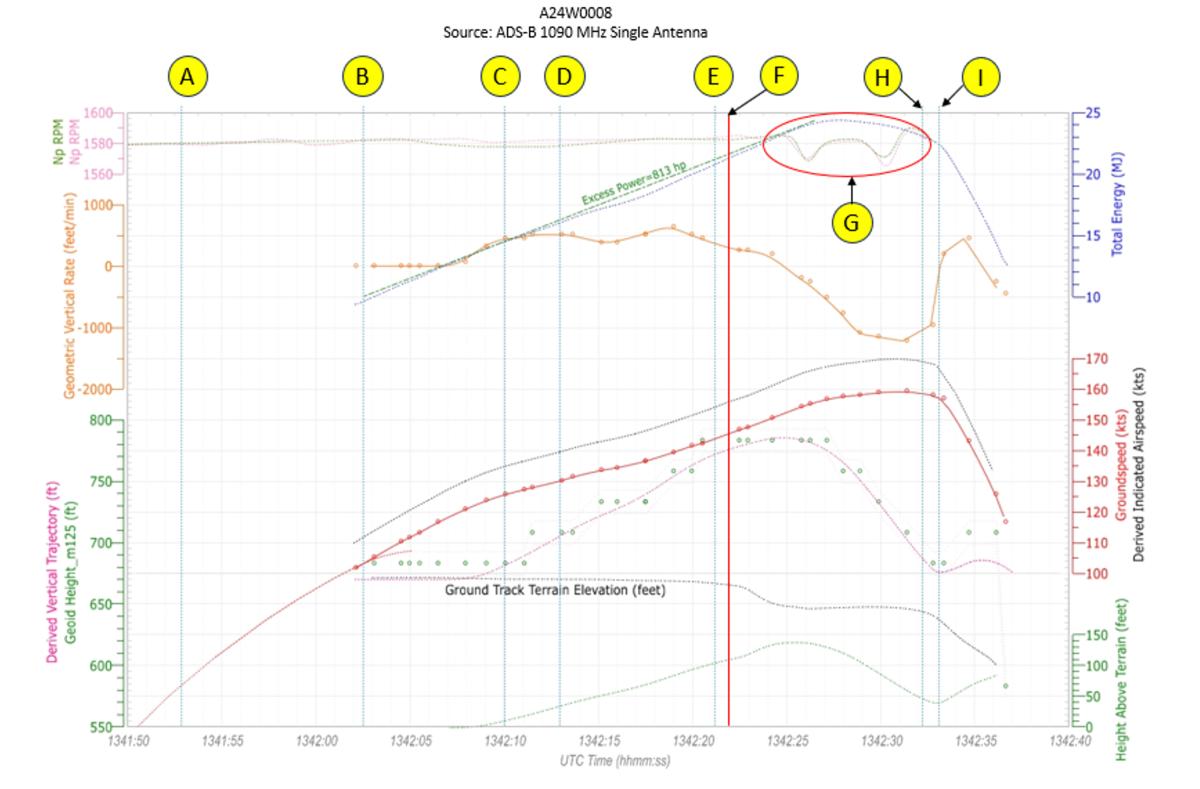
Event | Local time | Elapsed time (seconds) | Event description |
|---|---|---|---|
A | 0641:53 | 0 | “70 knots” call |
B | 0642:03 | 10 | “V1” and “Rotate” calls |
C | 0642:10 | 17 | “Positive rate” call |
D | 0642:13 | 20 | First officer (FO) makes continuous ignition query |
E | 0642:21 | 28 | FO observes abnormal gear indication and calls for speed reduction |
F | 0642:22 | 29 | Aircraft passes the end of Runway 30 |
G | 0642:25 | 32 | Engine rpm fluctuations |
H | 0642:32 | 39 | Terrain awareness and warning system alert, “Descending” call made by FO |
I | 0642:33 | 40 | Initial impact sounds at the end of the runway clearway (end of cockpit voice recorder recording) |