
Collision with terrain
Privately registered
Cessna 421C, N264DC
Tofino/Long Beach Airport (CYAZ), British Columbia
The Transportation Safety Board of Canada (TSB) investigated this occurrence for the purpose of advancing transportation safety. It is not the function of the Board to assign fault or determine civil or criminal liability. This report is not created for use in the context of legal, disciplinary or other proceedings. See Ownership and use of content. Masculine pronouns and position titles may be used to signify all genders to comply with the Canadian Transportation Accident Investigation and Safety Board Act (S.C. 1989, c. 3).
History of the flight
On 18 July 2024, the privately registered Cessna 421C aircraft (U.S. registration N264DC, serial number 421C1248) was conducting a recreational instrument flight rules (IFR) flight from Tofino/Long Beach Airport (CYAZ), British Columbia (BC), to Portland International Airport (KPDX), Oregon, United States, with 1 pilot and 2 passengers on board.
The aircraft departed Runway 16 at approximately 1242.All times are Pacific Daylight Time (Coordinated Universal Time minus 7 hours). Shortly after takeoff, the aircraft occupants observed flames coming from the top of the right engine cowling. The aircraft turned east,All flight data pertaining to the occurrence flight is based on radar information captured by a station approximately 60 nautical miles southeast of the occurrence location. joined the left downwind leg for Runway 25, and levelled off at approximately 320 feet above ground level (AGL) (Figure 1).
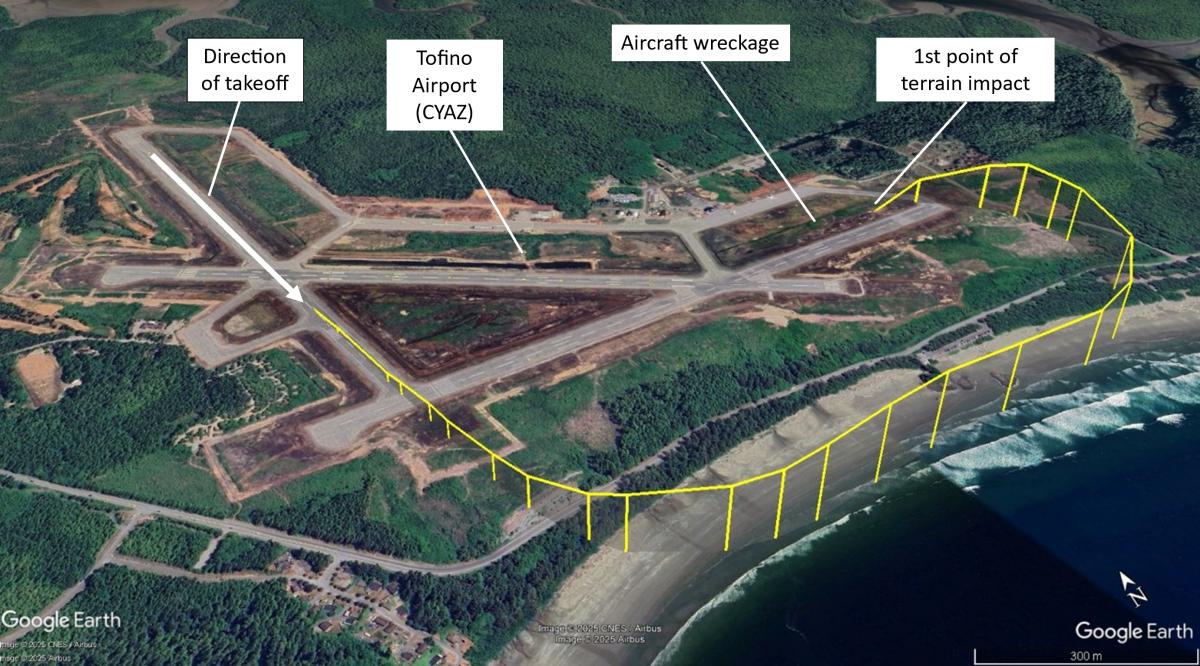
The aircraft subsequently performed a descending steep turn toward the threshold of Runway 25 but overshot the runway centreline to the north. During this turn, the aircraft’s rate of descent increased significantly.
At 1243, approximately 1 minute after takeoff, the aircraft impacted the ground north of Runway 25 in a wings-level attitude with the landing gear extended and the flaps partially extended.Estimated flap selection at time of impact was 15°. The initial point of impact was approximately 206 feet past the runway threshold and 157 feet north of the paved surface of Runway 25.
Post impact, the main landing gear separated from the aircraft while the aircraft travelled approximately 450 feet along the ground before coming to rest. When the aircraft was at approximately the mid-point of the distance travelled on the ground, it caught fire.
One passenger received serious injuries but was able to exit the aircraft. The pilot and the 2nd passenger were fatally injured. The aircraft was destroyed by the post-impact fire. The Canadian Mission Control Centre did not receive an emergency locator transmitter (ELT) signal from the aircraft.
Weather information
Weather was not considered to be a factor in this occurrence.
Pilot information
Based in the United States, the pilot held a private pilot certificate issued by the U.S. Federal Aviation Administration (FAA). He was rated for single- and multi-engine land airplanes and held an instrument airplane rating. He was also rated for rotorcraft helicopter. His Class 3 medical certificate was valid. At the time of the occurrence, the pilot had accumulated approximately 828 hours total flying time, with 678 hours on fixed-wing aircraft, including 145.2 hours on multi-engine aircraft. The pilot had flown a total of 113.8 hours on the occurrence aircraft.
The investigation examined the pilot’s initial multi-engine training and his training specific to the Cessna 421C aircraft. His initial multi-engine training was conducted on a Tecnam P2006 (Tecnam) aircraft from August to November 2023. Three days after his 1st multi-engine training flight on the Tecnam, the pilot purchased the occurrence Cessna 421C while also completing a multi-engine rating on the Tecnam so that he could fly the Cessna 421C.
When compared to the Cessna 421C, the Tecnam has a lower stall speedWing loading for the Tecnam P2006 is 16.37 to 17.1 pounds per square foot, whereas wing loading for the Cessna 421C is approximately 34.65 pounds per square foot. The investigation was unable to find an example of a multi-engine aircraft with a wing loading lower than the Tecnam.,The stall speed in the landing configuration of the Cessna 421C is 77 knots indicated airspeed and 53 knots indicated airspeed for the Tecnam P2006. and when flying with a failed engine, it has a lower minimum control speed and less asymmetric thrust.Transport Canada’s Instructor Guide: Multi-Engine Class Rating, TP 11575E, Second Edition (October 2010), Definitions, Applicable Speeds describes the Minimum Control Speed as “the minimum flight speed at which it is possible to retain control of the aeroplane and maintain straight flight, through the use of maximum rudder deflection and not more than 5° of bank, following sudden failure of the critical engine.”
In its training guidance, the FAA states that “[l]ow-altitude engine failure [training] is never [emphasis in original] worth the risks involved.”Federal Aviation Administration (FAA), FAA-P-8740-66 AFS-8, Flying Light Twins Safely (2008), Training Recommendations, p. 8 at https://www.faasafety.gov/files/notices/2015/Nov/FAA_P-8740-66.pdf (last accessed on 25 February 2026) As a result, low-altitude engine malfunctions in multi-engine aircraft, such as those that may occur during takeoff, are typically simulated at higher altitude or practised in flight simulators. Records indicate the pilot had no flight-simulator training, nor was it required by regulation.
The pilot’s 1st attempt at a multi-engine flight test was unsuccessful. This was in part due to difficulties encountered while conducting a simulated engine failure scenario. Specifically, the pilot did not feather the inoperative engine. A subsequent multi-engine flight test was successful.
After obtaining his multi-engine class rating, the pilot completed training on the Cessna 421C. This consisted of 30.4 hours over 16 flights. Approximately half of these flights included emergency procedures training; however, only a single reference to the in-flight simulation of an engine fire was documented (24 June 2024). The emergency procedure for an engine fire in the occurrence Cessna 421C differs from the Tecnam in both the specific actions required and their ordering. Additionally, the Cessna 421C procedure includes activation of an engine fire suppression system, but the Tecnam is not equipped with such a system. Familiarity with the engine fire procedure for the Tecnam does not translate effectively to the Cessna 421C.
There was no indication that the pilot’s performance was negatively affected by medical, pathological, or physiological factors, including fatigue.
Aircraft information
The Cessna 421C is a low-wing, twin-engine, light aircraft with a pressurized cabin. The occurrence aircraft (Figure 2), manufactured in 1982, was equipped with 2 Continental Aerospace Technologies GTSIO-520-N engines and constant-speed propellers. It was also equipped with a fire detection and suppression system for each engine. At the time of the occurrence, the aircraft had flown approximately 2795 hours.The total aircraft flight hours were determined using available maintenance records and subsequent hours flown, as documented by radar records or the occurrence pilot’s personal digital log, with times corrected from flight time to estimated air time.

None of the original aircraft documents, including aircraft technical logs, were available to the investigation because they were on board the aircraft and were destroyed in the post-impact fire.
A flight plan filed for the occurrence flight indicated the aircraft had an endurance of 4 hours and 3 minutes.Approximately 162 U.S. gallons of 100LL AVGAS, based on fuel burn at cruise power settings. The investigation was unable to determine if the aircraft was operating within its weight and balance limitations at the time of the occurrence.
Based on records supplied by the aircraft maintainer, the aircraft’s last annual inspection occurred on 01 August 2023.Based on records obtained by the maintenance provider. The aircraft’s subsequent annual inspection would have been due on 01 September 2024. A recurring airworthiness directive (AD) exists for this aircraft for the purpose of detecting and correcting “cracks and corrosion in the exhaust system, which could result in exhaust system failure and a possible uncontrollable in-flight fire with pilot and/or passenger injury."Federal Aviation Administration (FAA), Airworthiness Directive No. 2000-01-16: Cessna Aircraft Company 300 and 400 Series Airplanes (effective 15 February 2000), Summary.
One of the requirements of this AD—a visual inspection of the exhaust system—was overdue at the time of the occurrence.The Canadian Aviation Regulations (CARs) paragraph 605.84(1)(b) state that, “[…] no person shall conduct a take-off […] unless the aircraft […] meets the requirements of any airworthiness directive issued under section 521.427 […].” This inspection must be performed for every 50 hours of time in service or every 30 days, whichever occurs later. Documentation indicated that this inspection was last performed at approximately 102 hours, and 352 days before the occurrence.
U.S. federal regulations state that an aircraft owner or operatorAccording to the Federal Aviation Administration (FAA), Code of Federal Regulations, Title 49, Subtitle B, Chapter XII, Subchapter C, Part 1540, Subpart A, section 1540.5, aircraft operator “means a person who uses, causes to be used, or authorizes to be used an aircraft […] for the purpose of air navigation including the piloting of aircraft […].” is responsible for compliance with the ADs applicable to their aircraft. In Canada, this responsibility is assigned to aircraft owners and lessees.
The aircraft’s right engine was examined by TSB investigators and laboratory personnel at an engine repair and maintenance facility in Kamloops, BC. The right engine turbocharger was sent to the TSB Engineering Laboratory in Ottawa, Ontario, for further analysis. During examination of the turbocharger components, it was noted that the 1-piece V-band clamp, which connects the engine turbocharger to its exhaust pipe, exhibited wear. This indicates that it may have been either improperly installed or misaligned.
A reportGeneral Aviation Joint Steering Committee, Exhaust System Turbocharger to Tailpipe V-band Coupling / Clamp Working Group - Final Report (January 2018), at https://www.gajsc.org/wordpress/wp-content/uploads/2018/04/Final-Report-BPG-ACS_013018.pdf (last accessed on 24 February 2026). was published by the General Aviation Joint Steering CommitteeThe General Aviation Joint Safety Committee is an American public-private partnership that includes the Federal Aviation Administration (FAA) and other industry stakeholders, including pilot organizations, flight instructors, mechanics, builders, and manufacturers. in 2018, which examined V-band clamp failures associated with turbocharged, reciprocating-engine-powered aircraft. Among the report’s findings, installation issues associated with these V-band clamps were noted as a “common thread.” The report also noted a “high probability for uncontrolled, in-flight fire” following a cracked and separated V-band clamp.
In-flight fire
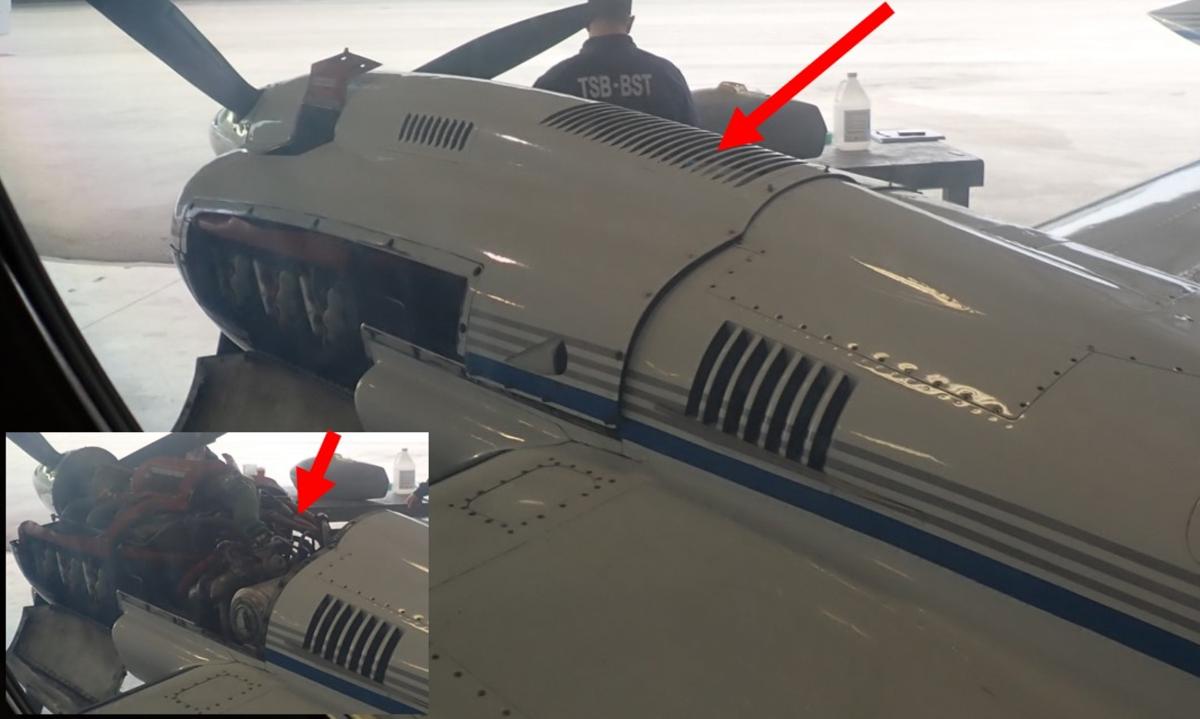
An in-flight fire, located in the right engine nacelle (Figure 3), occurred just after takeoff. The fire characteristics were consistent with a turbocharger exhaust fire resulting from a disconnected turbocharger exhaust pipe. It is unknown if the aircraft fire warning system activated.All components of the aircraft fire warning and suppression system were consumed by post-impact fire and could not be examined.
The engine fire emergency procedure (Figure 4) contains memory items (boxed) and non-memory items (not boxed).In the Cessna 421C pilot operating handbook, emergency procedure steps that are enclosed within a solid black line (“boxed” items) are immediate-action items and should be committed to memory
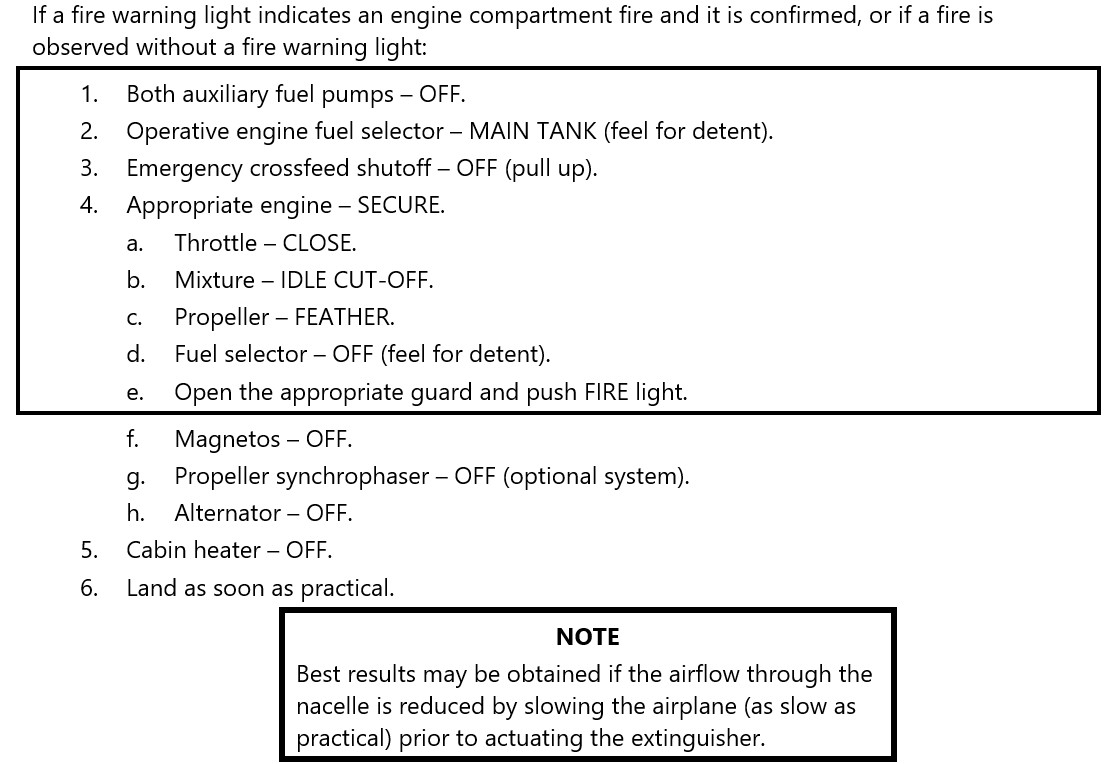
The engine fire emergency procedure
If a fire warning light indicates an engine compartment fire and it is confirmed, or if a fire is observed without a fire warning light: |
| 1. Both auxiliary fuel pumps – OFF. 2. Operative engine fuel selector – MAIN TANK (feel for detent). 3. Emergency crossfeed shutoff – OFF (pull up). 4. Appropriate engine – SECURE. a. Throttle – CLOSE. b. Mixture – IDLE CUT-OFF. c. Propeller – FEATHER. d. Fuel selector – OFF (feel for detent). e. Open the appropriate guard and push FIRE light. |
| f. Magnetos – OFF. g. Propeller synchrophaser – OFF (optional system). h. Alternator – OFF. 5. Cabin heater – OFF. 6. Land as soon as practical. |
NOTE Best results may be obtained if the airflow through the nacelle is reduced by slowing the airplane (as slow as practical) prior to actuating the extinguisher. |
The aircraft was found post accident with the throttle, mixture, and propeller controls all in their forward positions rather than in the positions required by the checklist. The period of straight and level flight available to perform the procedure while the aircraft was not climbing, descending, or turning, was approximately 14 seconds.
Turn to final
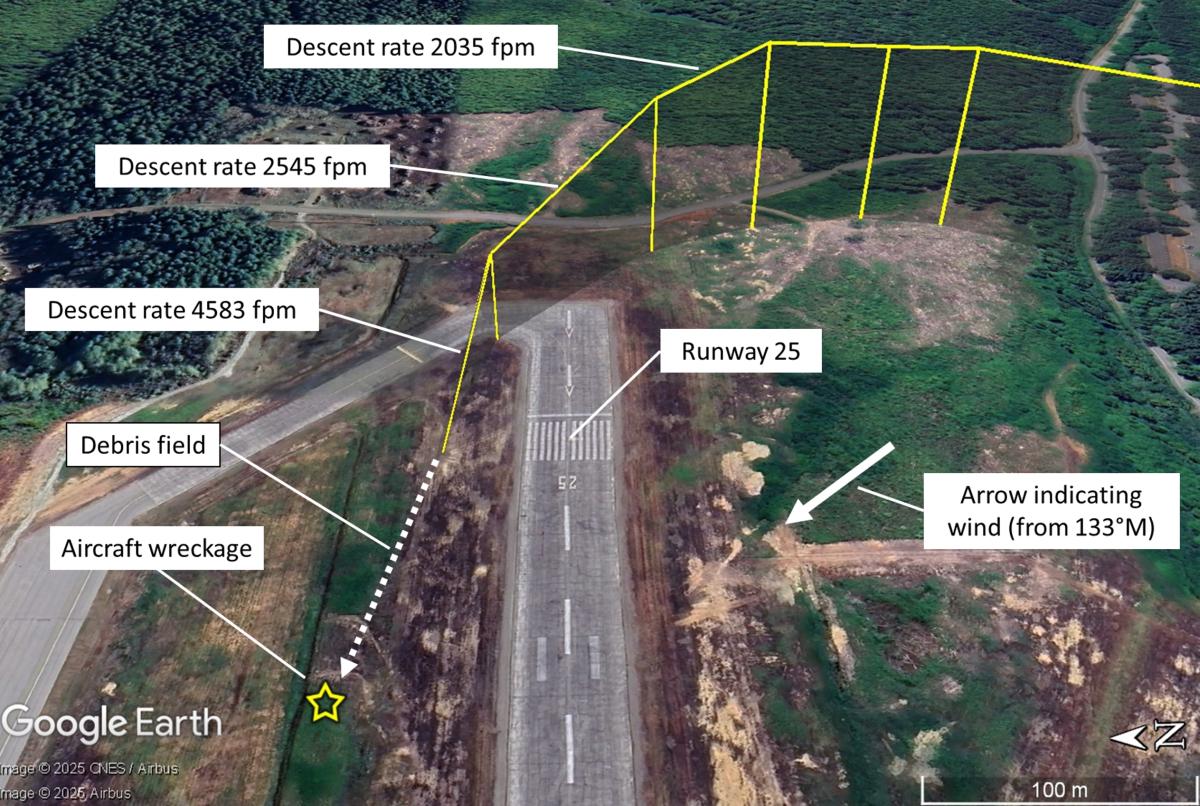
The aircraft’s stall warning systemThe occurrence aircraft was equipped with an audible stall warning system that activates when the aircraft is travelling 5 to 10 knots indicated airspeed above the stall speed in all flight configurations. activated while the aircraft was performing the descending turn toward the threshold of Runway 25 (Figure 5). The descent rate for a normal approach to landing in the Cessna 421C is approximately 500 fpm.Based on a 3° glide slope and the pilot operating handbook recommended approach speed of 100 knots indicated airspeed. Between the last 2 recorded data points during the turn, the aircraft’s rate of descent averaged approximately 4583 fpm. The maximum bank angle during the turn was calculated to be 57°, and the lowest true airspeed was calculated to be 110 knots.
Wreckage and impact information
Post impact, aircraft components, including the main landing gear, landing gear doors, fairings, a propeller blade, and nose cargo doors, separated from the aircraft and were later found along a linear debris field. The post-impact fire that began before the aircraft came to rest consumed the aircraft nose, cockpit, upper fuselage, cabin interior, as well as portions of both wings, nacelles, and engines. The aircraft pivoted approximately 90° to the right at the end of its ground travel.
Damage to both engines and propellers was consistent with power being produced at the time of impact. Flight control continuity was established to the rudder and elevator bell crank but could not be established to the ailerons owing to fire damage. Rudder trim was found to be in an approximately neutral position.
The turbocharger exhaust for the right engine was found disconnected from its turbocharger, whereas the same components for the left engine were found connected.
Survival aspects
Approximately 128 pounds of fish, in 4 unsecured boxes, were inside the aircraft cabin. The investigators observed that remnants of these boxes and their contents were scattered throughout the aircraft aisle and cabin. It is not known to what degree this cargo may have impeded egress.
The occurrence aircraft was equipped with an automatic-fixed ELT capable of transmitting on 121.5 MHz and 243 MHz. The ELT was not damaged by fire, and the ELT switch was found in the armed position when the ELT was removed from the aircraft. The ELT was also sent to the TSB Engineering Laboratory for analysis. The ELT and its G-switch functioned under laboratory testing. During transmission tests, the ELT did not meet all regulatory specifications,Likely due to aging of the ELT electronic circuitry and out-of-specification components. but it was capable of producing a 121.5 MHz transmission.
Transport Canada regulations require foreign-registered aircraft operating in Canada to carry either an ELT or personal locator beacon (PLB) capable of transmitting on 406 MHz.Transport Canada, SOR/96-433, Canadian Aviation Regulations, subsection 605.38(3). The occurrence aircraft was not equipped with a 406 MHz ELT, and the presence of a PLB could not be determined. The absence of an ELT transmission did not influence the survivability of the occurrence.
TSB laboratory reports
The TSB completed the following laboratory reports in support of this investigation:
- LP116/2024 – Aircraft Track Superimposed Over Terrain
- LP134/2024 – ELT Analysis
- LP138/2024 – Right Hand Engine Teardown
- LP167/2024 – Turbocharger Analysis
Safety messages
It is important that pilots have pre-departure plans for handling emergencies on takeoff. These plans should consider factors such as pilot experience, wind conditions, and all available landing options.
Pilots must be sufficiently trained in emergency procedures so that these procedures can be performed successfully in an emergency, which is a high-workload situation.
Loose or unsecured cargo and baggage can become projectiles or block an aircraft exit during an accident, creating a hazard for flight crew and passengers. Therefore, it is important that pilots ensure that these items are secured before flight.
Failures of turbocharger exhaust-to-tailpipe V-band clamps and couplings can result in engine fires. Therefore, V-band clamps on aircraft turbochargers must be installed, maintained, and inspected in accordance with the published guidance. Additionally, many of these V-band clamps and couplings are subject to ADs. Compliance with ADs is the responsibility of aircraft owners and lessees.
This report concludes the Transportation Safety Board of Canada’s investigation into this occurrence. The Board authorized the release of this report on 04 March 2026. It was officially released on 12 March 2026.