
Controlled flight into terrain
Air Tindi Ltd.
De Havilland DHC-6 Twin Otter Series 300, C-GMAS
Diavik Aerodrome (CDK2), Northwest Territories, 7 NM SE
The Transportation Safety Board of Canada (TSB) investigated this occurrence for the purpose of advancing transportation safety. It is not the function of the Board to assign fault or determine civil or criminal liability. This report is not created for use in the context of legal, disciplinary or other proceedings. See Ownership and use of content. Masculine pronouns and position titles may be used to signify all genders to comply with the Canadian Transportation Accident Investigation and Safety Board Act (S.C. 1989, c. 3).
Summary
At 1205 Mountain Standard Time on 27 December 2023, the wheel-ski equipped Air Tindi Ltd. De Havilland Inc. DHC-6 Twin Otter Series 300 (registration C-GMAS, serial number 438) aircraft departed Margaret Lake, Northwest Territories, as flight TIN601, on a visual flight rules flight to Lac de Gras, Northwest Territories, with 2 flight crew members, and 8 passengers on board.
Upon arriving over the Lac de Gras road camp, the flight crew conducted 4 approaches toward the desired landing area on the frozen lake surface, descending at times to heights below 50 feet above ground level. During the 4th and final approach attempt, the aircraft descended to below 50 feet above ground level, and the flight crew lost visual contact with the terrain. At 1245 Mountain Standard Time, the aircraft impacted the terrain 1 nautical mile southeast from the desired landing site. Two passengers were seriously injured and were unable to egress. The remaining occupants, including one passenger who was ejected, sustained minor injuries. The aircraft was substantially damaged from the impact forces. There was no post impact fire. The emergency locator transmitter activated, and search and rescue personnel from the Canadian Armed Forces and a volunteer search party from Diavik mine, Northwest Territories, arrived on the scene 8 hours after the occurrence. The following morning, all but the volunteer search party were flown to Diavik Aerodrome (CDK2), Northwest Territories, and subsequently to Yellowknife Airport (CYZF), Northwest Territories.
1.0 Factual information
1.1 History of the flight
Cockpit voice recordings Annex 13 to the Convention on International Civil Aviation requires States conducting accident investigations to protect cockpit voice recordings.International Civil Aviation Organization (ICAO), Annex 13 to the Convention on International Civil Aviation, Aircraft Accident and Incident Investigation, Thirteenth Edition (July 2024), paragraph 5.12. Canada complies with this requirement by making all on-board recordings—including those from cockpit voice recorders (CVR)—privileged in the Canadian Transportation Accident Investigation and Safety Board Act. While the TSB may make use of any on-board recording in the interests of transportation safety, it is not permitted to knowingly communicate any portion of an on-board recording that is unrelated to the causes or contributing factors of an accident or to the identification of safety deficiencies. The reason for protecting CVR material lies in the premise that these protections help ensure that pilots will continue to express themselves freely and that this essential material is available for the benefit of safety investigations. The TSB has always taken its obligations in this area very seriously and has vigorously restricted the use of CVR data in its reports. Unless the CVR material is required to both support a finding and identify a substantive safety deficiency, it will not be included in the TSB’s report. To validate the safety issues raised in this investigation, the TSB has made use of the available CVR information in its report. In each instance, the material has been carefully examined in order to ensure that it is required to advance transportation safety. |
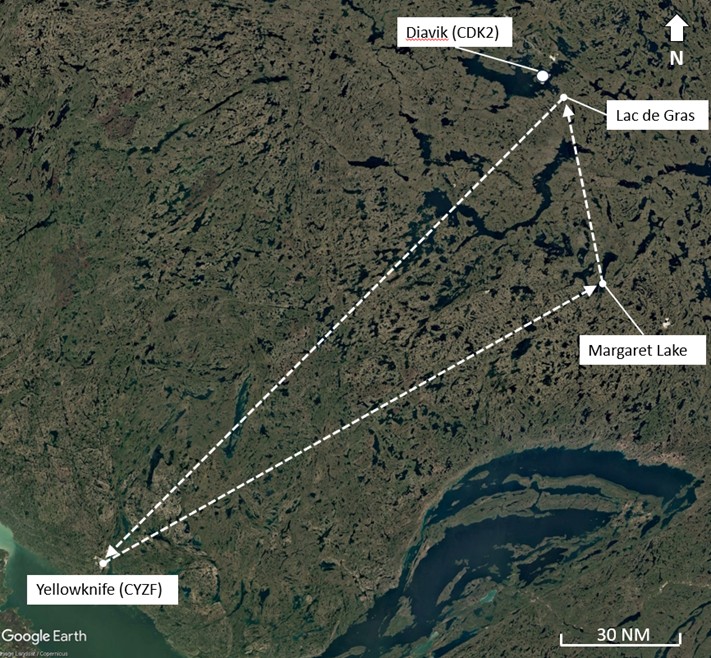
On 27 December 2023, two Air Tindi Ltd. (Air Tindi) De Havilland Inc. DHC-6 Twin Otter Series 300 (Twin Otter) aircraft were scheduled to depart Yellowknife Airport (CYZF)All locations mentioned in this report are in the Northwest Territories, unless otherwise noted. at 1000.All times are Mountain Standard Time (Coordinated Universal Time minus 7 hours). The Twin Otters were tasked with transporting workers and supplies to camps at Margaret Lake and Lac de Gras. After landing at Margaret Lake, one Twin Otter was to return to CYZF, and the occurrence aircraft, C-GMAS, would continue to land at Lac de Grasand then return to CYZF.
The occurrence aircraft was to conduct the 3 legs of its flight (as flight number TIN601) under visual flight rules (VFR)(Figure 1).
The first officer (FO) of the occurrence aircraft arrived at CYZF at approximately 0830 on the day of the occurrence and began checking the weather for the day. The FO then began to prepare the aircraft for departure.
Along with the captain, the FO reviewed the weather for the Gahcho Kué mine, Diavik Aerodrome (CDK2), and the surrounding area and proceeded to board 8 passengers for the flight to Margaret Lake. The captain would be the pilot flying (PF) for the first 2 legs, and the FO would be the pilot monitoring (PM).
At 1055, the flight crews of the 2 Air Tindi Twin Otters started their engines and prepared to depart from CYZF to Margaret Lake. Before departing, the flight crew of the occurrence aircraft briefed an initial en-route altitude of 1500 feet above ground level (AGL), with the plan to climb to a higher altitude later in the flight to take advantage of the strong westerly winds.
The occurrence aircraft departed CYZF at 1057, initially levelling off at a height of 1500 feet AGL. At 1104, in an effort to prevent unwanted terrain warnings announcing the hills near Lac de Gras, the flight crew disabled the aircraft’s terrain awareness and warning system (TAWS) by pulling the circuit breaker.
Shortly after the system was disabled, the occurrence aircraft began a climb through a layer of ice crystals, which it exited at 1109. It then proceeded to fly over the layer of ice crystals at an altitude of approximately 5500 feet above sea level (ASL).
At 1138, the occurrence aircraft began its descent to Margaret Lake. The flight crew observed the other Twin Otter’s approach and landing at Margaret Lake through the automatic dependent surveillance – broadcast (ADS-B) input on their electronic flight bags (EFBs).Electronic flight bags (EFBs) are explained in detail in Section 1.17.10 Electronic flight bag of this report.,The investigation was unable to determine which EFB was used when, only that they were used. This is reflected in the language used in the report.
At approximately 15 nautical miles (NM) from the improvised airstrip,An improvised airstrip is an unimproved surface used by an aircraft to land and take off as opposed to a runway, which is an improved, established, and monitored surface for aircraft to land and take off. the occurrence aircraft was levelled off at 500 feet AGL, and then it continued inbound toward the airstrip. At a distance of 1 NM from the airstrip, the flight crew spotted the camp that was adjacent to the surface where the flight crew was planning to land. The occurrence aircraft joined a left-hand downwind, remaining within ½ NM of the improvised airstrip, and completed the turn to final. At a distance of 0.2 NM from the airstrip, the aircraft lined up on final with aid from the airstrip markers. The aircraft touched down at 1152.
While on the ground, the occurrence aircraft flight crew discussed the fact that the weather was deteriorating, as well as options for conducting visual approaches in reduced visibilities on their next leg to Lac de Gras should the weather continue to deteriorate.
At 1158, the flight crews in both aircraft started their engines with the intention of backtracking down the airstrip together and then departing one after the other. The occurrence aircraft backtracked first, followed by the 2nd Twin Otter. Having reached the end of the airstrip, the occurrence aircraft flight crew turned into the wind and could not see the other Twin Otter, which was still backtracking, because of the blowing snow. The 2nd Twin Otter flight crew could not see the occurrence aircraft either and therefore opted to conduct a maximum performance short takeoff from halfway down the airstrip. The flight crew of the occurrence aircraft was able to confirm that the 2nd Twin Otter had departed once it could see it had climbed above the blowing snow and was turning toward CYZF.
At 1205, the occurrence aircraft flight crew commenced their take-off run from the improvised airstrip and initially levelled off at approximately 500 feet AGL for the flight to Lac de Gras.
While en route, the aircraft remained below the ceiling, which the flight crew estimated to have decreased to between 300 and 400 feet AGL with approximately ½ statute miles (SM) of forward visibility in light freezing drizzle. The flight crew considered the possibility of doing an improvised instrument approachImprovised instrument approaches are discussed in more detail in Section 1.17.7.4 Improvised approach procedures of the report. to Lac de Gras. At 1222, the flight crew attempted to contact the CDK2 universal communications station (UNICOM) for the station-reported weather. They waited a few minutes and called a 2nd time. Shortly after, they received a weather report indicating that winds were from 300° magnetic (M) at 25 knots gusting to 32 knots, with ½ SM visibility in blowing snow. The flight crew then loaded the Air Tindi Keyhole Markup Language (KML) fileKeyhole Markup Language (KML) is a format used to display geographical information through moving map applications such as Google Earth or ForeFlight. KML files are discussed in more detail in Section 1.17.6.1.1 Company Keyhole Markup Language files of the report. for the Lac de Gras road camp airstrip, which was on the lake’s frozen surface, into their respective EFBs. The PM extended the centreline for the north-south landing surface from the file on his EFB to provide lateral guidance into the Lac de Gras road camp airstrip from a greater distance away. The PF then intercepted the approach course 2.5 NM from the intended landing surface with guidance from the PM, who was using the EFB (A on Figure 2).
At 1228, at a distance of 1¾ NM from the Lac de Gras road camp and a height of 220 feet AGL, flaps to 10° were selected to help slow the aircraft. The flight crew spotted the road camp 1 minute later when they were at a distance of ½ NM. The aircraft overflew the road camp at 250 feet AGL and began a left-hand circuit for a visual inspection of the intended landing surface (B on Figure 2). While on the base leg for the inspection, the flight crew put the aircraft in a landing configuration,The landing configuration of flaps 20° and propellers levers full forward may also be used for inspection passes. (setting the flaps to 20° and the propellers levers full forward) (green square on Figure 2). After turning final, while overflying the desired landing surface at a height of between 50 and 100 feet AGL for the inspection pass, the flight crew was unable to differentiate the shoreline from the ice on the lake on which they intended to land and conducted a go-around (C on Figure 2).
The occurrence aircraft began a left-hand orbitFor the purposes of this report, an orbit is a circular path with no intention to land, as opposed to a circuit, which is a similar circular path, but with an attempt to land. of the desired landing area (D on Figure 2). While orbiting the landing area, the flight crew determined that the visibility and ceiling would not allow for a visual approach (Table 1).
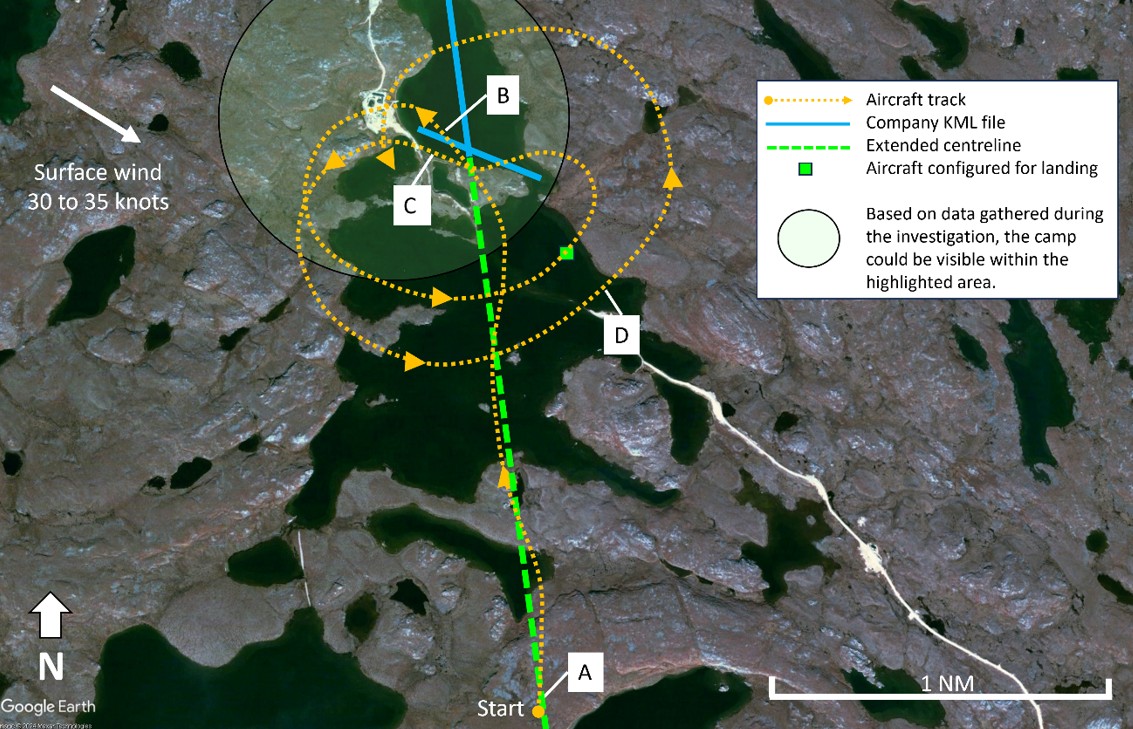
Event | Time (hhmm:ss) | Height (feet AGL) | Ground speed (knots) | Event description |
|---|---|---|---|---|
A | 1228:07 | 215 | 92 | Intercepted approach course |
B | 1229:25 | 250 | 70 | Overflew the road camp |
C | 1230:56 | 50 | 55 | Conducted a go-around |
D | 1231:59 | 495 | 123 | Left-hand orbit of the desired landing surface |
The occurrence aircraft conducted a 2nd orbit of the desired landing area to determine an appropriate heading for an improvised omni-bearing selector (OBS) approach.Section 1.17.7.4.2 Omni-bearing selector approach/heading approach of the report contains more information on this improvised instrument approach procedure. The flight crew agreed it would be best to conduct an improvised OBS approach to a new desired landing surface on a heading of 220°M (E on Figure 3). Approximately 1 NM to the east of the new desired landing surface, at an altitude of 290 feet AGL, a left turn was initiated, and the aircraft rolled out on an approach heading of 220°M (F on Figure 3) at approximately 155 feet AGL without compensating for the strong westerly winds. Once the turn was complete, the aircraft was aligned ½ NM to the southeast of the desired landing surface. The aircraft was configured for landing (green square on Figure 3) and continued the improvised instrument approach to between 100 and 50 feet AGL. With the aid of his EFB, the PM determined the aircraft was not aligned with the desired landing surface, and a go-around was initiated (G on Figure 3). During the go-around, at approximately 120 feet AGL, the flight crew entered instrument meteorological conditions (IMC)IMC or instrument meteorological conditions means meteorological conditions less than the minima specified in Part VI, Subpart 2, Division VI of Transport Canada’s Canadian Aviation Regulations (CARs) for visual meteorological conditions, expressed in terms of visibility and distance from cloud. and were unable to determine their position visually (H on Figure 3) (Table 2).
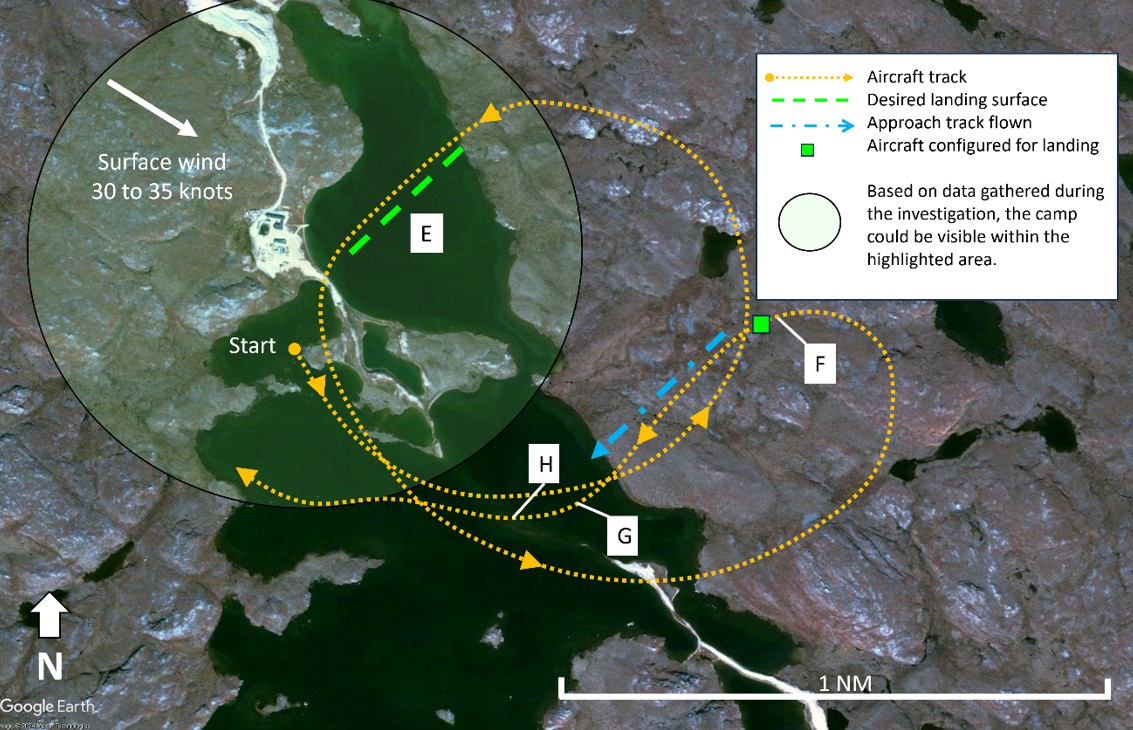
Event | Time (hhmm:ss) | Height (feet AGL) | Ground speed (knots) | Event description |
|---|---|---|---|---|
E | 1234:32 | 245 | 76 | Determined new desired landing surface and approach heading |
F | 1235:53 | 155 | 75 | Rolled out on heading 220°M |
G | 1236:12 | 50 | 57 | Initiated a go-around |
H | 1236:20 | 120 | 54 | Entered IMC |
While the aircraft climbed back up to approximately 300 feet AGL, the flight crew began to program a new improvised extended centreline approach into the EFB. The aircraft commenced a left-hand circuit (I on Figure 4) for a 3rd approach to a northbound landing. During the turn from downwind to final, the aircraft overshot the desired northbound track but then intercepted it with the flight crew’s use of an approach built on the EFB (J on Figure 4). Unable to see the lake, the flight crew relied on the EFB for positional information. Once the flight crew spotted the road camp approximately ½ NM away, they determined that the crosswind was too high to continue with a northbound landing, and the aircraft again entered a go-around of the road camp.
After the go-around, the aircraft began to drift upwards, steadily gaining altitude, and entered a right-hand downwind 2 NM to the north of the road camp (K on Figure 4). At 1241, the PF indicated on an EFB that he intended to fly a modified right-hand circuit and approach the road camp on a westerly heading, and the PM proceeded to build a 4th improvised approach into the EFB. On the downwind leg, the aircraft inadvertently climbed to approximately 1000 feet AGL (L on Figure 4). At the time of the 4th approach, the visibility was approximately ½ SM. During the base leg, the aircraft began descending (Table 3).
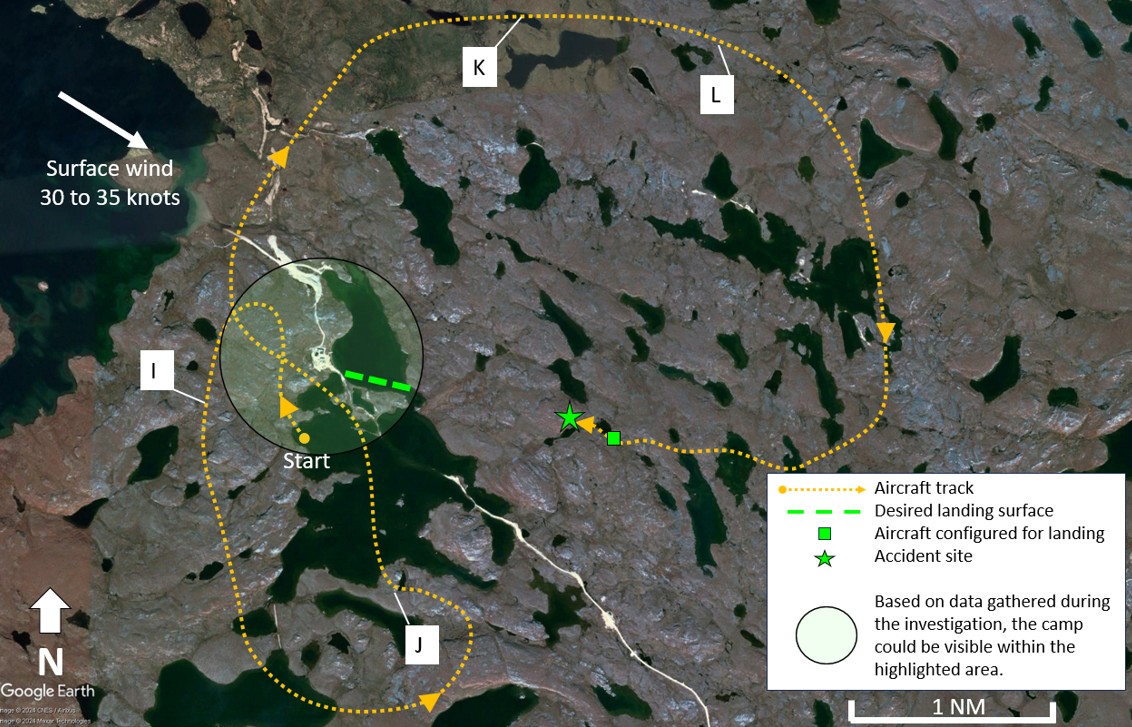
Event | Time (hhmm:ss) | Height (feet AGL) | Ground speed (knots) | Event description |
|---|---|---|---|---|
I | 1237:43 | 280 | 96 | Left-hand circuit for northbound approach |
J | 1239:40 | 155 | 62 | Intercepted desired northbound approach track |
K | 1242:01 | 700 | 124 | Right-hand downwind for westbound approach |
L | 1242:41 | 1000 | 130 | Inadvertent climb to 1000 feet AGL |
When the aircraft rolled out on final, it was approximately 2 NM from the road camp and at 150 feet AGL. After establishing the aircraft on the final approach course, the flight crew relied on the EFB guidance to determine their position relative to the desired landing path. The aircraft continued to descend to approximately 50 feet AGL on the final approach course. The PM was verbally providing lateral guidance to the PF based on the track on his EFB. At 1245:20, the aircraft was configured for landing (green square on Figure 4). When the aircraft was 1.5 NM from the desired landing surface, the PF descended below 50 feet AGL in anticipation of landing. At 1245:28, both flight crew members saw a hill in the windscreen. The PF applied full power, and both pilots pulled aft on the yoke to initiate a pitch up. The last recorded ground speed of the aircraft was 44 knots. The aircraft impacted the terrain 2 seconds later at 1245:30.
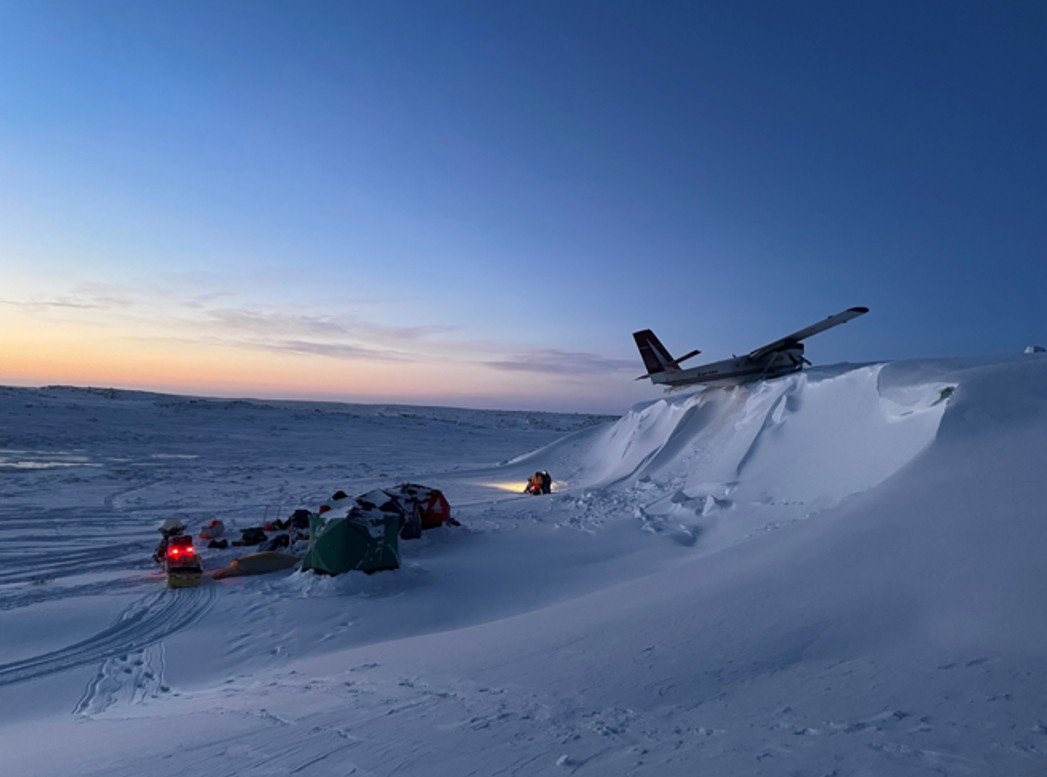
The aircraft came to rest balanced on the crest of the hill, with half of the aircraft overhanging the edge. The emergency mode on the aircraft SKYTRAC ISAT-200A tracking system was activated by the FO at 1247:50, notifying Air Tindi of the accident. The Canadian Mission Control Centre (CMCC) in Trenton, Ontario, received an emergency locator transmitter (ELT) signal from the aircraft on the 406 MHz frequency at 1248.
The Diavik mine assembled a volunteer search party to assist with the rescue. The search party departed from the mine at 1904 on 4 snowmobiles with additional winter survival equipment, travelling to the site at night through a blizzard. Canadian Armed Forces search and rescue technicians (SAR Techs) and the Diavik mine volunteers arrived at the scene at approximately the same time, at 2036.The search and rescue operation is discussed in more detail in Section 1.15 Survival aspects of the report.
Everyone stayed at the occurrence site overnight. The next morning, everyone but the Diavik mine volunteer search party was airlifted to CDK2 and subsequently flown to CYZF. The search party from Diavik mine rode their snowmobiles back to the mine.
1.2 Injuries to persons
There were 2 flight crew members and 8 passengers on board.
Table 4 outlines the degree of injuries received.
Degree of injury | Crew | Passengers | Persons not on board the aircraft | Total by injury |
|---|---|---|---|---|
Fatal | 0 | 0 | – | 0 |
Serious | 0 | 2 | – | 2 |
Minor | 2 | 6 | – | 8 |
Total injured | 2 | 8 | – | 10 |
1.3 Damage to aircraft
The aircraft was substantially damaged by impact forces.See Section 1.12 Wreckage and impact information of the report for more details.
1.4 Other damage
There was no other damage.
1.5 Personnel information
Captain | First officer | |
|---|---|---|
Pilot licence | Airline transport pilot licence (ATPL) - Aeroplane | Commercial pilot licence (CPL) - Aeroplane |
Medical expiry date | 01 May 2024 | 01 December 2024 |
Total flying hours | approximately 14 300 | approximately 400 |
Flight hours on type | approximately 8000 | approximately 200 |
Flight hours in the 24 hours before the occurrence | 1.8 | 1.8 |
Flight hours in the 7 days before the occurrence | 3.6 | 16.6 |
Flight hours in the 30 days before the occurrence | 14.1 | 64.6 |
Flight hours in the 90 days before the occurrence | 66.3 | 167.1 |
Flight hours on type in the 90 days before the occurrence | 66.3 | 167.1 |
Hours on duty before the occurrence | 2.8 | 4.2 |
Hours off duty before the work period | 110 | 66 |
The captain was the PF during the occurrence flight and was sitting in the left seat. The FO was the PM and occupied the right seat.
1.5.1 Captain
The captain was hired by Air Tindi in 2008 as a captain on Beechcraft King Air aircraft, a position that he held for approximately 2.5 years. On 05 June 2010, he completed his line indoctrination as a captain on Twin Otter aircraft. On 12 July 2011, approximately 1 year after completing his line indoctrination, he was made a training captain on the Twin Otter. At the time of the occurrence, the captain flew both the Twin Otter and Single Otter aircraft as an off-strip captain,Off-strip or off-airport flying is a term used to describe the takeoff and landing of aircraft where no runway has been constructed. It may include operations on wheels, floats, or skis. Off-strip captain is a term used by Air Tindi to describe the pilot-in-command of an aircraft operating off-strip. operating aircraft on wheels, skis, and floats. Before joining Air Tindi, the captain had worked for a different Canadian air operator in Ontario, flying Cessna Caravan, Pilatus PC-12, and Twin Otter aircraft in airport-to-airport and off-strip operations.
The captain’s most recent Twin Otter pilot proficiency check was completed on 30 October 2023.
The captain held the appropriate licence and ratings for the flight in accordance with existing regulations.
1.5.2 First officer
The FO joined Air Tindi in 2021 as a flight dispatcher. During his time as a dispatcher, he worked toward his commercial pilot licence. He obtained his commercial pilot licence on 15 March 2023. On 20 April 2023, he successfully completed a Twin Otter pilot proficiency check and was promoted to part-time FO on the Twin Otter beginning on 01 August 2023. The FO was then promoted to a full-time flying position on 17 November 2023. This is a typical progression for new pilots at Air Tindi.
The FO held the appropriate licence and ratings for the flight in accordance with existing regulations.
1.6 Aircraft information
1.6.1 General
The occurrence aircraft, a De Havilland Inc. DHC-6 Twin Otter Series 300, is a twin-engine turboprop aircraft that features a high wing with struts, fixed landing gear, and an unpressurized cabin. The aircraft was designed as a rugged short takeoff and landing commuter, capable of off-airport takeoffs and landings. To achieve the short takeoff and landing performance, the Twin Otter was designed to have a low stall speed allowing it to conduct approaches at low speeds. The aircraft is certified for single-pilot operations, but many air operators often operate the aircraft with a flight crew of 2, as in the occurrence flight. At the time of the occurrence, the occurrence aircraft was equipped with wheel skis and seating for 9 passengers.
Manufacturer | De Havilland Inc.* |
|---|---|
Type, model, and registration | DHC-6 Twin Otter Series 300, C-GMAS |
Year of manufacture | 1974 |
Serial number | 438 |
Certificate of airworthiness | 09 April 1976 |
Total airframe time | 51 995.2 hours |
Engine type (number of engines) | Pratt & Whitney Canada PT6A-27 (2) |
Propeller type (number of propellers) | Hartzell HC-B3TN-3DY (2) |
Maximum allowable take-off weight | 12 500 lb (5669 kg) |
Recommended fuel types | Jet A, Jet A-1, Jet B |
Fuel type used | Jet A-1 |
* De Havilland Aircraft of Canada Limited is the current type certificate holder for the DHC-6.
There were no recorded defects outstanding at the time of the occurrence. There was no indication that a component or system malfunction played a role in this occurrence.
The aircraft’s weight and centre of gravity were within the prescribed limits.
1.6.2 Flight instruments
1.6.2.1 Terrain awareness and warning system
The occurrence aircraft was equipped with a Sandel ST3400 TAWS/RMI (radio magnetic indicator) unit, which is a TAWS Class A and Class B system. This met the requirements of the Canadian Aviation Regulations (CARs).Transport Canada, SOR/96-433, Canadian Aviation Regulations (CARs), subsection 703.71(1). The CARs also stipulate that the aircraft may be operated without being equipped with an operative TAWS if the aircraft is operated in day VFR only or if it is necessary, in the interest of aviation safety, for the pilot-in-command to deactivate it.Ibid., subsection 703.71(2).
The unit is capable of providing flight crews with various levels of alerts ranging in urgency from amber caution alerts to red warning alerts. Amber caution alerts require a pilot’s immediate attention whereas red warning alerts require immediate aggressive pilot action.Sandel, ST3400 TAWS/RMI with Traffic Capability: Pilot’s Guide (February 2004), Responding to an Alert, p. 47. When an aircraft is operating from aerodromes with runways under 2500 feet in length or from improvised strips, of which neither are in the unit’s database, the unit provides a TAWS INH (inhibit) function that cancels all forward-looking terrain avoidance and premature descent alerts but does not cancel basic ground proximity warning system alerts. The aircraft flight manual does not provide a specific procedure for a response to a TAWS warning; however, the Air Tindi Flight Operations Manual (FOM) provides guidance as to the actions to be taken in the event of a ground proximity warning.Air Tindi Ltd., Flight Operations Manual, Edition 4: Version 7 (09 December 2022), section 13.36: TAWS/EGPWS Procedures, p. 13-44.
Given the distraction caused by having both cautions and warnings activated during off-strip landings, Twin Otter pilots at Air Tindi would disable the TAWS by pulling the circuit breaker. Following discussions with 11 Air Tindi pilots, the investigation determined that there was no common procedure on when to disable the TAWS. The company does not provide any guidance on whether or when the TAWS should be disabled.
1.6.2.2 Radio altimeter
Radio altimeters detect the height of the aircraft above ground in real time and are effective up to 2500 feet AGL. They have no ability to look forward – they can only detect height immediately below the aircraft. The occurrence aircraft’s radio altimeter was functional at the time of the occurrence.
Air Tindi provides guidance for pilots in VFR flight in the form of a common procedure in the FOM, that states the following:
Unless specific airframe configurations preclude it, both pilots shall have Radio Altitude and related alerting information set upon commencing descent from cruise altitude (carried out as part of the descent checklist). Where possible, both pilots Radio Altimeter Alert Heights should be set to the same value.Ibid., section 13.35.2: Common Procedures, p. 13-43.
There is a company-wide standard practice to have the radio altimeter set to 500 feet AGL while operating in VFR conditions. Because of the high workload during off-strip operations, pilots would often disable the radio altimeter warnings by setting the selector to either the highest or lowest setting, to avoid the distraction of the warning while on final approach. The investigation determined that there was no specific moment for pilots to disable the warning, but it was common to disable the warnings either once the pilots could see the desired landing area or at the top of descent while in visual meteorological conditions (VMC).
During the accident, the radio altimeter was set to 200 feet AGL.
1.7 Meteorological information
1.7.1 Reported weather
1.7.1.1 Station-reported weather at Diavik Aerodrome
A privately operated weather reporting station at Diavik Aerodrome (CDK2) issued weather reports at 1100, 1200, and 1300 (occurrence time 1245). The information contained in those reports is included in Table 7.
Conditions | At 1100 | At 1200 | At 1300 |
|---|---|---|---|
Winds | 270°T/15 kt | 290°T/22 to 27 kt | 300°T/30 to 35 kt |
Visibility (statute miles) | 10 SM | 3 SM in blowing snow | ¼ SM in blowing snow |
Ceiling (feet above ground level) | Overcast at 900 ft AGL | Overcast at 500 ft AGL | Overcast at 1000 ft AGL |
Temperature/Dew point (degrees Celsius) | −3 °C/−3 °C | −4 °C/−4 °C | −6 °C/−6 °C |
Altimeter setting (inches of mercury) | 29.14 inHg | 29.18 inHg | 29.22 inHg |
At 1223, approximately 10 NM from the Lac de Grasroad camp, the flight crew received the following weather report from CDK2 over the radio:
- Winds from 300° true (T) at 25 knots, gusting to 32 knots
- Visibility of ½ SM in blowing snow
- Altimeter setting of 29.20 inHg
1.7.1.2 Aerodrome forecast for Yellowknife Airport
An aerodrome routine meteorological report (METAR) was issued at 0440 on the day of the occurrence for Yellowknife Airport (CYZF) containing the information in Table 8.
Time | Wind (degrees true/knots) | Visibility (statute miles) | Clouds (feet above ground level) |
|---|---|---|---|
From 0700 | 230°T/15 to 25 kt | More than 6 SM | Scattered clouds at 1500 and 18 000 ft AGL |
Temporary between 0700 and 1300 | N/A | N/A | Broken ceiling at 1500 ft AGL and additional broken layer at 18 000 ft AGL |
From 1300 | 280°T/18 to 28 kt | More than 6 SM | Few clouds at 1500 ft AGL |
Becoming at 1800 | 280°T/10 to 20 kt | More than 6 SM | N/A |
1.7.1.3 Graphic area forecast
Very little meteorological information is available for the area of the occurrence. The only predictive meteorological information produced by NAV CANADA for this area is the graphic area forecast (GFA). According to the GFA that was available to the flight crew before departure and valid during the occurrence flight,Graphic area forecast issued by NAV CANADA at 0425 on 27 December 2023, and valid from 1100 to 2300 on 27 December 2023. the flight would be operating in an area of localized ceilings based at 500 feet AGL and patchy visibility of ½ SM to 3 SM in blowing snow (Appendix A).
1.8 Aids to navigation
The aircraft was equipped with 2 Garmin GNS 430W GPS (global positioning systems) with a limited moving-map showing large bodies of water, terrain outlines, and real-time aircraft position. The aircraft was also equipped with a Garmin Flight Stream 210, which allows position information from the Garmin GNS 430W to be broadcast to the flight crew’s EFBs and the ForeFlight Mobile application (ForeFlight).
ForeFlight allows real-time aircraft position information to be overlaid on aeronautical maps, such as VFR navigation charts.
1.9 Communications
The occurrence aircraft was equipped with a SKYTRAC ISAT-200A, which is a GPS and an Iridium transceiver that provides voice, text messaging, flight following, and data communications with global coverage. The unit provides automatic position reporting, with a default reporting interval of 1 minute that begins at either the “Transceiver On” or “Engines On” event, depending on how the aircraft is wired.
Aircraft position information (location, altitude, track, speed, time up, and time down) can be viewed on SKYTRAC’s web application SkyWeb in real time. At the time of the occurrence, Air Tindi used the SKYTRAC system as part of its flight watch.
The SKYTRAC ISAT-200A has 2 modes of operation: NORM [normal] and EMERG [emergency], selected by a two-way locking toggle on the unit’s face. In the NORM mode, it sends position reports according to the reporting interval and can also be used as a satellite phone to provide two-way voice communication through a pilot’s headset to any other phone. In the EMERG mode, the unit can automatically increase the frequency of position reports, send an email or text message notification to designated recipients, and change the colour of the aircraft icon in the SkyWeb application to bright red while giving visual and aural alerts.
The Air Tindi FOM states that if an emergency occurs, pilots are to activate the emergency mode (EMERG) by actioning the toggle switch.Air Tindi Ltd., Flight Operations Manual, Edition 4: Version 7 (09 December 2022), section 8.7: Flight Following and Communications, p. 8-5.
1.10 Aerodrome information
Not applicable.
1.11 Flight recorders
The aircraft was not equipped with a flight data recorder, nor was it required by regulation.
However, the aircraft was equipped with an automatic dependent surveillance-broadcast system, which provided the investigation with significant information about the flight path of the aircraft, including the altitude, the track, and the ground speed.
The aircraft was also equipped with a CVR that had a recording capacity of 120 minutes. The CVR data was successfully downloaded at the TSB Engineering Laboratory in Ottawa, Ontario; it included both flights on the date of the occurrence and contained good quality audio.
1.12 Wreckage and impact information
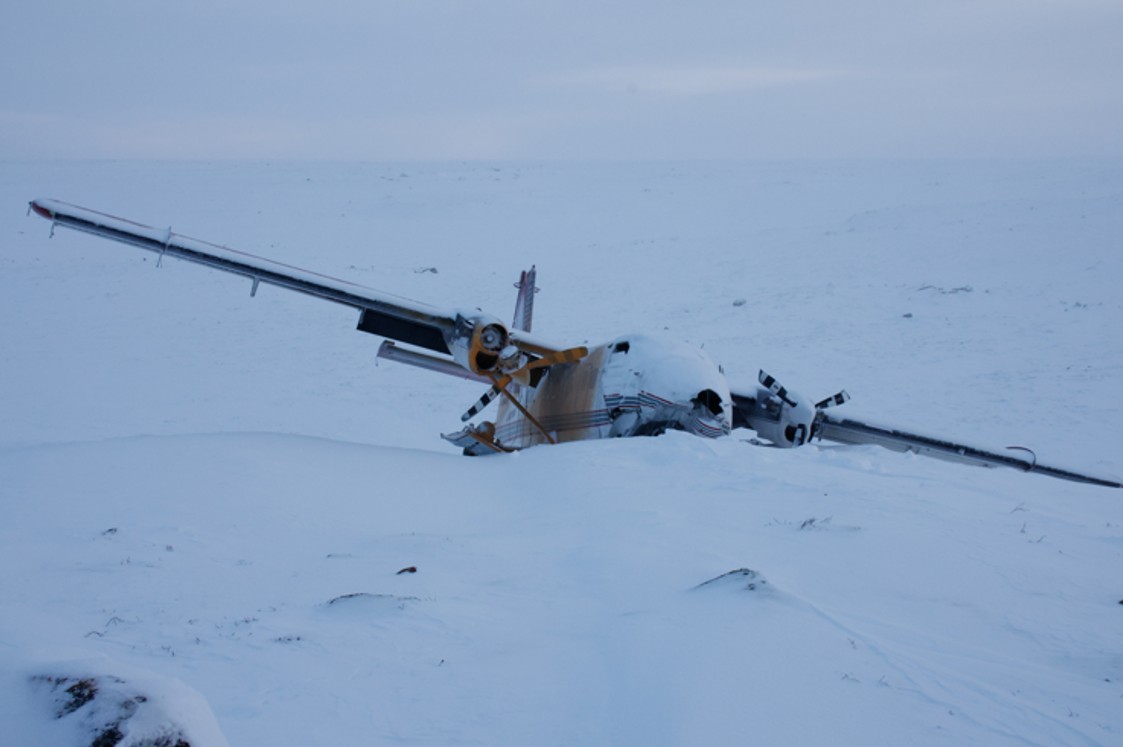
The wreckage was located on the crest of a snow-covered hill in a nose-high attitude (Figure 5), with the rear half of the aircraft overhanging the edge (Figure 6). There was considerable damage to the underside of the fuselage; both main landing gears collapsed and the nose gear compressed into the fuselage. The right-hand engine separated at the power turbine, with the hub and propeller left loosely attached.
1.13 Medical and pathological information
There was no indication that the performance of the flight crew members was negatively affected by medical or physiological factors, including fatigue.
1.14 Fire
There was no indication of fire either before or after the occurrence.
1.15 Survival aspects
1.15.1 General
After the aircraft came to rest, the flight crew assessed both the passengers and themselves for injuries; most had injured backs, and the FO had a sprained ankle.
The FO initially switched the SKYTRAC ISAT-200A to the EMERG mode to report the accident and the aircraft’s current position to Air Tindi dispatch and then switched the unit back to the NORM mode to use the satellite phone. The FO attempted to call Air Tindi but was unable to make contact because the headsets of both flight crew members were broken. He then switched the unit back to the EMERG mode.
The captain exited the aircraft through the left-hand (PF’s) door and observed that several passengers had already exited the aircraft, including the passenger who had been seated adjacent to the rear cargo door on the rearmost seat. This passenger was ejected from the aircraft through the rear cargo door when their seat became dislodged during the impact sequence. The captain assisted the FO out of the aircraft through the PF door. The captain and 2 passengers then began to secure the aircraft’s nosewheel ski to a rock with ratchet straps to provide extra stability and prevent the aircraft from sliding backwards down the hill. The remaining passengers began assembling a 6-person tent to provide shelter and provided first aid to both the FO and the more injured passengers.
Despite the low visibility and quickly approaching nighttime, several passengers started to walk in the direction of the Lac de Gras road camp (located 1.25 NM to the west); however, they were encouraged to return to the aircraft by the captain, and all passengers and flight crew remained at the aircraft to wait for rescue.
Two passengers, unable to egress owing to their injuries, remained in the aircraft and were joined by the captain, who remained with them until the SAR Techs arrived and extricated them. In an effort to preserve heat, the aircraft’s engine tents were used to block the doors of the aircraft and as makeshift blankets.
One passenger produced, from his luggage, a satellite phone that the captain used to contact Air Tindi to report the accident and the occupants’ conditions and to coordinate the rescue.
At 1250, the CMCC relayed the ELT signal it had received to the Joint Rescue Coordination Centre (JRCC) in Trenton, which dispatched a Hercules aircraft with SAR Techs from Winnipeg, Manitoba, at 1306.
The JRCC had also contacted 2 local helicopter operators (at 1330) and the Canadian Armed Forces’ 440 Squadron in Yellowknife (at 1332) to determine whether they could provide immediate assistance. Both helicopter operators were limited to day VFR operations and 440 Squadron was limited to day VFR operations for off-strip landings. Sunset at the accident site was at 1421, and given the distance from Yellowknife, none of these operators would be able to arrive at the site during daylight.
The Diavik mine had assembled a volunteer search party to assist with the rescue. The volunteers departed from the mine at 1904 on 4 snowmobiles with additional winter survival equipment and began the 6 NM trip, travelling to the site at night through a blizzard.
The Hercules aircraft arrived overhead of the site at 1900; however, owing to the weather conditions upon arrival, the pilots of the Hercules only spotted the occurrence aircraft at 1949. The SAR Techs successfully parachuted to the occurrence aircraft at 2036. At roughly the same time, the volunteer search party arrived on snowmobiles. By 2352, the SAR Techs had extricated the 2 remaining passengers from the aircraft and provided medical assistance.
Heated shelters were erected below the hill, and all people at the site spent the night in the shelters. Everyone but the volunteer search party was retrieved the following morning via helicopter and flown to CDK2, where Air Tindi aircraft were waiting. The seriously injured passengers were flown back to CYZF on a MEDEVAC-equipped Beechcraft King Air aircraft and subsequently taken to hospital. The rest of the occurrence aircraft occupants returned to CYZF on an Air Tindi De Havilland Inc. DHC-7 aircraft. The Diavik mine volunteer search party returned to the mine using the snowmobiles.
1.15.2 Safety harness
All the passengers and the flight crew were wearing their lap belts at the time of the accident. Although the FO was wearing his lap belt, he was not wearing the shoulder harness of the 5-point restraint system. The CARs specify that for landings, pilots must be seated with their safety belts fastened, including the shoulder harness.Transport Canada, SOR/96-433, Canadian Aviation Regulations (CARs), subsection 605.27(a).
1.15.3 Emergency locator transmitter
The aircraft was equipped with a Kannad 406 AF ELT unit that sent a 406 MHz signal to the SARSAT satellites.
1.15.4 Survival kit
Subsection 602.61(1) of the CARs specifies that
[…] no person shall operate an aircraft over land unless there is carried on board survival equipment, sufficient for the survival on the ground of each person on board, given the geographical area, the season of the year and anticipated seasonal climatic variations, that provides the means for
(a) starting a fire;
(b) providing shelter;
(c) providing or purifying water; and
(d) visually signalling distress.Ibid., subsection 602.61(1).
The occurrence aircraft was equipped with a survival kit that the company had interpreted to meet the requirements of CARs subsection 602.61(1). During the occurrence, the survival kit was difficult to access by the flight crew as it was stored in the aft baggage compartment, which was overhanging the edge of the hill after the impact.
The standard survival kit carried on board the aircraft and used during the occurrence was contained in a hard plastic case. The kit included food capable of providing 5000 Kcal per person for 12 people and the following equipment:
- 12 foil blankets;
- 6 four-hour candles;
- 2 mess tins;
- 2 nine-foot-long pieces of heavy aluminum foil;
- 12 foil containers;
- 12 insect headnets;
- 2 insect repellants;
- 2 knives with sheaths;
- 4 light sticks;
- 4 tubes of waterproof matches;
- 2 tubes of windproof matches;
- 1 heliograph mirror;
- 1 fifty-foot-long parachute cord;
- 1 pocket saw;
- 2 nine-feet by twelve feet tarps for shelter;
- 1 fire starter;
- 2 tinder;
- 1 strobe light and batteries;
- 1 survival manual;
- 4 spoons;
- 1 sewing kit;
- 2 eight-m-long pieces of flagging tape;
- 1 package of 30 water purification tablets;
- 2 pealess whistles; and
- 2 coreless rolls of toilet tissue.Label describing the survival kit (Model FE 12A) that was on board the occurrence aircraft.
A tent was added to the survival kit on board the occurrence aircraft; however, the tent that was carried on the aircraft was not large enough for the number of people on board, which forced them to lay on top of each other to fit inside and shelter from the environment.
Air Tindi has a more robust survival kit, which includes tents and sleeping bags as well as the standard kit content, for pilots to equip the aircraft with if they deem it warranted. These kits are typically only carried on longer (multiday) flights away from the base. Generally, the standard survival kit is carried on flights that return to Yellowknife on the same day.
1.16 Tests and research
1.16.1 TSB laboratory reports
The TSB completed the following laboratory report in support of this investigation:
- LP049/2024 – CVR Audio Recovery
1.17 Organizational and management information
1.17.1 General
Air Tindi was founded in 1988 and has operated out of CYZF since its inception. Air Tindi is authorized to operate under the following CARs subparts: 702 (Aerial Work), 703 (Air Taxi Operations), 704 (Commuter Operations), and 705 (Airline Operations).
The company operates a fleet of 17 single- and multi-engine turboprop aircraft and provides daily scheduled flights servicing isolated communities, air ambulance services, and charter flights for mining, tourism, government, and community support services throughout northern Canada.
At the time of the occurrence, Air Tindi operated 6 Twin Otter aircraft. It was certified to operate Twin Otter aircraft under subparts 702, 703, and 704 of the CARs in day and night VFR and instrument flight rules (IFR) flights. The occurrence flight was being operated under Subpart 703 (Air Taxi Operations) of the CARs.
1.17.2 Organizational structure at Air Tindi Ltd.
At the time of the accident, Air Tindi’s organizational structure was as shown in Figure 7.
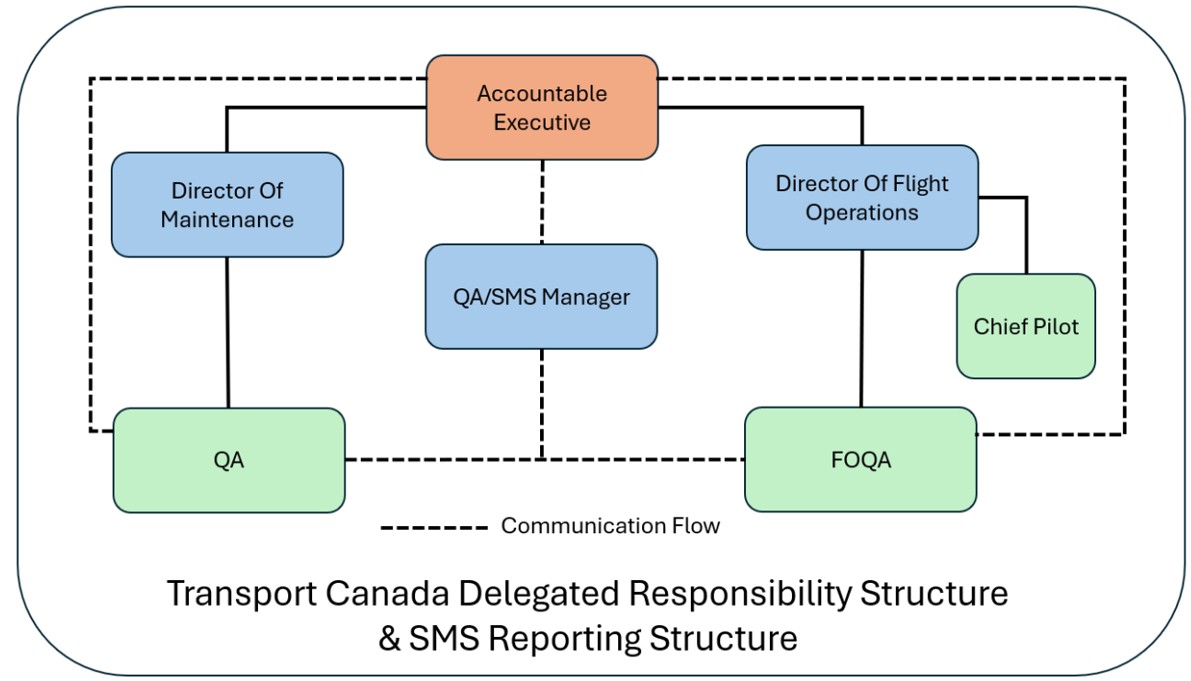
According to the FOM, at Air Tindi,
[t]he Accountable Executive is responsible for establishing and maintaining the overall corporate culture, for providing the functional heads with the necessary resources to comply with the regulations and maintain the necessary levels of safety, and is accountable for the functionality and development of the Safety Management System.Air Tindi Ltd., Flight Operations Manual, Edition 4: Version 7 (09 December 2022), section 6.5.1, p. 6-4.
The manual goes on to describe the director of flight operations’ main responsibility, which is to ensure flight operations are safe. This includes, without being limited to:
- control of operations and operational standards of all aeroplanes operated; […]
- supervision, organization, function and manning of the following:
- flight operations;
- cabin safety; […]
- training programs; […]
- safety management system; […]
- assurance that company operations are conducted in accordance with current regulations, standards and company policy;Ibid., section 6.5.2, p. 6-5.
At Air Tindi, the person who takes on the role of chief pilot becomes responsible for the establishment and implementation of professional standards to guide the flight crews under their authority. This includes, without being limited to:
- developing standard operating procedures;
- developing and/or implementing all required approved training programs for the flight crew; […]
- supervising of flight crew;Ibid., section 6.5.3, p. 6-6.
1.17.3 Operational control system
Air Tindi uses a Type C pilot self-dispatch operational control system for its CARs subparts 702, 703, and 704 operations. Under a Type C pilot self-dispatch system, the director of flight operations is responsible for the operational control system and delegates operational control of flights to the captains, while retaining the responsibility for the day-to-day conduct of flight operations.
1.17.4 Managerial oversight of line pilots
Compliance with operational policies and procedures at Air Tindi is primarily conducted through the training program, pilot proficiency checks, line checks,Flight crew members’ qualification requirements found in CARs 703.88 do not include a line check nor are line checks required to be conducted by a delegate of the Minister (i.e., an approved check pilot). Line check flight test reports are not submitted to Transport Canada. and a hazard registry that helps identify safety hazards in the organization. The system of oversight also relies on pilots reporting issues through the company safety management system (SMS).
Operational issues are often dealt with less formally rather than through the SMS, with pilots discussing issues with their superiors (assistant chief pilots, chief pilot) and the issues being dealt with through informal meetings and by word of mouth.The investigation conducted several interviews with pilots and a summary is discussed in more detail in Section 1.17.13 Information gathered from Air Tindi Ltd. Pilots of the report.
Air Tindi also uses a flight operations quality assurance (FOQA) program to aid in providing oversight on flights. At the time of the occurrence, there was an FOQA coordinator, who reported to the SMS manager. The FOQA coordinator position largely entailed assisting in preparing the company for audits (client, regulator, and internal) and occasionally aiding the SMS manager with investigations if required.
1.17.4.1 Flight data monitoring
In typical IFR operations, flight paths and parameters are mostly predictable; therefore, the use of flight data monitoring (FDM) is a good tool to catch deviations. However, FDM becomes more complicated when dealing with operations outside typical airport-to-airport flights. During off-strip operations, aircraft are frequently required to circle the intended landing area numerous times to confirm safety-critical parameters (wind speed and direction, obstacles on the landing surface, taxi routes, or the required performance for takeoff and landing). Further to this, by the nature of VFR flying, aircraft may be required to change heading and altitude frequently during a typical flight. At the time of the occurrence, the FOQA program did not utilize FDM nor was it required by regulation.
1.17.5 Flight operations manual
The Air Tindi FOM (version 7 of the 4th Edition) was approved by Transport Canada (TC) on 23 December 2022. The purpose of the manual is to provide “management and operations personnel with instructions and guidance for the conduct of a safe and efficient air service.”Air Tindi Ltd., Flight Operations Manual, Edition 4: Version 7 (09 December 2022), section 1.2: Preamble, p. 1-2. The manual also states that “[t]he company requires that personnel know the contents of the manual and apply the policies and procedures accordingly.”Ibid., section 1.2: Preamble, p. 1-2.
With regards to this occurrence, the following sections of the FOM that outline specific responsibilities for various individuals are relevant.
For the captain:
The Captain is responsible to the Chief Pilot for the safe conduct of assigned flights. Specific duties include: […]
checking weather, all applicable NOTAMs where available, determining fuel and oil requirements; […]
conducting flights in strict adherence with the company aeroplane Standard Operating Procedures (when applicable); and,
conducting flights in accordance with Canadian Aviation Regulations, the Aircraft Flight Manual, and this Flight Operations Manual.Ibid., section 6.6.10: Captain, p. 6-15.
For the FO:
The First Officer’s duties include, but are not limited to the following: […]
- conduct flights in strict adherence with the company aeroplane Standard Operating Procedures; [emphasis in original]
- conduct flights in accordance with Canadian Aviation Regulations, the Aircraft Flight Manual, and this Flight Operations Manual; […]
- assist the Captain in the management and operation of the flight;
- participate in the execution of cockpit procedures, emergency procedures, checklist procedures, and instrument approach procedures as directed by the Captain and, in accordance with the procedures outlined in this manual, the Aircraft Flight Manual, [emphasis in original] and the aircraft Standard Operating Procedures; [emphasis in original] […]
- shall be responsible to inform the Captain immediately of any situation when the aircraft is being handled improperly or placed in jeopardy.Ibid., section 6.6.11: First Officer, pp. 6-15 and 6-16.
The section that outlines VFR flight requirements also contains relevant information. With regards to day VFR operations below 1000 feet AGL, the FOM states that flight visibility must not be less than 2 miles, and the aircraft must be operated clear of cloud. This is consistent with the CARs minimum weather for VFR flight below 1000 feet AGL.Transport Canada, SOR/96-433, Canadian Aviation Regulations (CARs), section 602.115. Air Tindi pilots are forbidden to continue VFR flights when they are incapable of maintaining an altitude of more than 500 feet AGL and a flight visibility of at least 2 miles.Air Tindi Ltd., Flight Operations Manual, Edition 4: Version 7 (09 December 2022), section 10.2.2: VFR Flight Requirements, p. 10-4. The FOM also states that pilots should not attempt to continue flying VFR when encountering IMC.Ibid., section 10.4.2: Controlled Flight into Terrain (CFIT) Avoidance Procedures, p. 10-11.
1.17.6 Visual meteorological conditions operations at Air Tindi Ltd.
1.17.6.1 Company Keyhole Markup Language files
KML is a file format used to display information in a geographic context through many applications such as Google Earth or ForeFlight. Information in a KML file can be added as a layer to an existing map or scene. In doing so, a KML file can provide a reference line for pilots to follow.
At Air Tindi, KML files are uploaded to the EFBs via a document cloud application, which then allows the files to be imported into ForeFlight. The company-created KML files are intended to be used as guidance during VFR approaches to locations without certified approach procedures, allowing pilots to line up on final with off-strip locations from a greater distance than if only visual navigation was used. The KML files also allow for better situational awareness while circling in relatively featureless terrain, providing a PM with a constant visible track on their EFB. The KML file for the Lac de Gras road camp displayed 2 landing areas on the lake, one in a northwest to southeast direction and one in an east-west direction.
The only formal guidance provided by Air Tindi for pilots was in the form of an online EFB training course that states the following:
3.9 USING KML (Keyhole Markup Language) FILES
This feature is commonly used for company procedures to locations that do not typically have approaches such as Tundra and Mould Bay. It allows for the importing and displaying of custom maps shapes into ForeFlight.
For additional information on its use and function, the following video is provided:
ForeFlight Feature Focus: Use Map Shapes: https://www.youtube.com/watch?v=RXUEIOWSJrA&feature=youtu.beAerostudies Inc., Ascent aviation e-training system, EFB Training 2024, section 3.9 Using KML Files, p. 32.
1.17.7 Instrument meteorological conditions operations at Air Tindi Ltd.
When the weather is below the prescribed VFR limits and it is not possible to maintain visual contact with the terrain, aircraft are to be operated under IFR. On a standard precision instrument approach, aircraft are able to safely operate down to an altitude that is 200 feet AGL with a forward visibility of ½ statute mile. To fly in IMC, aircraft are to be equipped with the required flight instruments.Transport Canada, SOR/96-433, Canadian Aviation Regulations (CARs), section 605.18. The occurrence aircraft was equipped and certified for IFR flight. In addition, to fly in IMC, pilots are required to hold an instrument rating. The occurrence flight crew members both held the required rating.
1.17.7.1 Minimum instrument flight rules altitudes
During flight in IMC, aircraft are required to maintain a certain altitude for given phases of flight to ensure terrain separation.Ibid., section 602.124. Minimum IFR altitudes are the lowest altitudes established for use in a specific airspace that provide a guaranteed terrain separation. It may be a minimum obstacle clearance altitude, a minimum en-route altitude, a minimum safe altitude, a safe altitude within a radius from a point in space, or a missed approach altitude. In the absence of a published minimum IFR altitude and given the geographic location of the occurrence, an aircraft operated under IFR is required to maintain a minimum altitude of 1000 feet above the highest obstacle located within a horizontal distance of 5 NM from the estimated flight path.Ibid., paragraph 602.124(2)(a).
1.17.7.2 Instrument approach procedures
Instrument approach procedures provide pilots with set procedures to transition from instrument flight to a visual landing. These procedures provide guaranteed terrain separation provided that the procedures are followed within the tolerances of their design.Transport Canada, TP308E, Criteria for the Development of Instrument Procedures, Change 9.0 (01 January 2024). Although there are instrument approaches at CDK2, there are no published instrument approach procedures for the road camp at Lac de Gras.
1.17.7.3 Let-down procedures
A common procedure for transitioning from IMC to VMC at remote locations that are not serviced by published instrument approach procedures is to conduct a controlled descent to a predetermined minimum IFR altitude. This altitude is often derived from IFR sector heights, nearby airport minimum safe altitudes, or maps that show terrain. During normal operations, descent below a minimum IFR altitude must only be conducted if visual reference has been established at or above a minimum IFR altitude.
Air Tindi’s FOM states the following:
When transition[sic] from IFR to VFR at airports without a current instrument approach, or airports without current weather, the following procedures must be briefed (prior to descent) and flown:
Minimum altitude authorized when descending in IMC conditions to an airport without a published instrument approach is the lower of:
- 2000' above the highest obstacle within 10 nautical miles of a destination GPS fix; or
- The MOCA [minimum obstacle clearance altitude], AMA [area minimum altitude] as published on LE charts [en route low altitude charts], or MSA [minimum safe altitude] (if near an airport with an approach) based on a local altimeter setting.Air Tindi Ltd., Flight Operations Manual, Edition 4: Version 7, (09 December 2022), section 10.7.1: Let-down Procedure, p. 10-24.
1.17.7.4 Improvised instrument approach procedures
For the purpose of this report, improvised instrument approach procedures is considered to be all procedures developed without certification for the purpose of operating an aircraft in IMC below a published IFR safe altitude. These procedures have become adaptations to established IFR procedures. Unlike certified approaches, improvised approaches have not gone through a certification process and thus do not guarantee terrain or obstacle clearance provided by the guidance in TC’s Criteria for the Development of Instrument Procedures.Transport Canada, TP308E, Criteria for the Development of Instrument Procedures, Change 9.0 (01 January 2024).
1.17.7.4.1 Radio altimeter improvised instrument approach procedure
A practice adopted by Air Tindi pilots at the time of the occurrence was to set the radio altimeter to aid with conducting an improvised instrument approach to a lower altitude than a minimum IFR altitude. The common practice at Air Tindi was to set 500 feet on the radio altimeter as an acceptable descent altitude for regions in the tundra, where terrain height does not vary drastically, and man-made structures do not exceed that height. Pilots would fly in IMC down to the height above ground level set in the radio altimeter in a manner similar to a minimum descent altitude on published non-precision approaches. Several Air Tindi pilots also expressed that setting the descent altitude below 500 feet on the radio altimeter was also a common practice if they felt that terrain was not a factor.
1.17.7.4.2 Omni-bearing selector approach/heading approach
A method to get lateral guidance to conduct an improvised instrument approach is using the OBS or by following a fixed heading. On many GPS units, it is possible to set an OBS track to any waypoint in the database or any user-created waypoint. Once an OBS track is selected, the aircraft’s horizontal situation indicator can provide lateral guidance to or from a waypoint on a specified desired track. This is often used in conjunction with the radio altimeter to provide both lateral and vertical guidance.
When an OBS track is not used in conjunction with the aircraft’s horizontal situation indicator, and only a heading is flown, wind drift will not be detectable. Although the aircraft may be facing the desired direction, the track over the ground may not be as intended as the aircraft will drift with the wind. The investigation was unable to determine if the flight crew referred to the OBS during the improvised instrument approaches conducted during the occurrence flight.
1.17.7.4.3 Improvised area navigation approaches
Improvised instrument approaches may also be constructed through the on-board global navigation satellite system devices, such as the Garmin GNS430, or with the EFB, through the use of “user waypoints”. Like the KML files, these can provide point-to-point lateral guidance and can also be programmed to show a pseudo-glideslope for vertical guidance.
1.17.8 Standard operating procedures
The Air Tindi standard operating procedures (SOPs) for the Twin Otter were reviewed and accepted by TC on 26 February 2020. The SOPs are issued for “guidance in the operation of the Twin Otter aircraft within the limitations of the Aircraft Flight Manual.”Air Tindi Ltd., De Havilland Twin Otter (DHC-6) Standard Operating Procedures, Edition 1, Version 2 (01 February 2020), chapter 1, section 1.2: Preamble, p. 1-2. The SOPs state the following:
Although SOPs ensure standardization for flight crewmembers to complete their duties, they do not encompass all situations. Crewmembers are therefore expected to exercise judgment and consistency in their application. Any deviations from the SOPs should be thoroughly briefed and understood by all concerned.Ibid.
The SOPs refer to the FOM for direction on how the various procedures are to be performed.
1.17.9 Approach briefings
The information required to be briefed varies for a VFR approach and an IFR approach. VFR approaches require a briefing of the landing runway and approach speeds as well as a threat review.As outlined in Air Tindi Ltd.’s Flight Operations Manual, Edition 4: Version 7 (09 December 2022), section 13.29.3: Threat Based Briefings, p. 13-35, during a threat review, the pilot monitoring is required to name any relevant threats for the procedure being briefed as well as strategies to mitigate them. The pilot flying must then signal any further perceived threats and mitigation strategies. If no threats exist, the flight crews are not required to brief threats. For an IFR approach, the flight crew is required to brief the type of approach, the landing runway, the primary navigation source, the minimum descent altitude, the approach speeds, the missed approach procedure, and the missed approach altitude. The flight crew is also required to conduct a threat review.Air Tindi Ltd., Flight Operations Manual, Edition 4: Version 7 (09 December 2022), section 13.29.3: Threat Based Briefings, p. 13-34.
Flight crew approach briefings at Air Tindi are presented in the FOM, which states the following:
Prior to each take-off or landing, crews will conduct a threat based briefing. The primary objective of these briefings includes: […]
PM lists any relevant threats for briefed procedure, with strategies to mitigate the threat(s)
PF follows up with any further perceived threats, with strategies to mitigate
If no perceived threats exist, crews are not required to brief any threats
Crew may reference type specific threat management cards, located onboard each aircraft.Ibid.
During the occurrence flight, the flight crew did not conduct any formal approach briefing or associated threat review. They did, however, periodically throughout the flight, identify the poor weather, icing conditions, and the aircraft’s gross operating weight. They also discussed that the 4th approach attempt would be their last before returning to CYZF.
1.17.10 Electronic flight bag
1.17.10.1 General
Air Tindi equips its pilots with EFBs to assist in various aspects of flight preparation and execution. These devices are loaded with applications that replace traditional paper-based materials. The EFBs provide easy access to the company’s FOM, SOPs, and other essential documents, ensuring that pilots have the latest information at their disposal.
In accordance with Air Tindi’s FOM, both the captain and the FO had an EFB in the form of an iPad mini.Ibid., section 13.19: Electronic Flight Bag (EFB) Operations, p. 13-18. These devices were equipped with ForeFlight, which includes maps, charts, weather information, manuals, and checklists required for planning and carrying out a flight. This application, in conjunction with the Garmin Flight Stream 210 device installed in the aircraft, provided GPS navigation functions in the form of own-ship display on the device. ForeFlight is also capable of providing synthetic visionThe synthetic vision displays an artificially generated view of the terrain outside the aircraft. to both pilots on their respective EFBs, if selected. Selection of this view is made by tapping the appropriate icon in a toolbar at the top of the display. This toolbar is visible at all times when using the application.
The document cloud application, which acts as a document repository linked to a server, allowing for easy synchronization of documents for every EFB at the company, was also installed on the EFBs. The company would keep documents such as airstrip condition reports specific to destinations not published in NAV CANADA’s Canada Flight Supplement in discrete folders for easy access by pilots. The document cloud application is also capable of storing KML files in these folders.
1.17.10.2 Electronic flight bag usage at Air Tindi Ltd.
Pilots undergo training on EFB usage through a combination of online learning and on-the-job training. The online portion of training is completed on initial hire and then every 12 months. Many pilots reported that most of the functionality of the EFBs is learned while flying with more experienced pilots or by experimenting with the EFBs on their own.
Using the own-ship position functionality on EFBs for navigation is prohibited at Air Tindi when flying above 80 knots unless the aircraft is equipped with a Garmin Flight Stream 210.Air Tindi Ltd., Flight Operations Manual, Edition 4: Version 7 (09 December 2022), section 13.19.2: Preflight Procedures, p. 13-19. At the time of the occurrence, all of Air Tindi’s Twin Otters were equipped with Garmin Flight Stream 210 devices.
Guidance for the usage of the EFB within the FOM is largely centred around device management (battery level, EFB failures, application management, etc.). The FOM also provides the following instructions on EFB usage during flight operations:
- Climb - During climb, the pilot(s) will monitor the applicable charts and route segments on the EFB.
- Cruise - During the cruise or enroute phase of flight, the EFB will be periodically monitored for route progress. Caution should be taken to avoid long exposure to direct sunlight to reduce risks of overheating. Flight crews will select and review the anticipated arrival and approach procedures for the destination airport, leaving the next needed chart displayed.
- Arrival/Approach - If a published Arrival Procedure is being flown, the pilot(s) will monitor the applicable chart. During the approach phase of flight, the EFB will be monitored and appropriate approach chart displayed. Landscape or Portrait view will be “locked” via the ForeFlight application when necessary.Ibid., section 13.19.4: Flight Operations, p. 13-20.
1.17.10.3 Transport Canada guidance on electronic flight bag usage
TC provides guidance related to the use of EFBs in commercial operations in Advisory Circular (AC) 700-020. ACs are not enforceable regulations but rather represent guidance for air operators on a specific issue. As TC states in its circular, “[t]his AC on its own does not change, create, amend or permit deviations from regulatory requirements, nor does it establish minimum standards.”Transport Canada, Advisory Circular (AC) 700-020: Electronic Flight Bags (Issue 03: 28 March 2018), section 1.0: Introduction, p. 3 of 55, at https://tc.canada.ca/sites/default/files/migrated/ac_700_020___electronic_flight_bags.pdf (last accessed on 01 December 2025).
TC’s AC on EFBs states that “[o]wn-ship functionality should only be used for strategic purposes (e.g., situational awareness) and is not to be used as a tool for surface manoeuvring or airborne navigation.”Ibid., Appendix G: Operational Evaluation at the Corporate/Company Level, Use of Own-Ship Position, EFB Own-Ship Functionality, p. 33, at https://tc.canada.ca/sites/default/files/migrated/ac_700_020___electronic_flight_bags.pdf (last accessed on 01 December 2025).
The AC goes on to establish documentation requirements:
(1) The company’s Standard Operating Procedures shall include the following statement:
“This EFB is not certified as a navigation system. Transport Canada has not assessed the EFB for performance or reliability of the platform hardware or software (including GPS functionality).” [emphasis in original]Ibid., Appendix G: Operational Evaluation at the Corporate/Company Level, Company Documentation Requirements, p. 34, at https://tc.canada.ca/sites/default/files/migrated/ac_700_020___electronic_flight_bags.pdf (last accessed on 01 December 2025).
Neither Air Tindi’s SOPs nor the FOM contained this statement.
1.17.11 Controlled flight into terrain training at Air Tindi Ltd.
Controlled flight into terrain (CFIT)“occurs when an airworthy aircraft under the control of the flight crew is flown unintentionally into terrain, obstacles or water, usually with no prior awareness by the crew.”Flight Safety Foundation, “Controlled Flight Into Terrain (CFIT)”, at https://flightsafety.org/toolkits-resources/past-safety-initiatives/controlled-flight-into-terrain-cfit/ (last accessed on 02 December 2025).
The Commercial Air Services Standards require companies operating under CARs Subpart 703 and conducting IFR flights or night VFR flights to provide training on the avoidance of CFIT. This training must include the following topics:
(i) factors that may lead to CFIT accidents and incidents,
(ii) operational characteristics, capabilities, and limitations of GPWS [ground proximity warning system] (if applicable),
(iii) CFIT prevention strategies,
(iv) methods of improving situational awareness, and
(v) escape manoeuvre techniques and profiles applicable to the aeroplane type;Transport Canada, Commercial Air Service Standards, Standard 723: Air Taxi - Aeroplanes, Division VIII: Training, paragraph 723.98(29)(a): Controlled Flight into Terrain (CFIT) Avoidance Training.
Air Tindi provides this training in the form of an online course, which both the captain and the FO had completed in January and April 2023, respectively. The training includes all subjects that are required by the CARs.
The company also provides guidance in its FOM for situations when pilots flying VFR encounter deteriorating weather or whiteout conditions. The guidance states that pilots are required to conduct a 180-degree turn using the flight instruments while ensuring that no altitude is lost in the process. Pilots are further told to not be tempted to descend to a lower altitude to continue flying VFR because this would dramatically increase the risk of CFIT.Air Tindi Ltd., Flight Operations Manual, Edition 4: Version 7 (09 December 2022), section 13.48: Specialty Operations, p. 13-56.
1.17.12 Organizational safety culture
1.17.12.1 General
Safety culture established in complex organizations is recognized as adaptive, evolving “gradually in response to local conditions, past events, the character of the leadership and the mood of the workforce.”J. Reason, ”Achieving a safe culture: Theory and practice”, Work & Stress, Vol. 12, No. 3 (1998), pp. 293-306. As a determinant of how people behave day-to-day, safety culture was defined as “the ‘engine’ that drives the system toward the goal of sustaining maximum resistance toward its operational hazards regardless of the leadership’s personality or [economic] concerns [faced by the industry].”Ibid. As a subcomponent in complex organizations, smaller groups of people who operate unique technology or who by design perform independently of the wider organization reside within a subculture, which is characteristically marked by a set of unique beliefs and interests related to safety.
Safety culture tacitly communicates expectations to new and existing members of the organization, affecting both how the work is accomplished and how fully members participate in an organization’s processes.
Safety culture is the way safety is perceived, valued, and prioritized in an organization. A positive and active safety culture reflects the actual commitment to safe operations at all levels (i.e., the vertical integration of information) in the organization. Safety culture has also been described as “how an organization behaves when no one is watching”V. Aslan, et al., “Safety culture assessment and implementation framework to enhance maritime safety”, Transportation Research Procedia, Vol. 14 (2016), pp. 3895-3904. or "the way we do things around here.”Health and Safety Executive (United Kingdom), "Organisational culture: Overview," at https://www.hse.gov.uk/humanfactors/topics/culture.htm (last accessed on 23 September 2025). The organization’s safety culture is influenced by the values, attitudes, and behaviours of the stakeholders.
Establishing a positive safety cultureThere are several different ways to describe the safety culture in an organization. Terms such as “healthy” or “positive” safety culture are often used interchangeably, as are an “unhealthy” or “negative” safety culture. The TSB prefers to describe safety culture as either positive or negative. has many challenges; however, it is a necessary first step in creating the values, attitudes, and behaviours required for air operators to effectively manage the risks associated with their operations. These efforts and investments will eventually lead to a positive safety culture where unsafe practices are seen as unacceptable by all stakeholders and risks are managed to a level as low as reasonably practicable, improving the management of operational hazards.
The strength of an organization’s safety culture starts at the top and is characterized by proactive processes to identify, assess, and mitigate operational risks. If unsafe conditions are not identified, are allowed to persist or are not effectively prioritized by the air operator, an increased acceptance of such risks can result at all levels of the organization, reducing the effectiveness of the air operator’s SMS and its safety performance. The hierarchy of influences on the way work is accomplished in an organization has been described as the “4 Ps:”
- Philosophy: An organization’s philosophy provides a broad specification for how it wants to operate and it communicates values throughout the organization.
- Policies: An organization’s policies represent broad specifications of how management expects tasks to be carried out.
- Procedures: An organization’s procedures dictate the specific steps an individual should take to accomplish a task. They operationalize the philosophy and policies by indicating how work will be carried out.
- Practices: An organization’s practices represent what actually happens in day-to-day operations. In an ideal world, practices and procedures would be identical. However, in reality, practices may differ from procedures for any one of a number of reasons.A. Degani and E. L. Weiner, On the Design of Flight-Deck Procedures, NASA Contractor Report 177642 (NASA Ames Research Center: June 1994), p.p. 5-8, at https://ntrs.nasa.gov/api/citations/19940029437/downloads/19940029437.pdf (last accessed on 03 December 2025).
One measure of a positive safety culture could be an alignment across the 4 Ps and efforts to identify any gaps and continuously improve. If the 4 Ps are not focused on safety and are not aligned to achieve the higher-level goal of safe operations, this may indicate that a negative safety culture is present in an organization.
1.17.12.2 Safety culture at Air Tindi Ltd.
According to Air Tindi’s safety policy, Air Tindi is committed to safe, sustainable air transportation, with a focus on a positive safety culture and environmental protection. Through its SMS, Air Tindi encourages all personnel to prioritize health, safety, environment, and quality in their actions, aiming to prevent workplace hazards and ensure well-being. Employees are expected to visibly demonstrate leadership in matters of health, safety, environment, and quality, integrating company values into all activities and adhering to regulations and standards.Air Tindi Ltd., Flight Operations Manual, Edition 4: Version 7 (09 December 2022), section 2.2: Safety Policy, p. 2-2.
The investigation determined that pilots at Air Tindi demonstrated a goal-oriented attitude toward decision making and took great pride in completing their flights in challenging operational environments and generally accepted deviation from published procedures. The investigation also determined that the FOs at Air Tindi revere the experienced off-strip captains and hold them in high regard and may sometimes succumb to the halo effectAs outlined by Britannica, at https://www.britannica.com/science/halo-effect (last accessed on 23 September 2025), the halo effect is a cognitive bias in which an impression formed from a single trait or characteristic is allowed to influence multiple judgments or ratings of unrelated factors. In this instance, the junior FO’s way of looking up to the senior captain likely affected his judgment on the safety of conducting VFR procedures in IMC. during VFR flights in inclement weather. The FOs are generally very new to the aviation industry and often rely on the captains to determine what are acceptable practices in the organization and the industry. The FOs would not voice concerns about unsafe practices such as flying VFR in IMC to the captains because there was a perceived notion that “this is how it’s done” when flying in the north.
The SMS at Air Tindi is used to report operational occurrences that affected the flight but is generally not used to identify possible safety deficiencies. As in a previous Air Tindi occurrence,TSB Air Transportation Safety Investigation Report A21W0098, section 1.18.2. the investigation into the current occurrence did not identify any SMS reports relating to unsafe practices, despite these practices being identified by every pilot interviewed during the investigation. The investigation found that pilots who experienced deviations from company SOPs or from published procedures tended to talk informally to the senior captains rather than use the SMS.
These conclusions are consistent with previous TSB aviation transportation safety investigation reportsTSB aviation transportation safety investigation reports A21W0098, A19W0015, A14W0181, A11W0151, and A05W0127. on Air Tindi accidents as well as with Air Tindi’s internal investigation of both this accidentAir Tindi Ltd., DHC-6 | C-GMAS Controlled Flight into Terrain (CFIT), Report Number 5142364, Edition 1, Version 1 (16 February 2024). and its previous accident involving a Twin Otter.Air Tindi Ltd., TIN223 / C-GNPS Aircraft Accident, Initial Report for Issue #5106973 (05 November 2021).
The Air Tindi investigation into this current occurrence noted that the flight crew demonstrated a determined, can-do attitude typical of its personnel, continuing to seek ways to reach their destination despite deteriorating conditions. Because the company operates in challenging environments, it relies on highly experienced captains to manage these challenges, while FOs, who are often new to commercial aviation, learn on the job under the guidance of their captains. Given that FOs do not have the years of specialized experience and training that the captains possess, they also rely on the captains to inform them of the varied threats faced during flight operations.
The acceptance of deviations from procedures and insufficient correction of company culture was also identified in Air Tindi’s internal investigation of a previous accident,Ibid. in which a Twin Otter departed without sufficient fuel to complete the flight resulting in fuel starvation and landing off-airport.
1.17.12.2.1 Acceptance of unsafe practices
In the course of an organization’s activities, unsafe practices may be introduced when personnel work to accomplish goals. These unsafe practices may gradually become accepted as part of the job—in an undetected drift from safe practices—and eventually be taught to newcomers, perpetuating their use. Because these unsafe practices continue with no negative outcomes or often with positive outcomes, such as successful flights or satisfied customers, they may become the norm. Examples of unsafe practices include flying overweight, flying with inadequate fuel reserves, not recording defects in aircraft logs, and “pushing the weather.”
Many underlying factors can lead to the development of unsafe practices in aviation. When personnel carry out routine activities time after time, such as the same scheduled flight or the same aircraft inspection, these activities may become habitual, resulting in reduced vigilance. Personnel may find more efficient ways of doing something but may not account for the associated risk or relationships between tasks. In some cases, personnel are placed in situations where they must improvise and solve problems when they arise; the procedure as written may not always be practical in the field. In other cases, personnel and organizations need to make the most of the resources they have. In extreme cases, a company culture in which unsafe practices are accepted as a way of doing the job develops.
1.17.13 Information gathered from Air Tindi Ltd. pilots
During the investigation, information was collected from Air Tindi Twin Otter pilots to better understand the day-to-day practices of line pilots. The observations gathered are summarized below in Table 9:
Topic | Summary of observations |
|---|---|
Use of improvised instrument approaches |
|
Culture |
|
Use of EFBs |
|
Managerial oversight |
|
Weather |
|
Safety management system |
|
TAWS |
|
1.18 Additional information
1.18.1 Transport Canada oversight
1.18.1.1 General
Transport Canada Civil Aviation (TCCA), through its surveillance program, ensures that enterprises “effectively comply with their regulatory requirements.”Transport Canada, Staff Instruction (SI) SUR-001, Surveillance Procedures, Issue No. 09 (04 August 2020), section 1.11(1)0. There are 2 categories of surveillance activities that are applicable to this report: systems level and process level.Ibid.
At the systems level, program validation inspections provide for system surveillance and an overall review of the company using sampling methods to verify whether the company has the systems in place to comply with regulatory requirements. At the process level, process inspections focus on one or more specific processes. They verify whether the processes comply with regulatory requirements and work in accordance with them. The frequency of these inspections depends on factors such as the type of operations, turnover of key company employees, compliance history, and nature of the findings.
TCCA may issue 2 types of feedback from either program validation inspections or process inspections: findings of non-compliance and observations. Findings are a factual account supported by evidence of how an enterprise is not in compliance with the regulations. A finding may be either a non-compliance with certification requirements or a non-compliance with a rule of conduct. An observation is a factual account of how a Canadian aviation document holder is not in compliance with its own manuals, programs, systems, processes, and procedures, or with published industry safety standards. “An observation is meant to capture and communicate concern(s) that may not be included in a prescriptive regulation but has a material impact on aviation safety.”Transport Canada, Staff Instruction (SI) SUR-029, Addressing Deficiencies Identified Through Surveillance, Issue No. 03 (03 May 2023), section 5.3(2).
A company’s response to a finding of non-compliance is mandatory, and not responding can result in varying levels of escalating resolutions from monetary penalties to suspension of documents. Company responses to observations are voluntary; however, for companies who have implemented an SMS, “TCCA observations and findings should be logged and processed through this system.”Ibid., section 8.6(5).
1.18.1.2 Oversight at Air Tindi Ltd.
In the 5 years before the occurrence, TC had conducted the following surveillance activities at Air Tindi:
- 27 February 2019 – Reactive process inspection for airworthiness and flight operations;
- 16 December 2021 – Reactive process inspection for flight operations;
- 03 February 2022 – Planned process inspection for airworthiness and flight operations;
- 23 February 2022 – Planned process inspection for cabin safety;
- 30 May 2023 – Planned process inspection for cabin safety.
In addition, owing to COVID-19 travel restrictions, TC conducted several targeted inspections over the phone to record risk and status of the company from 04 April 2020 to 28 June 2021. During these surveillance activities, TC made 3 findings and 8 observations to Air Tindi.
During the reactive process inspection conducted after the accident in 2021,TSB Air Transportation Safety Investigation Report A21W0098. regional TC inspectors attempted to take a different approach with their regulatory activities. They were familiar with the company’s processes that were frequently in line with CARs requirements. This led them to believe that something that could not be detected through their usual auditing processes was likely one of the contributing factors to the pattern of accidents that Air Tindi had been experiencing.TSB air transportation safety investigation reports A21W0098, A19W0015, A14W0181, and A11W0151.
As a result, they set out to conduct an organizational culture assessment of issues related to that occurrence. The approach was approved by regional TC management and was welcomed by Air Tindi management to try to learn more about underlying factors related to the occurrence. Regional inspectors interviewed a variety of employees, from captains and FOs to management personnel, about the occurrence and the nature of day-to-day operations at Air Tindi. However, once the data was collected, the issue of how to analyze it and then communicate any potential issues based on that data was raised. TC does not have any regulatory communication products other than observations and findings where the results from this type of oversight activities could be communicated. Because no regulatory non-compliance was identified, the decision was made to close the inspection and issue a letter summarizing the data with 4 brief observations regarding some of the identified issues.
The reactive process inspection of Air Tindi that was conducted after the above-mentioned 2021 accident resulted in the following observations:
- There is a greater focus on the use of SOPs and checklists for Dash 7 crews than in the Twin Otter.
- Newer Twin Otter First Officers desire to fly using SOPs & checklists but not all Twin Otter captains use checklists on a regular basis.
- Seasoned Twin Otter captains have had influence on some captains to emulate their style of flying.
- There is a perceived pressure by crews to be on time causing some to rush even if this pressure is acknowledged as not coming directly from management.Transport Canada, letter from Technical Team Lead to the Air Tindi Ltd. Accountable Executive (19 January 2022).
1.18.2 Human factor issues
1.18.2.1 Plan continuation
Plan continuation is the tendency to continue an original plan of action even when changing circumstances necessitate a new plan.B. Berman and R. K. Dismukes, “Pressing the approach” in Aviation Safety World, Volume 1, Issue 6 (December 2006), p. 28.,S. Dekker, Safety Differently: Human Factors for a New Era, 2nd edition (CRC Press, 2015), p. 75.,J. Orasanu and L. Martin, “Errors in Aviation Decision Making: A Factor in Accidents and Incidents,” paper presented at HESSD 98, Working Conference on Human Error, Safety and Systems Development, Seattle, Washington (April 1998), p. 102. Once a plan is made and committed to, it becomes more difficult for cues or conditions in the environment to be recognized as indicating a need for change: more difficult than if there had been no plan at all.
For people to recognize and act on a reason to change their plan quickly, for example a pilot identifying the need to divert to an alternate landing site, conditions need to be perceived as sufficiently salient to require immediate action.
Most important for the continuation of plans (or in the abandonment of them for an alternative) are the contextual factors that surround people at the time. Two key aspects are the order in which cues about a developing situation arrive, and their relative influence.S. Dekker, Safety Differently: Human Factors for a New Era, 2nd edition (CRC Press, 2015), p. 75. Situational cues and conditions often deteriorate gradually and ambiguously, not quickly and obviously.
With this gradual deterioration of conditions, there are almost always initial cues that can be interpreted to indicate the situation is being managed and can be continued without an increase in risk level.Ibid., pp. 75-76. This helps lock people into continuing with the plan. Often, the consequences of abandoning a plan are serious for example a pilot diverting a flight or executing a missed approach, and strong evidence is needed to change the plan.
Research shows that, as goal achievement gets closer (e.g., getting closer to the destination or being only a short distance from the runway), there may be a natural tendency to downplay potential risk in favour of goal completion (i.e., reaching the destination).J. M. Orasanu, et al. “Errors in Aviation Decision Making: Bad Decisions or Bad Luck?”, paper presented at the Fourth Conference on Naturalistic Decision Making (May 1998), p. 8.
Human performance is goal-oriented, and often this is a very positive aspect. However, the combination of underestimating risks and being goal-oriented can contribute to a tendency for pilots to continue flight in marginal conditions, particularly if the consequences of choosing the alternative (e.g., delaying passengers) are high.
There has been research into mitigation for ambiguous and uncertain situations, in which pilots tend to continue with original plans. One mitigation strategy suggests that risk management training should teach pilots to move beyond their initial risk assessment of the situation and look for alternative views, especially when their initial risk assessment conclusion is to continue the flight.J. Orasanu, U. Fischer, and J. Davison, “Risk Perception and Risk Management in Aviation,” in: R. Dietrich and K. Jochum (eds.), Teaming Up: Components of Safety under High Risk (Routledge, 2004), pp. 93-116, in R. Key Dismukes, Human Error in Aviation, Critical Essays on Human Factors in Aviation series (Routledge, 2009), p. 270.
Another mitigation strategy for this type of situation is to change the company’s and pilot’s goal-oriented mindset from a default of “continue flying”, to the opposite “discontinue flying” when facing uncertain conditions with ambiguous cues. The purpose of this approach is to shift the decision making to one that can adequately assess the safety benefits or risks of either maintaining or modifying the original plan.Ibid.
A 3rd mitigation strategy is for pilots to consider how the company’s norms, values, goals, and reward system influence their own operational decision making. This is important because pilots often share the goals of the company, and there are often inherent goal conflicts present in normal, everyday operations.Ibid.
1.18.2.2 Work-as-prescribed versus work-as-done
When seeking to understand the ways in which organizations function in complex, high-risk socio-technical systems, one of the concepts that has been developed to understand how people accomplish work in these dynamic environments is that of work-as-prescribed versus work-as-done.E. Hollnagel, Safety I and Safety II: The Past and Future of Safety Management (2014), p. 40-41.,S. Shorrock, The Varieties of Human Work, at https://humanisticsystems.com/2016/12/05/the-varieties-of-human-work/ (last accessed on 08 December 2025).,S. Dekker, Foundations of Safety Science: A Century of Understanding Accidents and Disasters (2019). p. 50-54. Work-as-prescribed represents the ways in which work has been captured via procedures, regulations, and formal processes, often developed by management with minimal input from front-line operational staff.S. Shorrock, The Varieties of Human Work, at https://humanisticsystems.com/2016/12/05/the-varieties-of-human-work/ (last accessed on 08 December 2025). This form of work is very often assumed to be the “right” way to work, and usually it has the additional benefit of going through some form of formal risk assessment and mitigation process.
Work-as-done is what people actually do day-to-day in trying to accomplish a specific purpose while balancing various goals. This often takes place in a non-idealized world, where there are limitations on staffing, equipment, and time, among other factors. To meet the required goals while managing these factors, various adaptations tend to be adopted to keep the system functioning. This type of work is not typically risk assessed in any formal way, but it is informed by the knowledge and experience of those on the front lines of an operation.
The primary reason why there tends to be a divergence between these 2 varieties of work is because work-as-done is too complex and variable to be fully captured via procedures, and that it will always diverge from these static processes as it must adapt to varying conditions and factors.E. Hollnagel, Safety I and Safety II: The Past and Future of Safety Management (2014), p. 40-41.,S. Shorrock, The Varieties of Human Work, at https://humanisticsystems.com/2016/12/05/the-varieties-of-human-work/ (last accessed on 08 December 2025).
1.18.3 Risk associated with the air-taxi industry in Canada
In 2019, the TSB published Air Transportation Safety Issue Investigation (SII) Report A15H0001.TSB Air Transportation Safety Issue Investigation Report A15H0001, Raising the Bar on Safety: Reducing the Risks Associated with Air-taxi Operations in Canada (07 November 2019), at https://www.tsb.gc.ca/eng/rapports-reports/aviation/etudes-studies/a15h0001/a15h0001.html (last accessed on 08 December 2025). The SII was undertaken given that the air-taxi sector was experiencing more accidents and more fatalities than all other sectors of commercial aviation in Canada, which remained the case at the time of this occurrence.
The SII revealed that most fatalities resulting from accidents involved flights that had begun in VMC, continued through the loss of visual references, and ended in either CFIT or a loss of control. This practice is commonly referred to as “pushing the weather”. An analysis of accident data found that contributing factors fell into 2 broad areas:
- acceptance of unsafe practices; and
- inadequate management of operational hazards.
Pushing the weather has a long history in the air-taxi sector and was explored in the SII and several more recent occurrences.TSB air transportation safety investigation reports A23P0003, A22Q0122, A19C0145, A19Q0128, and A19P0112.
Furthermore, the SII sought to better understand the pressures faced by the industry, as well as the safety issues encountered in daily operations. The information gathered was organized into 19 safety themes that, after further analysis using additional data, yielded various conclusions. Of the 19 themes, the following 9 and their respective conclusions are relevant to this investigation:
- On-board technology:On-board technology refers to terrain avoidance instrumentation, ground proximity warning systems, on-board video recorders, electronic flight bags, etc. If incorporated into an operation, it has significant potential to enhance safety in air-taxi operations.
- Survivability: Aircraft crashworthiness, safety information, and safety equipment are key components to improve occupant survival in the event of an accident.
- Acceptance of unsafe practices: If unsafe practices are not recognized and mitigated, or if they are accepted over time as the “normal” way to conduct business, there is an increased risk of an accident.
- Weather information is a critical component of flight planning and allows pilots to make effective weather-related decisions.
- Operational pressure, which entails internal and external pressures, including pressure to get the job done, can negatively impact safety.
- Pilot decision making and crew resource management (CRM) are critical competencies that help flight crews manage the risks associated with aircraft operations.
- Safety management is important for air operators to be able to proactively identify hazards and mitigate risks to a level as low as reasonably practicable.
- Regulatory framework: Regulations must keep pace with advances in the aviation industry to help achieve an acceptable level of safety.
- Regulatory oversight: A robust system of regulatory oversight that includes safety promotion, monitoring, and enforcement is critical to ensuring that air operators are provided with the support they need to effectively manage the risks associated with their operation and that they are complying with the regulations.
The safety themes that emerged from the industry consultations were fitted into a model adapted from the safe operating envelope.Adapted from Cook and Rasmussen (2005) in D. D. Woods, J. Schenk, and T. T. Allen, “An Initial Comparison of Selected Models of System Resilience,” in: C. P. Nemeth, E. Hollnagel and S. Dekker (eds.), Resilience Engineering Perspectives, Volume 2: Preparation and Restoration (CRC Press, 2009), p. 78. This model was selected as a way to illustrate how the safety themes, the context, and the competing pressures inherent in the air taxi sector interact (Figure 8).
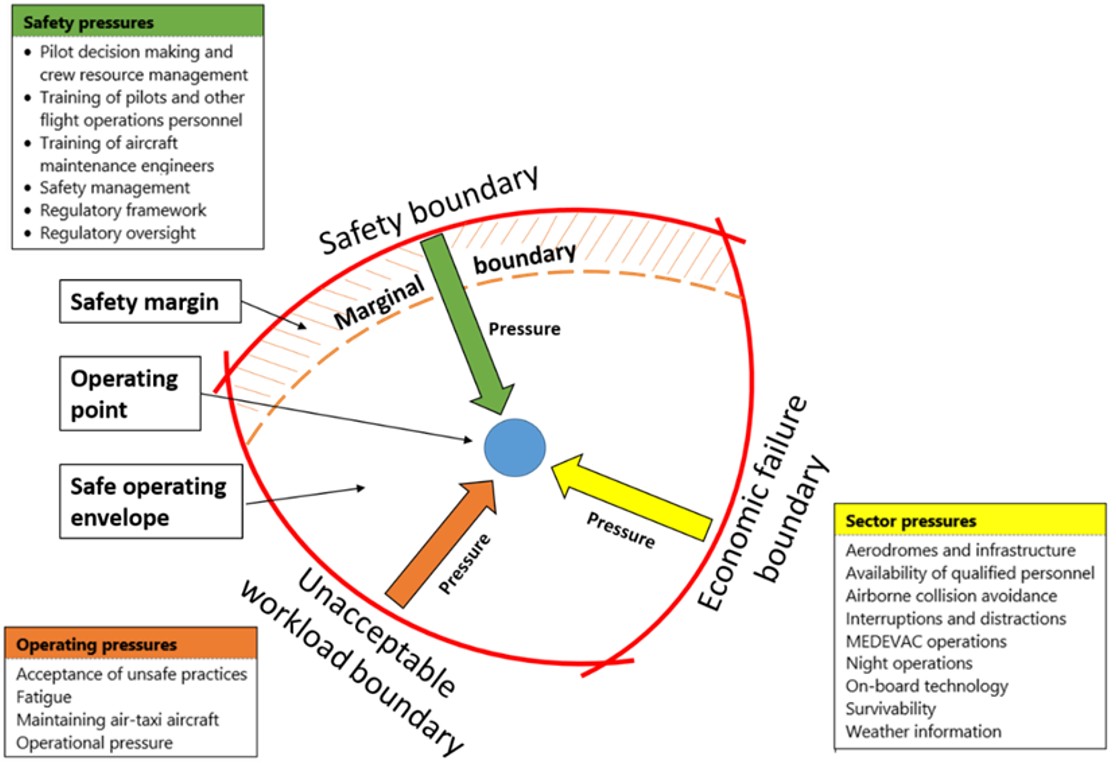
The varied and complex nature of the air-taxi sector and the extent of the pressures these air operators face introduce challenging hazards and risk factors. Risks affecting the air-taxi sector have persisted for decades and are proving resistant to more traditional safety mitigation.
1.18.3.1 Organizational drift
Research on system safety has identified that accidents are usually the result of a confluence of factors, which may include slips or lapses on the part of an individual, while also being influenced by organizational behaviour.
One of the organizational patterns we see in complex systems is a drift into failure. This occurs when components of these complex systems interact, evolve, and adapt to new situations in ways that cause operations to drift into the safety margin, often because of a scarcity of resources.S. Dekker, Drift Into Failure: From Hunting Broken Components to Understanding Complex Systems, (2011), p. 37.
This resource scarcity exerts a pressure on operations that results in tradeoffs between what is cost-effective or efficient and what is safe. The challenge with managing these competing pressures is that there is a feedback imbalance between these different elements. It is often easy to measure the cost savings or efficiency gained by a given decision, but harder to quantify how much was borrowed from safety in service of those other goals.Ibid., pp. 38-39. There can even be a pride in an organization’s ability to continue to operate successfully in the face of such pressures.
If those operational changes were followed by successful performance, they serve to reinforce the belief that they were a good decision and there was no obvious impact to safety. However, past success is not a guarantee of future successful performance, and decisions to continually borrow from safety in this manner will inevitably result in a change in the risk level that can be missed by an organization.
In addition, because this drift is gradual or incremental, it is not easily identifiable. As well, there is a tendency for the drift in organizational performance to be judged by the success of the most recent change and not its distance from the original design.
1.18.3.2 Crew resource management and threat and error management
TC’s AC 700-042 explains that CRM
integrates technical skill development with communications and crew coordination training and operational risk management by applying threat and error management (TEM) concepts.Transport Canada, Advisory Circular (AC) 700-042: Crew Resource Management (CRM), (Issue 02: 14 March 2020), section 2.3 Definitions and Abbreviations; 1)b), at tc.canada.ca/sites/default/files/migrated/ac_700_042.pdf (last accessed on 08 December 2025).
The AC goes on to describe TEM, stating that it consists of
the identification and analysis of potential hazards; the implementation of appropriate strategies to handle threats; and the implementation of steps to avoid, trap, or mitigate errors before they lead to undesired consequences such as an undesired aircraft state.Ibid., section 4.1 General (9), at tc.canada.ca/sites/default/files/migrated/ac_700_042.pdf (last accessed on 08 December 2025).
TEM is a general safety principle for all aviation operations and has 3 components: threats, errors, and undesired aircraft states. The TEM framework is based on the concept that flight crews must manage threats and errors as a regular part of aviation operations because they can both potentially lead to an undesired aircraft state, at which point a flight crew must take action to avoid an unsafe outcome.Ibid., Appendix E – Crew Resource Management Training Material, section (1): Introduction, at tc.canada.ca/sites/default/files/migrated/ac_700_042.pdf (last accessed on 08 December 2025).
Some aspects of an environment increase operational complexity. However, if flight crews recognize threats and develop ways to manage them, errors can be prevented. As the AC explains,
[i]f an error occurs, there may be things already built into the system, such as inspections and operational checks, which resist the error to avoid a harmful outcome, or the person doing the work could recognize that he/she made an error and resolve the error quickly.Ibid., Appendix E – Crew Resource Management Training Material, section (1)(h)(iii)(A), at tc.canada.ca/sites/default/files/migrated/ac_700_042.pdf (last accessed on 23 September 2025).
Under TC’s approach, the air operator has key responsibilities in ensuring the effectiveness of CRM training in its organization:
(1) Ultimately, the effectiveness of a contemporary CRM training program depends upon the extent to which an air operator treats CRM as an integral part of its culture. Company safety culture should support CRM throughout the organization, as well as among aircraft crew members.
(2) CRM training should also address hazards and risks identified by the operator’s safety management system (as applicable).
(3) CRM embraces all operational personnel and should include initial indoctrination, annual practice, feedback and continuing reinforcement.
(4) The operator is solely responsible for all activities related to the training of personnel both for in-house or any outsourced training program.Ibid., section 6.2: Operator Responsibilities, at tc.canada.ca/sites/default/files/migrated/ac_700_042.pdf (last accessed on 23 September 2025).
To further support the effectiveness of CRM, air operators should ensure that every stage of training incorporates it. CRM concepts should also be emphasized in checklists, briefings, abnormal and emergency procedures, and other areas of line operations.
1.18.4 TSB Watchlist
The TSB Watchlist identifies the key safety issues that need to be addressed to make Canada’s transportation system even safer.
1.18.4.1 Regulatory surveillance
All transportation operators are responsible for managing the safety risks in their organizations and operations. Regulations help by providing air operators a guiding framework and stipulating certain minimum requirements and levels of safety. However, while it is up to air operators to meet those requirements, it is TC’s responsibility to inspect and audit air operators to confirm that they are compliant with these regulations and that minimum levels of safety are met.
However, TC’s surveillance is not always effective at identifying gaps in a company’s safety management processes and intervening soon enough. Moreover, at times, there has been an imbalance between the use of traditional inspections to verify compliance with regulations, and auditing company safety processes to assess if they are working.
Following a fatal air ambulance helicopter accident near Moosonee, Ontario, in 2013,TSB Air Transportation Safety Investigation Report A13H0001. the Board recommended that
the Department of Transport enhance its oversight policies, procedures and training to ensure the frequency and focus of surveillance, as well as post-surveillance oversight activities, including enforcement, are commensurate with the capability of the operator to effectively manage risk.
TSB Recommendation A16-14
TC’s latest response to this recommendation was rated as Unsatisfactory by the TSB in March 2025. Specifically, TC’s response does not provide a clear framework for how it plans to ensure that the frequency and focus of surveillance (i.e., systems level vs. process level) and post-surveillance activities, including enforcement, are commensurate with an air operator’s ability to effectively manage risk.TSB Recommendation A16-14: Oversight of commercial aviation in Canada: policies, procedures and training, at https://www.tsb.gc.ca/eng/recommandations-recommendations/aviation/2016/rec-a1614.html (last accessed on 08 December 2025).
ACTIONS REQUIRED The issue of regulatory surveillance in air transportation will remain on the Watchlist until TC demonstrates that its surveillance framework can
Successfully addressing TSB Recommendation A16-14 is key to achieving these objectives. |
2.0 Analysis
The aircraft was certified, equipped, and maintained in accordance with existing regulations and approved procedures. The investigation did not identify any medical or physiological issues with the flight crew. The analysis will address the organizational, human, and operational factors that contributed to this occurrence.
The analysis will focus on the safety culture at Air Tindi Ltd. (Air Tindi) and its impact on the flight crew’s decision to depart and continue flights, the use of improvised instrument approaches, global positioning systems (GPS), and the terrain awareness and warning system (TAWS). The analysis will also address issues related to the company’s oversight of operations, how Transport Canada (TC) oversees these operations, as well as TC’s guidance on the use of on-board electronic devices such as electronic flight bags (EFBs). In addition, it will examine the survival aspects of this occurrence.
2.1 Air Tindi Ltd.
2.1.1 Decision to depart and continue the flight
The investigation determined that if the weather at Yellowknife Airport (CYZF) was compliant with visual meteorological conditions (VMC), it was standard practice at Air Tindi for Twin Otter pilots conducting off-strip operations to depart under visual flight rules (VFR), regardless of the weather at the destination. Destinations serviced by off-strip landings do not have instrument approaches, so pilots are required to conduct the arrivals and approaches visually. Outside of CYZF, weather reporting stations in the surrounding area are sparsely located, and weather forecasting is limited. This led pilots to attempt flights if the weather at their origin was VFR.
Given that the forecasts showed that the weather would remain VMC at CYZF, the flight crew was likely less concerned with the weather at the destination because they assumed they could always return to CYZF if they encountered weather outside of their operational comfort level. The aircraft departed CYZF under VFR on the 1st leg of the day and, once outside of the control zone, climbed through instrument meteorological conditions (IMC) to take advantage of more favourable winds. This practice of climbing through IMC while flying under VFR once outside of the CYZF control zone was also determined to be common at Air Tindi.
At various times throughout the 1st leg and early in the occurrence flight (2nd leg), the flight crew identified the challenging weather conditions; however, their identification of the threat posed by the weather never reached a threshold where it was felt that they could not successfully complete the flight. As the aircraft continued closer to destination, it became increasingly unlikely that the flight crew would discontinue the flight and return to CYZF owing to a downplaying of the risk in favour of goal completion.
In TSB Air Transportation Safety Issue Investigation (SII) Report A15H0001, it was identified that previous experience in successfully executing flights in marginal weather conditions further reinforced this practice among pilots.
This relates to the way pilots in air-taxi operations construct their understanding of risk with regards to deciding to begin and carry on with a particular flight. Given the greater complexity that exists in these operations, and by extension, the multitude of factors that a given pilot or flight crew is balancing in their decision to go or not, this naturally leads toward a higher-risk threshold that pilots must adopt in order to successfully operate in this sector.
When air-taxi pilots are calibrating their risk threshold, successful outcomes on these occasions where they proceeded in marginal VFR conditions produce a feedback imbalance that affects future decision making. It is often easy to measure the cost savings or efficiency gained by a given decision, but harder to quantify how much was borrowed from safety in service of those other goals. If those operational changes were followed by successful performance, i.e., the flight reached its destination and nothing “bad” happened, it serves to reinforce the belief that this was the “right” decision and there was no obvious impact to safety.
However, past success is not a guarantee of future successful performance, and decisions to continually borrow from safety in this manner will inevitably result in a change in the risk level present in a particular operation. This can be missed by organizations if their oversight mechanisms are not sensitive enough to detect over time this drift away from standard operating procedures (SOPs) or guidance provided in their flight operations manuals.
The occurrence captain’s extensive experience in the air-taxi sector likely altered his perception of risk over time, leading him to adopt a higher-risk threshold for weather limits. This made him confident that the day’s flights could be completed despite the challenging weather conditions, which contributed to the decision to make the flight and try to land at Lac de Gras.
Finding as to causes and contributing factors
The flight crew’s decision to depart on the day’s flights and continue flying in deteriorating weather was influenced by both the flight crew’s past successful experiences in similar conditions and by a plan continuation bias, which led to a reduced perception of risk associated with continuing this VFR flight in IMC.
2.1.2 Improvised instrument approaches
During the aircraft’s initial arrival in the area, the flight crew were unable to determine their position in relation to the road camp without the aid of their EFBs and decided to use an improvised instrument approach to complete their flight. The company-designed VFR approach provided the guidance required by the flight crew to find the road camp. During the attempts to land at the Lac de Gras road camp, the flight crew consistently visually identified the road camp at a distance of ½ nautical miles (NM).
During the 2nd approach, the flight crew flew an orbit to determine a heading to conduct an improvised instrument approach. After determining the heading, the flight crew repositioned the aircraft without compensating for the strong westerly winds. Flying according to a heading does not provide lateral position information; so even though the aircraft was facing the correct direction, it was not in the position the flight crew had intended. They therefore initiated the improvised instrument approach when the aircraft was ½ NM south of the track they had planned to use to reach the improvised airstrip on the frozen lake. Throughout this procedure, the flight crew was unaware of its position relative to the road camp, which was only recognized by the first officer (pilot monitoring) with the aid of the EFB once the aircraft had entered a short final approach to an unintended part of the lake.
For the final approach to Lac de Gras, the flight crew built a new track line to follow using the GPS device and initiated an improvised instrument approach to a height of 50 feet above ground level (AGL). In all 3 attempts to land at the road camp, the aircraft descended in IMC to altitudes below those defined in standard precision approach procedures. Improvised instrument approaches have no guaranteed terrain clearance built into them, contrary to certified instrument approaches.
The aircraft was operated below 50 feet AGL in IMC during the final approach. Given the low visibility from blowing snow and the low-contrast environment, the flight crew only observed the hill in the windscreen approximately 2 seconds before the impact. Although the flight crew did attempt to avoid the hill by applying full power and initiating a pitch up, impact with the terrain was unavoidable.
Finding as to causes and contributing factors
While conducting an improvised instrument approach in an area of reduced visibility, the flight crew intentionally descended below 50 feet AGL without sufficient visual reference to the surface and the aircraft impacted rising terrain.
During the investigation, the TSB investigators spoke with 11 Air Tindi Twin Otter pilots about the prevalence of various improvised instrument approaches in the operation. The majority of those pilots had all conducted improvised instrument approaches to altitudes below instrument flight rules (IFR) safe altitudes. There was a common perception among pilots that because the terrain to the north of Yellowknife is relatively flat and obstacles are sparse that there was enough margin to allow for a safe descent to 500 feet AGL.
This line of thinking was further reinforced by the availability of aircraft position information in a modern cockpit. Despite not being certified for IFR flight, GPS-equipped EFBs provide extremely accurate position information during flight, which can be overlaid onto terrain information. With this position information and the real-time height above terrain information displayed on radio altimeters, pilots felt comfortable creating their own safety envelope outside of the current regulations.
Finding as to risk
Operating an aircraft in IMC at altitudes below the minimums established for IFR increases the risk of controlled flight into terrain (CFIT).
2.1.3 Global positioning systems
At Air Tindi, pilots use the ForeFlight Mobile application (ForeFlight), a GPS application available on their EFBs, as the primary aid for navigation in operations, both in flight and on the ground. Even though the ability to navigate with reference to the EFB has been in place for quite some time, training and procedures with regards to EFBs at Air Tindi focus primarily on device management (acceptable battery levels, ensuring current software updates, managing approach plates for the flight, etc.). There is no training or guidance provided by Air Tindi on how the company expects the GPS and auxiliary navigation functionality available in ForeFlight to be used or integrated into in-flight decision making by pilots.
Using EFBs as a primary source of navigation guidance to fly in IMC is not a standardized procedure; it has not been formally risk assessed in any way by Air Tindi nor Transport Canada, and more importantly, it is not permitted by regulations. Furthermore, this practice can lead to risk-taking behaviours such as “pushing the weather” as well as other actions that would contravene the Canadian Aviation Regulations (CARs) in relation to IFR and VFR flight. The result is an as yet undefined safety risk when pilots leverage the powerful feature set available to them via ForeFlight on the EFB in order to manage challenging weather conditions to increase the chance of reaching their destination.
It is important to acknowledge the significant positive impact an EFB and specifically its GPS functionality has had on situational awareness and decision making in CARs Subpart 703 (Air Taxi Operations) off-strip operations. In a sector that has traditionally suffered from insufficient information and absence of information on many fronts, access to more detailed maps, live position information, and a host of other navigation features can provide a significant safety improvement in both normal and emergency operational contexts. The risk posed by an application such as ForeFlight in this context is that a tool with a very powerful set of features to augment pilot decision making and situational awareness has been introduced into a dynamic environment with an absence of constraints around how to safely integrate the technology into the cockpit.
During the occurrence flight, the flight crew frequently relied upon the EFBs as their primary source of navigation guidance. The ability to extend centrelines from potential landing surfaces, availability of traffic information, and georeferenced moving map display all increased their comfort in operating in deteriorating weather.
Finding as to causes and contributing factors
The flight crew’s overreliance on the EFBs for situational awareness contributed to their decision to continue operating visually in IMC.
Finding as to risk
If air operators do not provide formal guidance on the use of company-made VFR approach procedures, there is a risk that flight crews will use these approaches in IMC and elevate the risk of CFIT.
2.1.4 Terrain awareness and warning systems
TAWSs are designed to be used where the majority of aircraft operate: from runway to runway. Although these systems will provide terrain warnings in off-strip operations, they will also provide warnings while landing intentionally where there is no runway or aerodrome. These warnings are designed to be difficult to ignore. Pilots are trained to react to TAWS warnings in IMC without thought or verification of the validity of the warning; however, in the case of VFR flights, pilots might not action the warning if they are aware of the terrain and have the terrain in sight.
In off-strip operations, the inherent fact that TAWS warnings are meant to catch the attention of the pilots, causes the warnings themselves to be a distraction during visual manoeuvres to land. Because landing, particularly in off-strip operations, is one of the most critical phases of flight, pilots at Air Tindi would disable the TAWS before commencing a VFR approach to land.
During the occurrence flight, the flight crew was aware of the inclement weather and did not want the additional distraction of a TAWS warning for what would be a VFR approach to land. Because of this, the flight crew disabled the TAWS on the climb out of CYZF on the 1st leg of the day. The TAWS was never re-enabled, despite the various legs being conducted in IMC.
Finding as to risk
Intentionally disabling an aircraft’s TAWS eliminates a critical safeguard designed to warn pilots of an impending CFIT.
2.1.5 Ineffective oversight of operations
An indication that there is a positive safety culture at an organization is when the company’s philosophy, policies, procedures, and practices are in alignment. Although Air Tindi’s philosophy, policies, and procedures were thorough and in alignment with each other, at the time of the occurrence, the practices were not. The company did not assess how practices were being conducted from day-to-day as compared to the company’s stated philosophy, written policies, and developed procedures.
The current mechanisms available at Air Tindi to ensure or enhance compliance with operational policies and procedures are the training program, pilot proficiency checks, a hazard registry, line checks, a flight operations quality assurance program (FOQA), and self-reporting through the safety management system (SMS). These mechanisms did not identify or manage the unsafe practice of pilots using GPS devices to create and fly uncertified IFR approaches as well as that of continuing VFR flights in IMC.
Air Tindi’s Flight Operations Manual has procedures that specify the weather limits that pilots are expected to adhere to when conducting flights. As demonstrated in this occurrence, despite this guidance, there is still a practice of trying to complete flights even when weather is at or below these limits. There is consequently a gap between the procedures that Air Tindi has laid out with regards to weather limits and the practices that are enacted by pilots.
One of the limitations of Air Tindi’s approach to oversight is that few mechanisms were in place to allow for robust insight into how aircraft are being flown in relation to the organization’s SOPs. One of the oversight mechanisms used at Air Tindi is the pilot line check. These offer limited insight into operations given that they are conducted at infrequent time intervals (approximately once a year), that they tend to be focused on newer pilots as opposed to more experienced pilots at the company, and that the pilot’s performance during the line check can be affected by the sole presence of a check pilot.
Even though Air Tindi has an SMS, unsafe practices were accepted by pilots and were viewed as part of normal work; these practices never triggered an SMS report or generated more significant action from company management to address the issues.
Although Air Tindi has created a hazard registry, the hazard of continuing VFR flights into IMC was not a documented hazard that was formally tracked or managed. The risk posed by how the use of GPS tools on the EFBs’ impacts in-flight decision making is also absent from the registry.
The safe operating envelope concept presented in the TSB SII on air-taxi operations, explains how the fact that Air Tindi’s operations are subject to sector pressures and operating pressures has resulted in unsafe practices being adopted. The safety pressures that would normally offer resistance to the operational pressures ended up being ineffective in the context of this occurrence in the following ways:
- Air Tindi pilots have accepted unsafe practices as being normal work and therefore no longer perceive the risks in these practices. This way of working had normalized over time in the absence of any specific consequences to indicate that it constitutes an unsafe and ineffective approach to managing the various pressures the pilots face working for a CARs Subpart 703 (Air Taxi Operations) air operator.
- Training has no impact on these practices that are not formalized procedures. Instead, these practices are learned and proliferated through informal operational learning during flights.
- Company oversight had also become desensitized to the risk posed by these practices because the practices were only used operationally (during flight) and were not directly observed by company management, it was thus difficult to know exactly how far they had proliferated. However, this desensitization also created a feedback imbalance where the practices were tacitly approved given the absence of any clear evidence to indicate that safety margins had been eroded.
- Regulatory oversight is also not sensitive enough to detect this drift from the SOPs because TC’s approach to regulatory oversight is focused more on how the documented processes (e.g., SOPs, SMS manual, etc.) look in relation to the regulatory framework, than on how the processes are being conducted day-to-day. This issue will be further explored in the following section on regulatory oversight.
The result was a gradual but undetected increase in risk over time given that the unsafe practices go undetected and thus unaddressed. This underlying dynamic is also at least partially able to explain the recent history of accidents at Air Tindi. Previous TSB investigations into Air Tindi accidents identified unsafe practices such as departing with safety critical equipment not fully functioning, the drift away from the use of checklists, and an acceptance of deviations from published procedures that the company’s oversight mechanisms were unable to detect before they were contributory to an occurrence. The sector and operating pressures that resulted in the adoption of these unsafe practices will always be pushing operations toward the safety boundary as defined in the safe operating envelope concept, and if the company lacks the means to identify a gap between procedures and practice, then the risk of accidents such as this one will remain.
Air Tindi has a robust set of SOPs and guidance in its FOM with regards to crew resource management and threat and error management; however, regardless of the level of training or guidance provided by the company, even the most robust threat and error management and crew resource management programs will be ineffective if company culture allows and accepts the use of unsafe practices and deviations from procedures. Administrative defences against risks are only effective if they are used as they were designed. A misalignment between company procedures and pilot practices is indicative of a weakened safety culture.
Finding as to causes and contributing factors
The oversight mechanisms employed by Air Tindi were unable to detect the drift away from SOPs, and deviations by pilots, including the conduct of improvised instrument approaches in IMC, were not addressed.
Although the occurrence aircraft was equipped with a device capable of capturing flight data, Air Tindi had not established a flight data monitoring program, nor was it required to by regulation. These programs can identify issues with SOP compliance, pilot decision making, and adherence to aircraft limitations. They allow companies to proactively manage operational flight risk before an accident takes place. Despite the intrinsic difficulties with flight data monitoring in CARs Subpart 703 operations, valuable data can be retrieved and analyzed from aircraft with even rudimentary data recording capabilities. If air operators that have flight data monitoring capabilities do not actively monitor their flight operations, they might lose an opportunity to identify drifts toward unsafe practices, which increases the risk to pilots and passengers.
Finding as to risk
If air operators do not utilize the flight data monitoring capabilities available to them, they can miss opportunities to ensure the effectiveness of and adherence to published procedures, increasing the risk of an accident.
2.2 Regulatory framework
2.2.1 Transport Canada oversight of Air Tindi Ltd. operations
Regulatory oversight is particularly challenging in the air-taxi sector. There are hundreds of air operators with a wide range of operations: seaplanes, helicopters, and landplanes; single- and multi-engine aircraft; and VFR and IFR operations—all operating in a variety of hazardous environments.
TC’s oversight is to ensure that air operators are capable of managing the inherent risks in their operations, measures to enhance safety are working effectively to identify hazards and mitigate risks, and any non-compliance with regulations is addressed promptly and corrective action is taken.
Preceding this occurrence, TC’s oversight of Air Tindi included various planned process inspections in 2022 and 2023 as well as reactive process inspections following accidents in 2019 and 2021. The outcome of these 4 inspections was 3 findings and 8 observations.
TC’s current approach to oversight is heavily focused on evaluating air operators’ documented processes, leaving a potential gap in terms of assessing how aircraft are being flown day-to-day. The risk with this approach is that very often, as in other complex systems, there is a gap between work-as-prescribed, that has been captured in processes and procedures, and work-as-done by front-line staff.
Work-as-prescribed tends to offer a simplified and idealized version of how work is expected to be completed, with assumed system conditions (e.g., staffing, equipment, time) more optimal than those found in practice. Therefore, work-as-done will tend to diverge and drift from prescribed work as a result of front-line staff trying to accommodate the sector and operational pressures.
This accommodation is typically a significant source of success for air operators trying to manage the realities of operating a business in a complex, dynamic environment. However, when there is an incident or accident, this discrepancy tends to be highlighted as the reason why things went wrong with little attempt to understand why they were being done this way to begin with. This is not to suggest that all work-as-done should be considered the “wrong way”, only that it is understandable that these types of practices arise given the pressures that front-line staff must navigate. The risk with these undocumented practices and adaptations is that they have not been subjected to any formal risk assessments, and thus the resultant risk to the operation is unknown.
TC’s oversight is strong at identifying documented compliance with various regulations, yet it has a limited ability to identify gaps between documented processes and procedures and day-to-day flying behaviours. Much of this responsibility is up to the operator to manage. However, as was highlighted in the previous section, this internal oversight can be challenging for air operators, especially in a more resource-constrained environment such as that found in the air-taxi sector.
In addition, as has been identified by TSB Recommendation A16-14 and TSB’s assessments of TC’s responses to that recommendation since it was issued in 2016, simply verifying regulatory compliance in a cross-section of an organization does not confirm that commercial aviation operators are capable of effectively managing safety in their organization. TC must also confirm that air operators are capable of managing safety effectively whether or not they have an SMS.
Finding as to risk
The current approach to surveillance employed by TC relies heavily on examining an air operator's documented processes, versus conducting observations of operations, when assessing regulatory compliance. This makes it difficult for TC to detect drifts from current regulations, which may reduce safety margins to unacceptable levels.
Other available approaches that may be better suited to identifying these gaps could be integrated into TC’s process-based inspections. This is evidenced by TC inspectors’ attempt to take a different approach to the reactive inspection conducted in the wake of an Air Tindi accident in 2021.TSB Air Transportation Safety Investigation Report A21W0098.
After the 2021 occurrence, there was a recognition among the TC regional inspectors that the typical approach was going to yield little in terms of identifying the underlying safety issues that were contributing to the pattern of occurrences at Air Tindi. Their work identified some of the underlying factors that were present in the 2023 occurrence, albeit in a different context, such as the drift away from the SOPs, the implications of a steep experience gradient in Twin Otter cockpits, and the crews’ self-imposed pressure to complete flights.
An approach to regulatory surveillance heavily weighted to auditing documented processes and procedures will result in a narrow view of how companies are managing safety in their operations, especially in the context of how operations will have a natural tendency to drift toward the safety boundary over time as they are subjected to sector pressures and operating pressures inherent to these operations.
Finding as to risk
If, following regulatory surveillance, air operators are only required to respond to findings of regulatory non-compliance and are not required to respond to observations regarding non-compliance with their own manuals, programs, systems, processes and procedures, or with published industry safety standards, there is a risk that safety deficiencies that were identified during the surveillance will persist.
2.2.2 Transport Canada guidance on electronic flight bags
In Advisory Circular (AC) 700-020, TC states that the use of own-ship position via EFB GPS applications is only for added situational awareness and is not to be used for primary navigation. However, the guidance in AC 700-020 is not currently reflective of the functionality available in GPS applications and their ability to be integrated with flight instruments, thus creating a more advanced suite of tools that provides significantly more advanced position awareness functionality at the disposal of the pilots.
When AC 700-020 was published in 2018, it aligned Canadian guidance with that of the U.S. Federal Aviation Administration (FAA) and the International Civil Aviation Organization (ICAO). The circular built on the work that had already been done by these organizations to more clearly articulate directions related to a quickly growing piece of technology with a heavy focus on simplifying the different categories of hardware available and their most suited application.
Air operators have advanced quickly in implementing this new technology and its constant advancements to support their operations. Even though there may have been a sense of the possibility that these tools might eventually impact pilot decision making during the development of this Advisory Circular on EFBs, the use of certain advanced navigation features now available via EFBs and their integration into pilot decision making have accelerated much more quickly and in ways that were unexpected by TC.
TC guidance regarding the more advanced features available in GPS applications on EFBs is therefore unavailable, and in the absence of such guidance, there is a continued proliferation of informal practices that potentially increase safety risk. Further research into this issue is required to understand the extent to which this new technology has impacted pilot decision making and to develop appropriate guidance that highlights the safest ways to integrate this decision-making tool.
Finding as to risk
If regulations or regulatory guidance are slow in adapting to changing technology that impacts critical operational areas, there is a risk that this technology will be used in ways affecting the safe operation of aircraft.
2.3 Survivability
Given the relatively slow approach speed of the Twin Otter and the strong head wind on the final attempt to land, all occupants survived the impact with the hill. During the impact sequence, the pilots’ headsets were damaged to the point of being inoperable. The on-board satellite phone required a headset to be used. Fortunately, in this occurrence, a passenger had a personal satellite phone in his luggage, which was used to report the situation to Air Tindi and subsequently used to update the occupants on the rescue mission that was on its way to the accident site.
Once it had been established that there were no fatalities, the contents of the survival kit on board became critical for survival. Survival equipment should provide a means to create shelter, sustenance, and warmth. The company believed that the survival kit in the occurrence aircraft met CARs requirements, based on its interpretation. The generality of the written regulations allows for air operators to tailor the survival equipment to the needs of their specific operation, as opposed to a one size fits all approach. It is then the responsibility of the air operator to ensure that the survival equipment onboard is sufficient for their operation.
Shelter in the survival kit was to be provided by two 9 feet x 12 feet tarps. In addition, the aircraft was equipped with a small tent on board. The tarp as a shelter can only be effective if there are adequate supports in the environment to provide structure. In operations north of the tree line, and particularly in the winter, there is very little that can be used to provide supports for the tarp in order to make a shelter. Additionally, because of the uninsulated nature of tarps, any shelter constructed from them would be extremely difficult to heat to a survivable temperature in an average arctic winter. The tent that was carried on board was not large enough to shelter all of the people on board, and the occupants found it extremely difficult to set it up in the winds. The captain jury-rigged the aircraft’s engine tents into a makeshift door covering on the aircraft to help protect the passengers who were unable to egress from the aircraft owing to their injuries.
For warmth, the survival kit provided candles and matches. These were both inadequate to provide enough heat in an arctic survival situation. The captain lit a candle in the aircraft in an attempt to provide additional warmth and reported that it likely did not make a noticeable difference in the temperature inside the downed aircraft.
Given the vastness of Canada, the remoteness of some locations serviced by aircraft, and the potential for inclement weather, the time from an accident occurring to when help arrives may be hours or days. Air operators should take into account the possibility that rescue may not occur immediately and that the survival gear carried on the aircraft may be needed for extended periods of time in inclement weather.
Finding as to risk
Because the survival equipment required by regulation is open to interpretation, it may be insufficient to provide the necessities needed by survivors after an accident, creating a risk that passengers and pilots will be unable to survive in the environment.
3.0 Findings
3.1 Findings as to causes and contributing factors
These are the factors that were found to have caused or contributed to the occurrence.
- The oversight mechanisms employed by Air Tindi were unable to detect the drift away from standard operating procedures, and deviations by pilots, including the conduct of improvised instrument approaches in instrument meteorological conditions, were not addressed.
- The flight crew’s decision to depart on the day’s flights and continue flying in deteriorating weather was influenced by both the flight crew’s past successful experiences in similar conditions and by a plan continuation bias, which led to a reduced perception of risk associated with continuing this visual flight rules flight in instrument meteorological conditions.
- The flight crew’s overreliance on the electronic flight bags for situational awareness contributed to their decision to continue operating visually in instrument meteorological conditions.
- While conducting an improvised instrument approach in an area of reduced visibility, the flight crew intentionally descended below 50 feet above ground level without sufficient visual reference to the surface and the aircraft impacted rising terrain.
3.2 Findings as to risk
These are the factors in the occurrence that were found to pose a risk to the transportation system. These factors may or may not have been causal or contributing to the occurrence but could pose a risk in the future.
- Operating an aircraft in instrument meteorological conditions at altitudes below the minimums established for instrument flight rules increases the risk of controlled flight into terrain.
- If air operators do not provide formal guidance on the use of company-made visual flight rules approach procedures, there is a risk that flight crews will use these approaches in instrument meteorological conditions and elevate the risk of controlled flight into terrain.
- Intentionally disabling an aircraft’s terrain awareness and warning system eliminates a critical safeguard designed to warn pilots of an impending controlled flight into terrain.
- If air operators do not utilize the flight data monitoring capabilities available to them, they can miss opportunities to ensure the effectiveness of and adherence to published procedures, increasing the risk of an accident.
- The current approach to surveillance employed by Transport Canada relies heavily on examining an air operator’s documented processes, versus conducting observations of operations, when assessing regulatory compliance. This makes it difficult for Transport Canada to detect drifts from current regulations, which may reduce safety margins to unacceptable levels.
- If, following regulatory surveillance, air operators are only required to respond to findings of regulatory non-compliance and are not required to respond to observations regarding non-compliance to their own manuals, programs, systems, processes and procedures, or with published industry safety standards, there is a risk that safety deficiencies that were identified during the surveillance will persist.
- If regulations or regulatory guidance are slow in adapting to changing technology that impacts critical operational areas, there is a risk that this technology will be used in ways affecting the safe operation of aircraft.
- Because the survival equipment required by regulation is open to interpretation, it may be insufficient to provide the necessities needed by survivors after an accident, creating a risk that passengers and pilots will be unable to survive in the environment.
4.0 Safety action
4.1 Safety action taken
4.1.1 Air Tindi Ltd.
Following the accident, Air Tindi Ltd. (Air Tindi) conducted its own internal safety investigation and identified several processes and procedures that could be improved. As a result, Air Tindi took the following actions:
- Increased weather limitations on all flights with featureless terrain.
- Implemented mandatory pilot monitoring requirements and actions by the first officer for all off-strip approaches and landings.
- Conducted one-on-one conversations with each captain at Air Tindi regarding company culture, standards, human factors, and threat-based decision making over goal-based decision making.
- Enhanced crew resource management training to address culture and behaviour change.
- Implemented co-authority dispatch to all operations to address a culture and behaviour change.
- Implemented a Flight Risk Assessment Tool (FRAT) to better evaluate risks prior to dispatch.
- Increased simulator training to address the needed culture, behaviour change, and experience gradient in the cockpit.
- Reviewed the list of survival equipment included in survival kits and upgraded the contents to ensure that the effectiveness of the survival gear matches the environment and risk.
- Upgraded all aircraft instrumentation to increase situational awareness.
This report concludes the Transportation Safety Board of Canada’s investigation into this occurrence. The Board authorized the release of this report on 19 November 2025. It was officially released on 08 January 2026.
Appendices
Appendix A – Graphic area forecast – Clouds and Weather Chart GFACN35 issued at 0425 Mountain Standard Time on 27 December 2023 (yellow star denotes accident site)
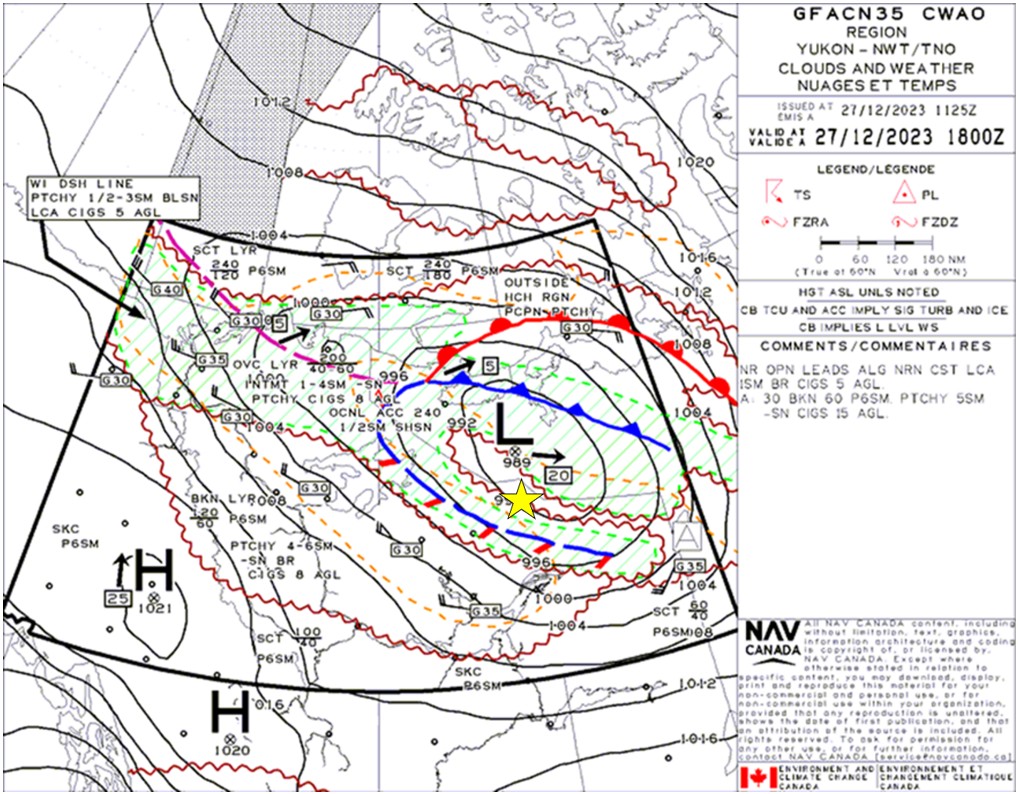
Source: NAV CANADA