
On this page
- From the Chair
- Plans to deliver on core responsibilities and internal services
- Planned spending and human resources
- Corporate information
- Supplementary information tables
- Federal tax expenditures
- Definitions
Read a summary of the Departmental Plan Departmental Plan in PDF
From the Chair
I am pleased to present the Transportation Safety Board of Canada’s (TSB) Departmental Plan for 2025–26, which outlines our plans and priorities for the next fiscal year.
Before looking ahead, it’s important to acknowledge several key changes to the composition of the Board. In August 2024, Chair Kathy Fox retired after nearly a decade of dedicated leadership, during which the TSB conducted hundreds of investigations and provided critical safety insights. Having joined the TSB as a Board Member in 2020, I am honoured to now serve as Chair and continue contributing to our important work.
I am also pleased to welcome Louise Smolska as a Board Member for a four-year term. With her extensive experience in railway safety, operations, and government affairs, Ms. Smolska is a valuable addition to the Board.
Looking forward, and in alignment with the TSB Strategic Plan 2021–22 to 2025–26, we will continue improving the way we conduct our investigations, remaining responsive to emerging challenges and opportunities. This will enable us to more effectively identify safety issues and provide timely results.
As the transportation sector continues to evolve, it is essential that the TSB has access to a world-class facility to conduct the engineering and testing needed to support its investigations. In 2024, as part of the Government of Canada's Laboratories Canada Program, funding for the construction of a new state-of-the-art facility for the TSB was announced. Located on the National Research Council of Canada's (NRC) Ottawa campus, this new joint facility with the NRC will play a key role in the critical work that supports our investigations and enhances transportation safety.
A primary focus for 2025 is the release of our next Watchlist, which highlights systemic safety issues that need to be addressed to make Canada’s transportation system even safer. In preparation for its release, we are engaging with industry stakeholders to identify current safety deficiencies and emerging issues. The data and insights from our investigation reports, along with Board safety concerns and recommendations, will provide a roadmap for ongoing safety improvements.
Digital transformation remains central to our Strategic Plan. We continue to focus on being digital by default, and as part of this effort, we will enhance how data is collected, managed, and utilized. This includes completing the migration of our core systems to the Cloud. We will also further strengthen SECURITAS, our voluntary reporting system, to better support the TSB’s mandate and align with other elements of the organization’s objectives.
At the TSB, we recognize that many aspects of our work can be both physically and mentally challenging, particularly our interactions with families, loved ones, and survivors (FLS) of transportation occurrences. To better support our investigation teams in their FLS-related activities, we are establishing a dedicated team to facilitate liaison with FLS and ensure that FLS have the information and clarity they need throughout the course of an investigation. In addition, we will continue to strengthen our support programs to promote employee well-being and mental health.
As we look to the future, our dedication to improving transportation safety remains resolute. At the TSB, we will persist in refining our investigative processes, while working to drive impactful change in the air, marine, pipeline, and rail sectors. Our goal remains clear: to ensure safer transportation for all Canadians.
Yoan Marier
Chair
Plans to deliver on core responsibilities and internal services
Core responsibilities and internal services
- Core responsibility: Independent safety investigations and communication of risks in the transportation system
- Internal services
Core responsibility: Independent safety investigations and communication of risks in the transportation system
In this section
- Description
- Quality of life impacts
- Indicators, results and targets
- Plans to achieve results
- Key risks
- Planned resources to achieve results
- Related government priorities
- Program inventory
Description
The Transportation Safety Board of Canada’s sole objective is to advance air, marine, rail and pipeline transportation safety. This mandate is fulfilled by conducting independent investigations into selected transportation occurrences to identify the causes and contributing factors, and the safety deficiencies evidenced by these occurrences. The Transportation Safety Board of Canada makes recommendations to reduce or eliminate any such safety deficiencies and reports publicly on its investigations. The Transportation Safety Board of Canada then follows up with stakeholders to ensure that safety actions are taken to reduce risks and improve safety.
Quality of life impacts
This core responsibility contributes to the Good Governance domain of the Quality of Life Framework for Canada and, more specifically the Confidence in Institutions indicator, through all of the activities mentioned in the core responsibility description.
Indicators, results and targets
This section presents details on the department’s indicators, the actual results from the three most recently reported fiscal years, the targets and target dates approved in 2025–26 for independent safety investigations and communication of risks in the transportation system. Details are presented by departmental result.
Tables 1, 2 and 3 provides a summary of the target and actual results for each indicator associated with the results under independent safety investigations and communication of risks in the transportation system.
| Departmental Result Indicators | Actual Results | Target | Date to achieve target |
|---|---|---|---|
| Number of accidents over 10-year period | 2021–22: N/A 2022–23: Met, 1402 compared to 1555 2023–24: Met, 1331 compared to 1535 | Reduction in number of accidents | March 2026 |
| Departmental Result Indicators | Actual Results | Target | Date to achieve target |
|---|---|---|---|
| Average time recommendations have been outstanding (active recommendations) | 2021–22: N/A 2022–23: Not Met, 10.8 years 2023–24: Not Met, 8.1 years | 8 years | March 2026 |
| Percentage of responses to recommendations assessed as Fully Satisfactory (since TSB’s creation) | 2021–22: N/A 2022–23: Not Met, 1% decrease 2023–24: Not Met, 0.5% decrease | 1.5% increase from previous fiscal year result | March 2026 |
| Percentage of safety advisories on which safety actions have been taken | 2021–22: N/A 2022–23: Not Met, 46% 2023–24: Met, 86% | 60% | March 2026 |
| Departmental Result Indicators | Actual Results | Target | Date to achieve target |
|---|---|---|---|
| Average time to complete a class 1 safety issue investigation | 2021–22: N/A 2022–23: N/A 2023–24: N/A | 730 days | March 2026 |
| Average time to complete a class 2 complex investigation | 2021–22: N/A 2022–23: 1143 days 2023–24: 1208 days | 600 days | March 2026 |
| Average time to complete a class 3 detailed investigation | 2021–22: N/A 2022–23: 611 days 2023–24: 796 days | 450 days | March 2026 |
| Average time to complete a class 4 limited-scope investigation | 2021–22: N/A 2022–23: 235 days 2023–24: 258 days | 220 days | March 2026 |
| Average time to complete a class 5 data-gathering investigation | 2021–22: N/A 2022–23: 56 days 2023–24: 53 days | 60 days | March 2026 |
| Percentage of class 1-4 investigations that were completed within the target time | 2021–22: N/A 2022–23: 32% 2023–24: 28% | 60% | March 2026 |
Additional information on the detailed results and performance information for the TSB’s program inventory is available on GC InfoBase.
Plans to achieve results
The following section describes the planned results for independent safety investigations and communication of risks in the transportation system in 2025–26.
Transportation System is safer
This departmental result will be assessed by calculating the number of accidents across all modes of transportation over a 10-year period, with the goal of determining whether there has been a reduction in accidents. The objective of this indicator is to assess the overall safety of the transportation system. However, it is important to acknowledge that transportation safety is influenced by a variety of factors, and multiple organizations contribute to this outcome. As such, it is not possible to directly attribute improvements in safety to any single organization. In recent years, indicators of accident and fatality rates have generally shown positive progress in enhancing transportation safety.
Results we plan to achieve
- Number of accidents over 10-year period:
- Target: reduction in number of accidents
Regulators and the transportation industry respond to identified safety deficiencies
This departmental result will be measured using three key indicators: the average time recommendations remain outstanding (active recommendations), the percentage of responses to recommendations assessed as Fully Satisfactory (since TSB’s creation), and the percentage of safety advisories for which safety actions have been taken. The goal is for the TSB to present compelling, data-driven safety communications that effectively persuade “agents of change” to take corrective actions in response to identified safety deficiencies. By tracking the responses received, the actions taken, and their timeliness, we aim to gauge the TSB's impact on improving transportation safety. The TSB will continue to engage actively with stakeholders across all federally regulated transportation sectors. It is important to note that performance targets and results are tailored to each sector, reflecting their unique baselines and challenges. These indicators will be consolidated to assess overall departmental progress and outcomes across all sectors within the TSB’s jurisdiction.
Results we plan to achieve
- Average time recommendations have been outstanding (active recommendations)
- Target: 8 years or less
- Percentage of responses to recommendations assessed as Fully Satisfactory (since TSB’s creation)
- Target: 1.5% increase from previous fiscal year result
- Percentage of safety advisories on which safety actions have been taken
- Target: At least 60%
Occurrence investigations are efficient
This departmental result will be measured by the timeliness of investigation reports. We plan to use the average time to complete a report, categorized according to the TSB’s Policy on Occurrence Classification, as an efficiency indicator. The primary objective is to improve the timeliness of TSB investigation reports, addressing the current challenges in this area to enhance overall efficiency and responsiveness.
Results we plan to achieve
- Average time to complete a class 1 safety issue investigation:
- Target: Equal to or under 730 days
- Average time to complete a class 2 complex investigation
- Target: Equal to or under 600 days
- Average time to complete a class 3 detailed investigation
- Target: Equal to or under 450 days
- Average time to complete a class 4 limited-scope investigation
- Target: Equal to or under 220 days
- Average time to complete a class 5 data-gathering investigation
- Target: Equal to or under 60 days
- Percentage of class 1-4 investigations that were completed within the target time
- Target: At least 60%
Key risks
The TSB recognizes the need for agency-wide integrated risk management practices to effectively manage operations, deliver on its mandate and strategic outcome, and meet central agency expectations. A key element of the department’s risk management activities is the annual update of its Corporate Risk Profile (CRP).
Six key strategic risks have been identified as representing an important threat (or opportunity) to the department in fiscal year 2025–26. All of these risks warrant particular vigilance from all levels of the organization.
Keeping up with technological advances/changes in the industry
New advances in engineering, designs, and operational systems occur at times faster than the organization can adapt. Some examples of technological change that could pose challenges to the TSB’s work are increased automation in some transportation sectors and remotely piloted vehicles being integrated into existing transportation systems, increased use of composite materials for which we have limited expertise, as well as the electrification of vehicles and equipment, and the proliferation of specialized software used by industry to manage and support vehicle operations.
To be able to properly access public and private data for investigations, additional efforts will be required for TSB employees to maintain or acquire the requisite expertise and have access to the equipment and training necessary to conduct transportation occurrence investigations in the future.
Keeping up with workplace technology
There is a risk that TSB employees do not have access to current workplace technology tools, systems, and applications to ensure they can deliver their work in an efficient and effective manner. As a world-class investigative organization, it is important that employees are equipped with and leverage the latest technology tools/software/hardware to be able to interact efficiently with other government departments, stakeholders, other investigation organizations and industry.
As demonstrated during the COVID-19 pandemic, there is a strong need to ensure that these tools are not subject to business disruptions by third parties or other events.
Employee Safety and Wellbeing
There is a need to be vigilant with respect to managing employee physical and mental wellbeing and maintaining a work environment that is supportive, respectful, inclusive, diverse, and free of harassment. Due to the nature of the work performed by the TSB, employees may be exposed to a number of physical and psychological hazards.
Operational responsiveness
There is a risk that the TSB may not be able to deploy in a timely manner, and to sustain operations, in certain remote regions due to the limited availability of transportation services and support infrastructure. There is also a risk that investigation deployment contingency plans will not be robust enough and sufficiently practiced to ensure a proper state of readiness.
This risk is also evident in regions impacted by seasonal availability of transportation services and support infrastructure due to tourism or other factors. Availability of sufficient personnel, including both investigation and support functions, during and outside of core hours, compounds this risk.
Legal challenges
Organizations and individuals are more frequently challenging TSB business processes, as well as the application of the Canadian Transportation Accident Investigation and Safety Board (CTAISB) Act. This puts the TSB at risk that some court rulings could negatively impact the way the TSB conducts its business.
Lack of Resources
The TSB’s investigative capacity and support functions remain challenged in meeting investigation report publication targets in a way that meets industry and public expectations. Increased time to publish investigation results risks diminishing their impact and the opportunity to improve transportation safety in a timely manner. The Budget 2023 Refocusing Government Spending initiative as well as uncertainty regarding the future direction of government spending further impacts the risk to TSB operations and its ability to achieve results.
Planned resources to achieve results
Table 4: Planned resources to achieve results for independent safety investigations and communication of risks in the transportation system
| Resource | Planned |
|---|---|
| Spending | 32,899,005 |
| Full-time equivalents | 193 |
Complete financial and human resources information for the TSB’s program inventory is available on GC InfoBase.
Related government priorities
Information on the TSB’s contributions to Canada’s Federal Implementation Plan on the 2030 Agenda and the Federal Sustainable Development Strategy can be found in our Departmental Sustainable Development Strategy.
Program inventory
Independent safety investigations and communication of risks in the transportation system is supported by the following programs:
- Aviation occurrence investigations
- Marine occurrence investigations
- Pipeline occurrence investigations
- Rail occurrence investigations
Additional information related to the program inventory for independent safety investigations and communication of risks in the transportation system is available on the Results page on GC InfoBase.
Internal services
In this section
- Description
- Plans to achieve results
- Planned resources to achieve results
- Planning for contracts awarded to Indigenous businesses
Description
Internal services are the services that are provided within a department so that it can meet its corporate obligations and deliver its programs. There are 10 categories of internal services:
- management and oversight services
- communications services
- legal services
- human resources management services
- financial management services
- information management services
- information technology services
- real property management services
- materiel management services
- acquisition management services
Plans to achieve results
This section presents details on how the department plans to achieve results and meet targets for internal services.
The Internal Services program will continue to strive to ensure that the TSB operations are well supported. With resources for Internal Services being reduced due to the approved Refocusing Government Spending exercise from Budget 2023 and potential for further reductions from the subsequent Refocusing Government Spending exercise from Budget 2024, the Internal Services program will have fewer resources and will be pressed to seek further efficiencies and to advance and make full and effective use of available tools and systems.
Becoming more efficient will include pursuing potential opportunities for digital improvements, automation and artificial intelligence. The TSB is progressing and will continue with migration to the Cloud to ensure employees have efficient access to workplace technology, whether they are working in TSB facilities or remotely. Advances this coming year are expected to include the migration to SharePoint Online (Cloud) to support investigations. This will provide better integration with the current M365 platform and improve overall user experience and efficiency.
Significant progress has been made in advancing the Transportation Safety and Technology Science (TSTS) Hub, that will see the TSB’s laboratory and head office and locations move to a new shared space building within the National Research Council campus in Ottawa as part of the government’s Laboratories Canada program. The coming year should see the project move into the detailed design phase as well as the award of the construction management services contract. The TSB will continue to work in collaboration with its partners, including the Laboratories Canada program and the National Research Council to advance this transformative initiative that will provide the TSB with a renewed and highly functional work environment that promotes efficiency, scientific collaboration, and innovation. As this initiative requires investment and on-going maintenance funding that is beyond TSB’s current appropriations, a key priority is to continue to work with partners and with central agencies to ensure that it is appropriately funded for implementation and successful on-going operation.
Always at the forefront, the TSB recognizes people are its strength, and Internal Services personnel will continue to support initiatives focusing on employee well-being, including responding to the results of the annual Public Service Employee Survey, improving mental health awareness and support, and promoting activities aimed at furthering diversity and inclusion. We continue to advance these efforts to support a positive space work environment and culture.
With a heavy agenda and many priorities, and facing the need to advance and do more with fewer resources, this will be a challenging year for the Internal Services program. The reductions from the Refocusing Government Spending exercise are significant, and the TSB will be monitoring closely to minimize the effects of these reductions on TSB operations.
Planned resources to achieve results
| Resource | Planned |
|---|---|
| Spending | 8,224,751 |
| Full-time equivalents | 52 |
Complete financial and human resources information for the TSB’s program inventory is available on GC InfoBase.
Planning for contracts awarded to Indigenous businesses
The Government of Canada is committed to reconciliation with Indigenous peoples and to improving socio economic outcomes by increasing opportunities for First Nations, Inuit and Métis businesses through the federal procurement process.
Government of Canada departments are to meet a target of awarding at least 5% of the total value of contracts to Indigenous businesses each year. This commitment is to be fully implemented by the end of 2024–25.
Table 6: Percentage of contracts planned and awarded to Indigenous businesses
Table 6 presents the current, actual results with forecasted and planned results for the total percentage of contracts the department awarded to Indigenous businesses.
5% Reporting Field | 2023–24 Actual Result | 2024–25 Forecasted Result | 2025–26 Planned Result |
|---|---|---|---|
| Total percentage of contracts with Indigenous businesses | 5.43% | Expected results: 11.75%. (*Rate expected to decrease before FY-End as additional non-indigenous contracts are issued.) Current results: 15.94% | Estimated Outcome: 5.74% |
The TSB will continue to focus its Indigenous procurement in the professional services, trainings, furniture, and information technology (IT) categories, as they account for a large portion of the TSB’s annual contracting budget. Where the market capacity allows it, TSB contracting will use the Centralized Professional Service System (CPSS) tool and target primarily Indigenous business, moreover, it will consider the set-aside of furniture contracts for Indigenous suppliers. The 2025–26 planned result reflects the ending of large IT projects. It is expected that service availability from indigenous businesses in categories other than IT, will be more in line with the overall government objective, which is a minimum of 5%.
As reported in last year’s plan, the TSB’s internal request for contract (RFC) form has been updated to raise our clients’ awareness of Indigenous businesses’ capacity to respond to their requirements, and to consider and propose Indigenous businesses when submitting requests for goods and services. Additionally, all recent files are completed using an Indigenous Procurement Checklist which considers the requirements of a modern treaty region and determines whether the procurement should be advanced to an Indigenous business.
Contracting officers will systematically implement a consultation of the Indigenous Business Directory to confirm if an Indigenous business exists and is qualified for individual requirements to ensure the TSB achieves the target set out in Appendix E to the Directive on the Management of Procurement.
Planned spending and human resources
This section provides an overview of the TSB’s planned spending and human resources for the next three fiscal years and compares planned spending for 2025–26 with actual spending from previous years.
In this section
Spending
This section presents an overview of the department's planned expenditures from 2022–23 to 2027–28.
Budgetary performance summary
Table 7: Three-year spending summary for core responsibilities and internal services (dollars)
Table 7 presents how much money the TSB spent over the past three years to carry out its core responsibilities and for internal services. Amounts for the current fiscal year are forecasted based on spending to date.
| Core responsibilities and Internal services | 2022–23 Actual Expenditures | 2023–24 Actual Expenditures | 2024–25 Forecast Spending |
|---|---|---|---|
| Independent safety investigations and communication of risks in the transportation system | 27,886,696 | 31,285,048 | 32,893,173 |
| Internal services | 8,927,284 | 12,243,603 | 8,223,293 |
| Total(s) | 36,813,980 | 43,528,651 | 41,116,466 |
Analysis of the past three years of spending
The expenditures for the fiscal years 2022–23 and 2023–24 reflect actual results, as reported in the Public Accounts of Canada. The increase in spending during 2023–24 was primarily due to additional funding received for critical operations from Budget 2023 as well as higher salary costs due to collective agreements. Additionally, the TSB made strategic investments in IT as well as upgrading and replacing essential laboratory equipment. Travel expenses also rose as operations fully resumed following the pandemic. The migration of applications to a Cloud-based environment also contributed to increased costs across several expense categories.
The forecasted spending for 2024–25 is based on anticipated authorities at the time of preparation. It includes additional funding above the Main Estimates, accounting for operating budget carryforward from the previous year, and salary increases and retroactive salary payments resulting from collective agreements.
The TSB also anticipates carrying forward a portion of its allotted funding into the 2025–26 fiscal year.
More financial information from previous years is available on the Finances section of GC Infobase.
Table 8 Planned three-year spending on core responsibilities and internal services (dollars)
Table 8 presents how much money TSB’s plans to spend over the next three years to carry out its core responsibilities and for internal services.
| Core responsibilities and Internal services | 2025–26 Planned Spending | 2026–27 Planned Spending | 2027–28 Planned Spending |
|---|---|---|---|
| Independent safety investigations and communication of risks in the transportation system | 32,899,005 | 32,942,646 | 32,942,646 |
| Internal services | 8,224,751 | 8,235,662 | 8,235,662 |
| Total | 41,123,756 | 41,178,308 | 41,178,308 |
Analysis of the next three years of spending
Analysis of table 8: In accordance with the definition of planned spending, the amounts for 2025–26 and subsequent fiscal years include only the Main Estimates and Annual Reference Level Update (ARLU) amounts. These amounts do not include any additional or exceptional funding that may be received through supplementary estimates or other one-time adjustments. Based on current forecasts, anticipated spending is expected to remain stable in the upcoming years, with no significant changes anticipated in the funding levels unless otherwise directed by future government decisions. It should be noted that Budget 2023’s Refocusing Government Spending initiative is accounted for in the Main Estimate and ARLU amounts, and thus reflected in the figures in table 8.
More detailed financial information on planned spending is available on the Finances section of GC Infobase.
Funding
This section provides an overview of the department's voted and statutory funding for its core responsibilities and for internal services. For further information on funding authorities, consult the Government of Canada budgets and expenditures.
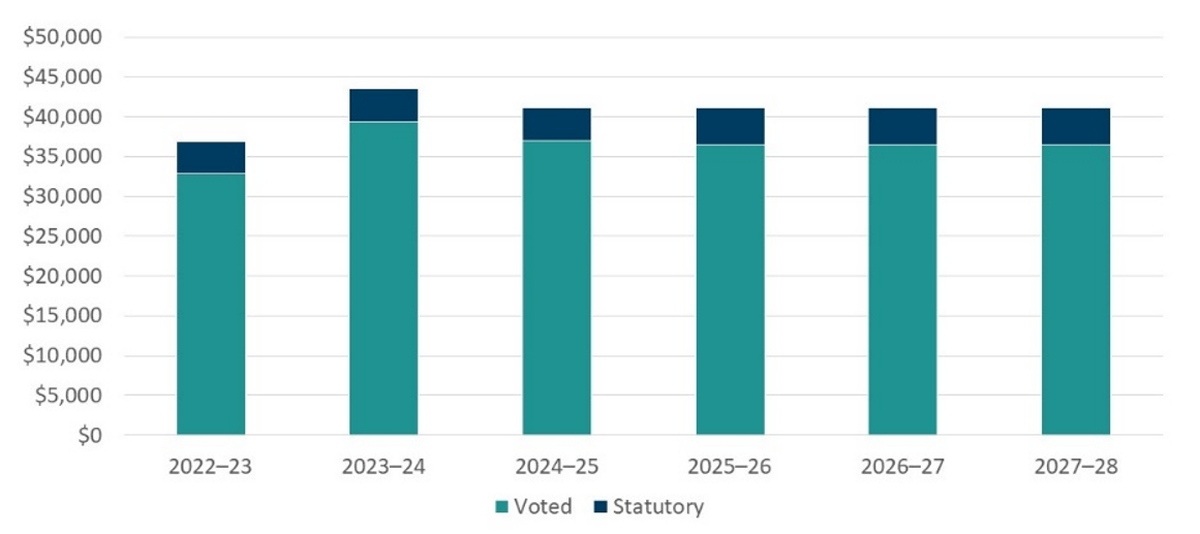
Graph 1: Approved funding (statutory and voted) over a six-year period
Graph 1 summarizes the department's approved voted and statutory funding from 2022–23 to 2027–28 (in thousands of dollars).
| Fiscal year | Total | Voted | Statutory |
|---|---|---|---|
| 2022–23 | $36,814 | $32,829 | $3,985 |
| 2023–24 | $43,529 | $39,334 | $4,195 |
| 2024–25 | $41,116 | $36,947 | $4,169 |
| 2025–26 | $41,124 | $36,494 | $4,630 |
| 2026–27 | $41,178 | $36,541 | $4,637 |
| 2027–28 | $41,178 | $36,541 | $4,637 |
Analysis of statutory and voted funding over a six-year period
The departmental spending trend graph shows actual spending (2022–23 to 2023–24) and forecasted and planned spending (2024–25 to 2027–28) in thousands of dollars. The variation in statutory amounts over the years is directly attributable to Employee Benefit Plan (EBP) allocations associated with employee salaries. As employee salaries increase due to collective bargaining increases or additional FTE counts, as does the amount of EBP required. Further trend analysis related to this table is provided in the sections above.
For further information on the TSB’s departmental appropriations, consult the 2025–26 Main Estimates.
Future-oriented condensed statement of operations
The future-oriented condensed statement of operations provides an overview of the TSB’s operations for 2024–25 to 2025–26.
Table 9: Future-oriented condensed statement of operations for the year ended March 31, 2026 (in thousands of dollars)
Table 9 summarizes the expenses and revenues which net to the cost of operations before government funding and transfers for 2024–25 to 2025–26. The forecasted and planned amounts in this statement of operations were prepared on an accrual basis. The forecasted and planned amounts presented in other sections of the Departmental Plan were prepared on an expenditure basis. Amounts may therefore differ.
| Financial information | 2024–25 Forecast results | 2025–26 Planned results | Difference (Planned results minus forecasted) |
|---|---|---|---|
| Total expenses | 45,512 | 45,456 | -56 |
| Total revenues | 8 | 7 | -1 |
| Net cost of operations before government funding and transfers | 45,504 | 45,449 | -55 |
Analysis of forecasted and planned results
The TSB’s 2025–26 planned results are expected to remain consistent from its 2024–25 forecasted results. Revenues at the TSB are of a low-dollar nature and have minimal impact on the overall net cost of operations.
A more detailed Future-Oriented Statement of Operations and associated Notes for 2025–26, including a reconciliation of the net cost of operations with the requested authorities, is available on the TSB’s website.
Human resources
This section presents an overview of the department’s actual and planned human resources from 2022–23 to 2027–28.
Table 10: Actual human resources for core responsibilities and internal services
Table 10 shows a summary of human resources, in full-time equivalents, for the TSB’s core responsibilities and for its internal services for the previous three fiscal years. Human resources for the current fiscal year are forecasted based on year to date.
| Core responsibilities and internal services | 2022–23 Actual full-time equivalents | 2023–24 Actual full-time equivalents | 2024–25 Forecasted full-time equivalents |
|---|---|---|---|
| Independent safety investigations and communication of risks in the transportation system | 176 | 173 | 197 |
| Internal services | 51 | 54 | 52 |
| Total | 227 | 227 | 249 |
Analysis of human resources over the last three years
The actual number of full-time equivalents (FTEs) for 2022–23 was 227 FTEs, which aligns with the planned staffing levels. For fiscal year 2023–24, the TSB had forecasted an increase in the number of FTEs following the approval of Budget 2023, which provided the TSB with additional funding for critical operating requirements, however, the delays in creating new positions and staffing did not permit the TSB to be staffed at full capacity before the end of the 2023–24 fiscal year. As staffing processes continue, it is anticipated that the TSB will reach 249 FTEs by the end of the 2024–25 fiscal year.
Table 11: Human resources planning summary for core responsibilities and internal services
Table 11 shows information on human resources, in full-time equivalents, for each of the TSB’s core responsibilities and for its internal services planned for the next three years.
| Core responsibilities and internal services | 2025–26 Planned full-time equivalents | 2026–27 Planned full-time equivalents | 2027–28 Planned full-time equivalents |
|---|---|---|---|
| Independent safety investigations and communication of risks in the transportation system | 193 | 193 | 193 |
| Internal services | 52 | 52 | 52 |
| Total | 245 | 245 | 245 |
Analysis of human resources for the next three years
For fiscal year 2025–26 and onward, the TSB plans to maintain a consistent number of full-time equivalents (FTEs). The anticipated reduction of 4 FTEs from 2024–25 is as a result of the Budget 2023 Refocusing Government Spending initiative.
Corporate information
Departmental profile
Appropriate minister(s): The Honourable Harjit S. Sajjan, P.C., O.M.M., M.S.M., C.D., M.P.
Institutional head: Yoan Marier
Ministerial portfolio: Privy Council
Enabling instrument(s): Canadian Transportation Accident Investigation and Safety Board Act, S.C. 1989, c. 3
Year of incorporation / commencement: 1990
Departmental contact information
Mailing address:
Transportation Safety Board of Canada
Place du Centre, 4th floor
200 Promenade du Portage
Gatineau, Quebec K1A 1K8
Telephone: 1-800-387-3557
Email: communications@tsb-bst.gc.ca
Website(s): www.tsb.gc.ca
Supplementary information tables
The following supplementary information tables are available on the TSB’s website:
Information on the TSB’s departmental sustainable development strategy can be found on the TSB’s website.
Federal tax expenditures
The TSB’s Departmental Plan does not include information on tax expenditures.
The tax system can be used to achieve public policy objectives through the application of special measures such as low tax rates, exemptions, deductions, deferrals and credits. The Department of Finance Canada publishes cost estimates and projections for these measures each year in the Report on Federal Tax Expenditures.
This report also provides detailed background information on tax expenditures, including descriptions, objectives, historical information and references to related federal spending programs as well as evaluations and GBA Plus of tax expenditures.
Definitions
appropriation (crédit)
Any authority of Parliament to pay money out of the Consolidated Revenue Fund.
budgetary expenditures (dépenses budgétaires)
Operating and capital expenditures; transfer payments to other levels of government, departments or individuals; and payments to Crown corporations.
core responsibility (responsabilité essentielle)
An enduring function or role performed by a department. The intentions of the department with respect to a core responsibility are reflected in one or more related departmental results that the department seeks to contribute to or influence.
Departmental Plan (plan ministériel)
A report on the plans and expected performance of an appropriated department over a 3year period. Departmental Plans are usually tabled in Parliament each spring.
departmental result (résultat ministériel)
A consequence or outcome that a department seeks to achieve. A departmental result is often outside departments’ immediate control, but it should be influenced by program-level outcomes.
departmental result indicator (indicateur de résultat ministériel)
A quantitative measure of progress on a departmental result.
departmental results framework (cadre ministériel des résultats)
A framework that connects the department’s core responsibilities to its departmental results and departmental result indicators.
Departmental Results Report (rapport sur les résultats ministériels)
A report on a department’s actual accomplishments against the plans, priorities and expected results set out in the corresponding Departmental Plan.
full-time equivalent (équivalent temps plein)
A measure of the extent to which an employee represents a full person-year charge against a departmental budget. For a particular position, the full-time equivalent figure is the ratio of number of hours the person actually works divided by the standard number of hours set out in the person’s collective agreement.
gender-based analysis plus (GBA Plus) (analyse comparative entre les sexes plus [ACS Plus])
Is an analytical tool used to support the development of responsive and inclusive policies, programs, and other initiatives. GBA Plus is a process for understanding who is impacted by the issue or opportunity being addressed by the initiative; identifying how the initiative could be tailored to meet diverse needs of the people most impacted; and anticipating and mitigating any barriers to accessing or benefitting from the initiative. GBA Plus is an intersectional analysis that goes beyond biological (sex) and socio-cultural (gender) differences to consider other factors, such as age, disability, education, ethnicity, economic status, geography (including rurality), language, race, religion, and sexual orientation.
Using GBA Plus involves taking a gender- and diversity-sensitive approach to our work. Considering all intersecting identity factors as part of GBA Plus, not only sex and gender, is a Government of Canada commitment.
government priorities (priorités gouvernementales)
For the purpose of the 2025–26 Departmental Plan, government priorities are the high-level themes outlining the government’s agenda in the November 23, 2021, Speech from the Throne: building a healthier today and tomorrow; growing a more resilient economy; bolder climate action; fight harder for safer communities; standing up for diversity and inclusion; moving faster on the path to reconciliation; and fighting for a secure, just and equitable world.
horizontal initiative (initiative horizontale)
An initiative where two or more federal departments are given funding to pursue a shared outcome, often linked to a government priority.
Indigenous business (entreprise autochtone)
For the purpose of the Directive on the Management of Procurement Appendix E: Mandatory Procedures for Contracts Awarded to Indigenous Businesses and the Government of Canada’s commitment that a mandatory minimum target of 5% of the total value of contracts is awarded to Indigenous businesses, a department that meets the definition and requirements as defined by the Indigenous Business Directory.
non‑budgetary expenditures(dépenses non budgétaires)
Non-budgetary authorities that comprise assets and liabilities transactions for loans, investments and advances, or specified purpose accounts, that have been established under specific statutes or under non-statutory authorities in the Estimates and elsewhere. Non-budgetary transactions are those expenditures and receipts related to the government's financial claims on, and obligations to, outside parties. These consist of transactions in loans, investments and advances; in cash and accounts receivable; in public money received or collected for specified purposes; and in all other assets and liabilities. Other assets and liabilities, not specifically defined in G to P authority codes are to be recorded to an R authority code, which is the residual authority code for all other assets and liabilities.
performance (rendement)
What a department did with its resources to achieve its results, how well those results compare to what the department intended to achieve, and how well lessons learned have been identified.
performance indicator (indicateur de rendement)
A qualitative or quantitative means of measuring an output or outcome, with the intention of gauging the performance of a department, program, policy or initiative respecting expected results.
plan (plan)
The articulation of strategic choices, which provides information on how a department intends to achieve its priorities and associated results. Generally, a plan will explain the logic behind the strategies chosen and tend to focus on actions that lead to the expected result.
planned spending (dépenses prévues)
For Departmental Plans and Departmental Results Reports, planned spending refers to those amounts presented in Main Estimates.
A department is expected to be aware of the authorities that it has sought and received. The determination of planned spending is a departmental responsibility, and departments must be able to defend the expenditure and accrual numbers presented in their Departmental Plans and Departmental Results Reports.
program (programme)
Individual or groups of services, activities or combinations thereof that are managed together within the department and focus on a specific set of outputs, outcomes or service levels.
program inventory (répertoire des programmes)
Identifies all the department’s programs and describes how resources are organized to contribute to the department’s core responsibilities and results.
result (résultat)
A consequence attributed, in part, to a department, policy, program or initiative. Results are not within the control of a single department, policy, program or initiative; instead they are within the area of the department’s influence.
statutory expenditures (dépenses législatives)
Expenditures that Parliament has approved through legislation other than appropriation acts. The legislation sets out the purpose of the expenditures and the terms and conditions under which they may be made.
target (cible)
A measurable performance or success level that a department, program or initiative plans to achieve within a specified time period. Targets can be either quantitative or qualitative.
voted expenditures (dépenses votées)
Expenditures that Parliament approves annually through an appropriation act. The vote wording becomes the governing conditions under which these expenditures may be made.