
Collision with terrain and fire
Privately registered
KitFox Model IV (advanced ultralight), C-GMFA
Casey Aerodrome (CSQ4), Quebec
The occurrence
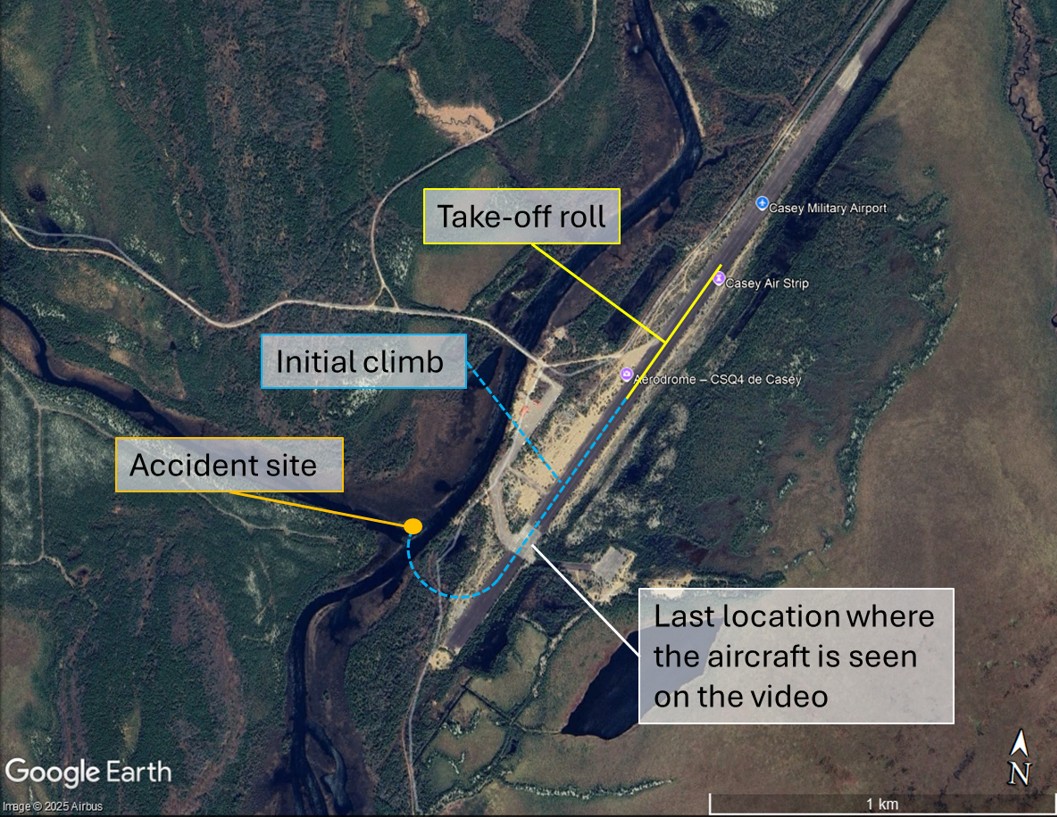
At approximately 1659All times are Eastern Daylight Time (Coordinated Universal Time minus 4 hours). on the day of the occurrence, the privately registered SkyStar Aircraft Corporation KitfoxModel IV advanced ultralight aircraft (registration C‑GMFA, serial number 1616), was taking off from Casey (Camp de base) Aerodrome (CSQ4),All locations mentioned in the report are in the province of Quebec, unless otherwise indicated. for a visual flight rules flight to a private runway in Sainte‑Eulalie, with the pilot and 1 passenger on board. Just after flying over the end of the runway during the initial climb, the aircraft was seen turning to the north (Figure 1). The turn became steeper and tighter until the aircraft ended up in a very steep nose-down attitude. The aircraft’s takeoff was captured on video by a passenger on board a helicopter that was flying north of the runway. The aircraft struck the ground and a post-impact fire started. Eyewitnesses attempted to extinguish the fire with portable fire extinguishers, but the 2 occupants were fatally injured. The aircraft was destroyed.
Pilot information
The pilot held a recreational pilot permit – aeroplane that had been issued on 19 July 2025. The pilot also held a valid Category 3 medical certificate with no restrictions. Based on the information gathered by the investigation, the pilot had just over 100 hours of flight time.
Weather information
On the day of the occurrence, a high-pressure system was over the Great Lakes Region. The conditions were suitable for visual flight. Visibility was more than 6 statute miles (SM), with scattered cumulus clouds at 4000 feet above ground level (AGL).
Just before takeoff, the following conditions were reported to the pilot: winds from 250° magnetic at 10 knots, gusting to 15 knots, and altimeter setting 30.15 inches of mercury (inHg).
Aircraft information
The Skystar Aircraft Corporation Kitfox Model IV is a 2-seat, high-wing, advanced ultralight constructed of metal tubing and fabric. The occurrence aircraft was built in the United States in 1997. It had a maximum take-off weight of 1210 pounds. On 16 August 2025, the aircraft had accumulated 926.7 hours since new. The aircraft was equipped with a Rotax 912 UL engine (serial number 4005095) manufactured by Bombardier Recreational Products (BRP). The Rotax 912 UL is a 4-stroke, 4-cylinder engine with both liquid and air cooling, producing 80 hp at a maximum operating speed of 5800 rpm.
The pilot had owned the aircraft since July 2023.
Examination of the occurrence flight path
In the video taken by the passenger on board the helicopter that was flying north of the runway, the aircraft can be seen taking off and then climbing while remaining over the runway. When the aircraft moves out of the camera’s field of view, its shadow remains visible. Based on the shadow, the aircraft continues on the same path for a short time. Then, when the shadow disappears from the camera’s field of view, the flight path can no longer be tracked visually. The aircraft likely turned right immediately after its shadow was last seen on the video. The investigation was unable to determine why the aircraft turned right toward the north, particularly because its destination was to the left (south) and an aircraft had been reported to be north of the runway.
Based on the photos of the accident site, the aircraft seemed to be in a near-vertical attitude on impact, which is characteristic of a spin-induced autorotation.
Aerodynamic stall and incipient spin
A stall is a loss of lift and an increase in drag that occurs when an aircraft is flying at an angle of attack greater than the angle that provides maximum lift. Regardless of airspeed, an aircraft always stalls when its wings reach this critical angle of attack.Transport Canada, TP 1102, Flight Training Manual, 4th Edition (revised 2004), p. 76.
Stall speed varies depending on factors such as the aircraft’s weight, power setting, flap position, and angle of bank. An incipient spin occurs when an aircraft stalls and one wing produces more lift than the other. Because the descending wing is at a greater angle of attack, it stalls even further and produces more drag, which triggers an autorotation. During this phase of the incipient spin, the flight path changes from horizontal to vertical.Ibid., p. 82.
Generally, even if the pilot takes the necessary measures to stop the autorotation as soon as it begins, the aircraft is in a vertical position while accelerating rapidly, and a high altitude is necessary to regain a horizontal flight path. If the autorotation continues, the aircraft could stabilize in a spin and follow a spiral path downward (Figure 2).
![Figure 2. Incipient spin (Source: TSB, based on Transport Canada, TP 1102, Flight Training Manual, 4th Edition [revised 2004])](/sites/default/files/2026-05/A25Q0137-figure-02-ENG.jpg "Figure 2. Incipient spin (Source: TSB, based on Transport Canada, TP 1102, Flight Training Manual, 4th Edition [revised 2004])")
Next steps
This investigation is closed.
Investigation information
Download high-resolution photos from the TSB Flickr page.
Class of investigation
This is a class 5 investigation. Class 5 investigations are limited to collecting data, which are then stored in the modal database. If TSB investigators deployed to the occurrence site, a short description of the occurrence is posted to the TSB website once the investigation has been completed. These investigations are generally completed within 90 days. For more information, see the Policy on Occurrence Classification.
TSB investigation process
There are 3 phases to a TSB investigation
- Field phase: a team of investigators examines the occurrence site and wreckage, interviews witnesses and collects pertinent information.
- Examination and analysis phase: the TSB reviews pertinent records, tests components of the wreckage in the lab, determines the sequence of events and identifies safety deficiencies. When safety deficiencies are suspected or confirmed, the TSB advises the appropriate authority without waiting until publication of the final report.
- Report phase: a confidential draft report is approved by the Board and sent to persons and corporations who are directly concerned by the report. They then have the opportunity to dispute or correct information they believe to be incorrect. The Board considers all representations before approving the final report, which is subsequently released to the public.
For more information, see our Investigation process page.
The TSB is an independent agency that investigates air, marine, pipeline, and rail transportation occurrences. Its sole aim is the advancement of transportation safety. It is not the function of the Board to assign fault or determine civil or criminal liability.